
'An extremely rare perspective' - Stuart Fallon on the photography of Sandra George


The remarkable photographs of Sandra George stand as a powerful reminder that protest is not simply an act of resistance, but a force capable of bringing about meaningful and lasting change, writes Stuart Fallon
The work of Sandra George captures a portrait of Edinburgh that is rarely seen. In a city that’s image is largely defined by its historic centre, celebrated institutions and annual festivals, George offers a vital glimpse into lesser-known and rarely lauded parts. For over four decades, from the late 1970s until her death in 2013, she worked as a photographer for local newspapers including The Sentinel in Wester Hailes and the Craigmillar Festival News, and led innovative youth projects and adult education courses. Her photographs centre those often found on the margins - both socially and geographically - be it through class, disability, age or ethnicity. Rather than depicting hardship alone, Sandra presents working-class communities with dignity, agency and solidarity. Although George wasn’t originally from these communities (she was born in Nottingham and spent her early years in Jamaica), she made them her own - committing her time, building relationships and trust. She became an insider, resulting in works that have the quality of looking outward from the communities, as opposed to looking voyeuristically in from the outside.
On her untimely death George left behind an archive of over 60,000 photographic negatives, personal artefacts and other artworks, including drawings, paintings, stained glass, jewellery and sculpture. Initially held by her family, who were unsure of what to do with them, in 2020 a chance meeting resulted in the archive coming into the care of Craigmillar Now, an arts and heritage charity based in the east of Edinburgh. Since then, a team of dedicated volunteers, many of whom knew George personally, have painstakingly looked after her work - an act of community-led care that reciprocates the way George operated throughout her life. One-by-one each of George’s negatives have been re-housed into archival storage, catalogued and digitally scanned. The process has protected George’s work for future generations and made them easily accessible for public display.
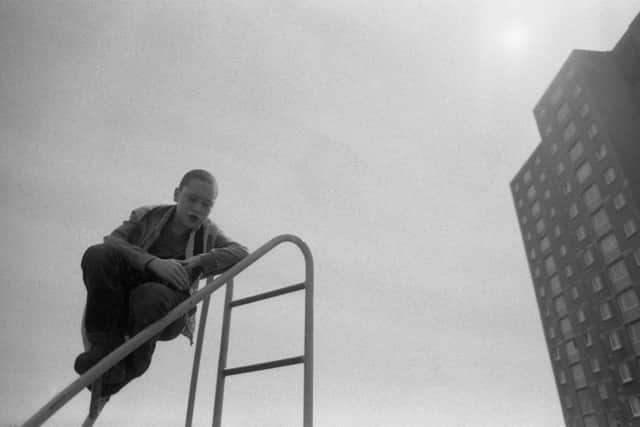
The City Art Centre exhibition, part of Edinburgh Art Festival 2026, focuses on George’s work between 1979 and 2002. It highlights four key areas of importance in her life and practice: community, home, childhood and identity. The community section shows her work with disability rights groups, youth clubs and a women’s shelter - as well as her journalistic work covering public protests and community organising. It includes a striking series of works made with Shakti Women’s Aid - an Edinburgh organisation supporting women of colour experiencing domestic abuse. These works sensitively portray the quiet strength in collective organising behind closed doors - as powerful as any of the direct street protests shown alongside. Accompanying these images is a sketch-book of her drawings, opened to the first page. George has written the word “community” repeatedly, end to end, filling the double-page spread - affirming the primary preoccupation in her life.
She also turned her lens inward, towards her home and her son Tyler. She charted their intimate relationship, documenting Tyler’s life from his premature birth to early teenage years. In the earliest of these works, the tiny baby is shown inside a hospital incubator, George places her hand alongside her son, her fingers spanning the length of his vulnerable body. George extensively documented Tyler’s difficult first weeks, and, in a later work, of Tyler now at around 8 years old in the living room, one of these images can be seen displayed on the wall behind him - an ongoing reminder of the delicacy of life, and her own challenge of balancing her maternal role with that of a professional photographer.
George had a deep affinity with young people, and a special ability to capture the joy and freedom of childhood. Her subjects are visibly comfortable in her presence as they express themselves in school playgrounds and gym halls - and in makeshift sites across the city. One particular image, Leith, 1979, depicts four adolescent boys atop a fort made of old furniture and scraps of wood. The word “PLAYGROUND” has been painted on the wall of a derelict factory building behind them. This act of reclaiming space for play was echoed across Scotland and Europe in the post-war decades, as children occupied bombed-out sites in search of recreational space. This evolved over decades into the modern adventure playground (or the Scots version - the “Venchie”). In Leith George’s boys look down at her and her camera - a warm defiance in their eyes as one of them gives her a V-sign. George was in her early 20s at this time, but clearly had the confidence and commitment to navigate these spaces. The boys in turn are happy for her to be there, provided she knows who’s in charge.

Self-portraiture played a key role in George’s work. She regularly turned the camera on herself, either in ad-hoc shots in the mirror, or carefully choreographed portraits with the aid of a tripod and timer. She knew the power that her image held, and remained in complete control of her own identity within these images. A key example of these portraits, from 1993, sees George seated in her kitchen. Alongside a carefully positioned still-life of fruit bowl and water jug, the artist sits proudly in her iconic pillarbox hat. Her face is fixed in professional self-assurance - confident in herself and her work.
Whilst George had a formal training in photography (studying at Napier University from 1979-81) she didn’t pursue a traditional career in the arts. The focus of her practice was centred on the community and youth projects she developed. In addition to her freelance community arts work, George was employed as a Project Worker in the Craigmillar area with the City of Edinburgh Council and later became the Manager of Youth Services at Hunter’s Hall Cooperative, a housing association in Niddrie. In 2011 she launched her own charity, Niddrie Community Youth Group, which organised creative activities for children and young adults from all over the Niddrie and Craigmillar area. George led the charity until her death. This work offered her unfiltered access to people and spaces she chose to document. On top of this, she undoubtedly had a personality that people were warm and open to - the eyes and actions of her subjects show a sense of being at ease in her presence.

The City Art Centre exhibition takes its title, Start from the Level, from George’s own words. She filled a Filofax with thoughts and philosophies on life and photography. She ends one of the pages with the statement, “stop making assumptions about people, start from the level where people are based”. This reveals the foundation of George’s world-view. She rejected the conventions of hierarchy, and met people where she found them - be it people with disabilities, skinheads undertaking community service or the young people she surrounded herself with. She even insisted that Tyler called her “Sandra” rather than “mum” - wanting him to regard himself as an equal partner in their relationship. The title therefore describes not simply a method of working, but a way of seeing. As a young Black woman navigating what were, and still are, predominantly white spaces - George undoubtedly faced personal adversity and marginalisation, but her confidence in operating in these spaces, and commitment to document them, offers an extremely rare perspective - in Scottish social history, as well as photographic history.
Whilst George’s work depicts the personal and the local - the themes she pictured are universal, steeped in empathy and shared concerns. Her work confronts a period in British history when the policies of the then Conservative government, led by Margaret Thatcher, saw swathes of cuts to welfare support and civil liberties. At a time where many of these concerns are still being felt - as state-sanctioned austerity has seen support to the elderly and disabled curtailed, the rights of women being systematically rolled back, and an emboldened far-right are taking to the streets - it could be read as depressing that not much has changed since George was practicing. Yet her images ultimately offer something more hopeful. They testify to the power of collective action, solidarity, and the courage to speak truth to power. In particular, her series documenting anti-apartheid protests in Edinburgh and demonstrations against the far right in Birmingham, culminating in celebrations following Nelson Mandela’s release, stand as a powerful reminder that protest is not simply an act of resistance, but a force capable of bringing about meaningful and lasting change.
Stuart Fallon is a curator at City Art Centre, Edinburgh.
Sandra George: Start from the Level is at City Art Centre, Edinburgh until 27 September, see www.cultureedinburgh.com. A range of associated events takes place during Edinburgh Art Festival 2026, see www.edinburghartfestival.com
The Scotsman’s arts newsletter is now sent twice a week - subscribe today
Enjoying the Arts & Culture journalism on scotsman.com? Make it easier to find by selecting us as a preferred Google source
Want the latest Scottish headlines sent directly to your phone? Sign up to our new WhatsApp channel here
Comments
Want to join the conversation? Please or to comment on this article.