
Andy Goldsworthy: Fifty Years, Edinburgh review: 'Just bring your imagination'
This is a once-in-a-lifetime chance to experience a large group of significant works by Andy Goldsworthy in one place, writes Susan Mansfield
Andy Goldsworthy: Fifty Years, Royal Scottish Academy, Edinburgh ★★★★★
The Royal Scottish Academy is one of Scotland’s great exhibition spaces and, while the spacious Georgian rooms adapt surprisingly well to contemporary art, they always remain themselves. You can show what you want, they seem to say, but you’ll never forget where you are.
Andy Goldsworthy, though, has challenged this building. His 50-year retrospective for National Galleries of Scotland squares up to it like a wrestler spoiling for a fight. A significant proportion of this show is new work, made specifically for this building. He has filled rooms with rocks, reeds and roughly sawn oak branches. He has changed how these spaces feel.

From the carpet of raw fleeces running up the stairs to the beautifully woven screen of barbed wire which appears to bar the entrance, and the paintings made of hare’s blood and snow, he brings the outside in. You can smell it.
At each end of the Sculpture Court hangs a Sheep Painting, made by fixing a canvas to the ground in a field and placing a round mineral block in the centre. The sheep come and go, making the marks with their feet, their faeces (this might be the first time these refined rooms have hosted art made of sheep scat), and the block is then removed, leaving a white circle like a moonscape.
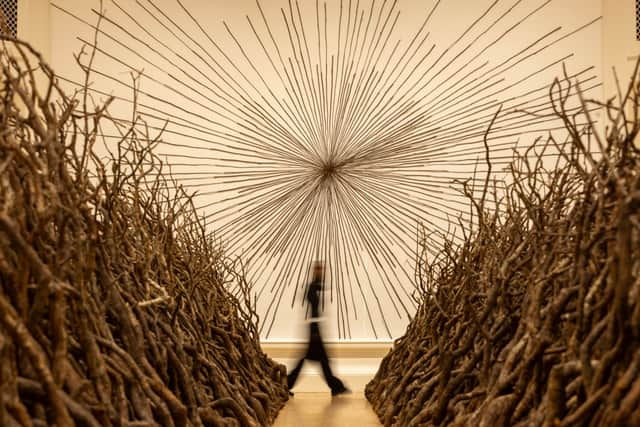
In the central, largest room, he has built Oak Passage, a monumental construction of windfallen branches with a straight path down the centre. He says little about what it means, and the labelling in this show is minimal throughout. What you must do is walk down it, smell the wood, feel the way it seems to open up just enough to accommodate your presence. In the imagination, it’s a portal to a wilder place. In terms of simple observation, it’s oak branches on an oak floor. He wants us to remember what this building is made from: wood and earth and rock.
This is Goldsworthy’s first museum show in Scotland since Hand to Earth at Inverleith House in 1990, and one of just a handful of survey shows so far in his life. His larger works are mostly in collections overseas, or out in the landscape, well off the beaten track, like his Hanging Stones Project, a series of ten sculptures along a six-mile walk in North Yorkshire. This is a once-in-a-lifetime chance to experience a large group of significant works in one place.

His Gravestones project will ultimately rest at the top of a hill in Dumfriesshire, but it gets an outing here, a room full of rough, undressed stones which have been dug out of the ground by gravediggers all over Dumfries & Galloway. They cover most of the floor in a softly lit room; a straight edge indicates a walkway. As in much of Goldsworthy’s work, the history of the material is important: these stones were taken from earth into which the dead are placed. It’s more than a memorial, it’s a kind of gathering of those gone before. A benign one, it feels, but we’re left in no doubt that they outnumber us, and one day we will join them.
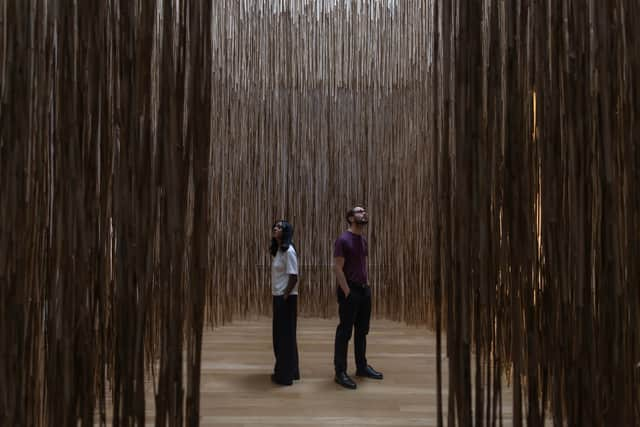
The counterbalance to this work is Skylight, a hanging sculpture made from 10,000 reeds which defines the oval space beneath a central skylight. It invites you to step inside it. The air is warm and still. It makes you look up, just as the stones made you look down. Before you know it, you’ve assumed a posture of reverence. We are mortal, then, but we also have moments of transcendence.
Goldsworthy is perhaps still best known for his ephemeral works, arrangements of leaves, twigs, ice, flower petals, stones balanced on one another, which come to us as photographs. Perhaps their beauty and artfulness are somewhat diminished by the fact that pictures of a similar nature, now usually made digitally or by AI, are ubiquitous on wellbeing websites and spirituality books. There is comparatively little of this work here.
One room, however, contains 90 photographs of ephemeral works made on a single fallen elm tree near Goldsworthy’s home. There are pictures made with coloured leaves, foxglove bells, frost, twigs and branches. They remind us of his formal rigour: the square blocks and perfect circles, zig-zags, curves. Not so much as a twig is out of place. This is less arte povera than geometric abstraction. The Oak Passage is, after all, at its most basic form, a straight line. The directness and simplicity of these forms are part of the works’ power.
READ MORE: Andy Goldsworthy on curating his 50 year retrospective at the National Galleries of Scotland
Downstairs, a room of his earliest work from the 1970s shows the lines of continuity which have run right through his practice. He walks and climbs trees, buries himself in seaweed, crawls out of Morecambe Bay covered in black mud like the creature from the black lagoon. In the next room, films from the last 20 years show him crawling horizontally along a hedge, lying down to make rain shadows, burying himself in seaweed (again). At its most basic, his work is about engaging with the natural world through touch and, although we can’t touch it, the work conjures that sense of touch in our imagination.
Time is always part of this work. The giant snowballs, first made for Tramway in 1989, and then again in 2000 when they were left to melt on the streets of the City of London at midsummer, lasted several days. Some works last only a split second: hazel rods thrown in the air, patterning the sky; a rainbow created by striking running water with a sharp stone. An elaborate spiral of ferns on the wall will brown and shrivel during the course of the show. These works have a way of reminding us, too, of our own lifespan, our own place in the cycle of life.
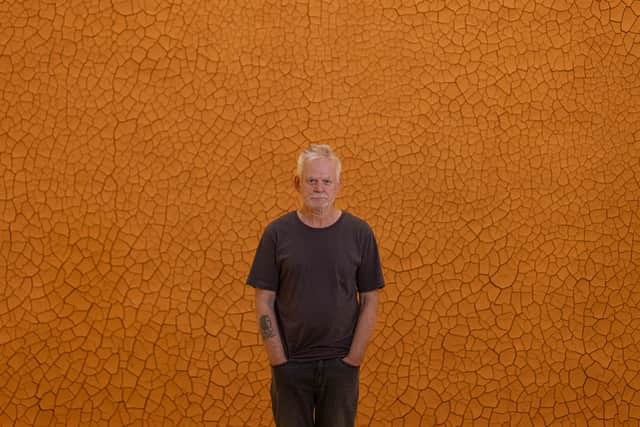
Humankind’s connection to the earth might be Goldsworthy’s most enduring theme. Take iron oxide, for example: it’s what colours clay, and what colours blood. Our fate is bound up with the earth’s fate, not because we’re damaging it through climate change - although that’s here too in places - but because we are actually made of the same thing. One room contains series of flags made for the Rockefeller Centre in New York, each one coloured with pigment from the earth of a different US state. They are different shades, but in the same spectrum. Boundaries and borders are arbitrary, then; the stuff of life is the same on either side.
In a way, there are two exhibitions here. The retrospective work downstairs offers precious insights into how Goldsworthy works, and the continuity of his themes and practice. But the new, monumental pieces on the main floor are to be experienced on their own terms.
These are extraordinary works and they invite a physical response. There is an art history behind them and a conceptual foundation beneath them, but these are not the most important things. They invite us to experience them physically rather than intellectually - children will respond to them just as much as adults. Just bring your imagination, and your body will do the rest.
Until 2 November
Comments
Want to join the conversation? Please or to comment on this article.