
Art reviews: Barbara Rae | Chaos and Control | Frances Walker
Drawn from across her career, the works by Barbara Rae currently on show in Inverness illustrate how her technique has evolved, writes Duncan Macmillan
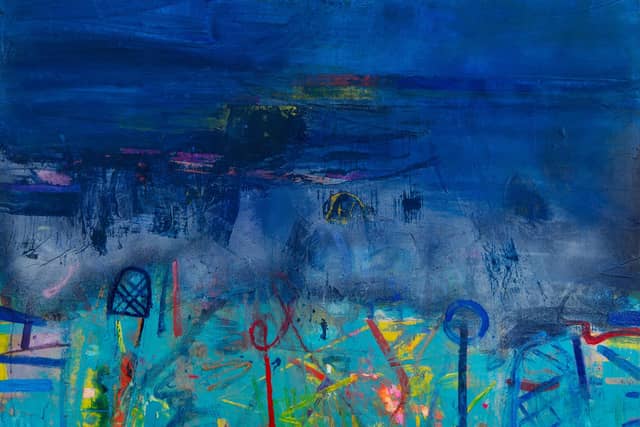

Dame Barbara Rae: Time Lines, Brown’s Gallery, Inverness ★★★★
Chaos and Control: Printmaking in Scotland Now, RSA, Edinburgh ★★★★
Frances Walker: Recent Prints and Rarities, RSA, Edinburgh ★★★★
Gordon Brown opened Brown’s Gallery in Tain in 1992. Backed by a successful framing business, not only did he find significant artists living in the north to exhibit – John Byrne, for instance, was based in Nairn for many years – he increasingly attracted artists from elsewhere too.
Then in 2022, his Tain gallery still flourishing after 30 years, he also opened a gallery in Inverness. On a first floor in Castle Street, it is pretty central. It is also light and spacious with high ceilings and so makes a beautiful setting for the current show, Time Lines, by Barbara Rae. The title suggests a retrospective angle and indeed as well as recent prints and paintings the show does include a few works ranging back to the 1980s. It is, for instance, interesting to see paintings like Glenuig and January Quarry, Ballachulish, the drawing Night Reflections at Alisary, or the multi-media piece Trellis, all from the 80s. In them her ability to convey the impact of a scene was already powerful, but it depended more on drawing and intricate overall structures and less on freedom and gesture than it does now.
She has also become much more of a traveller and there are works here inspired by a variety of places. As well as these earlier west coast pictures, there are, for instance, others of the north and west done more recently including a pair of vivid monotypes of Raasay, unusual in their long, landscape format. There are also a couple of paintings of Orkney, a place she has visited but not so often painted. Mostly, however, in recent years she has worked further afield. She has been a regular visitor to the neighbourhood of the Ceide Fields, a prehistoric landscape on the coast of County Mayo. Here a magnificent painting called Shoreline is a view out over the Atlantic from that coast. Predominantly blue it makes a vivid contrast to the yellows and fiery reds of Ceide, Late Night inspired by the mysterious site of the Ceide Fields themselves.
During lockdown over the winter of 2019 to 2020, however, when travel was impossible, Rae turned for inspiration to the Lammermuir Hills south of Edinburgh and the work she did there provides the largest group of pictures here. Bare but not empty, being so close to urban centres and to a busy agricultural landscape, the Lammermuirs are marked all over by millennia of human activity. These are the kind of things that inspire Rae’s interest in a landscape. The paths, the shelter belts, the patterns of marginal fields, and very often too the field gates, all feature in paintings like Lammermuir Farm, Path through the Moor, Cranshows, or the magnificent Snow Penshiel. It is great to see these, big powerful paintings given the space and light they deserve.
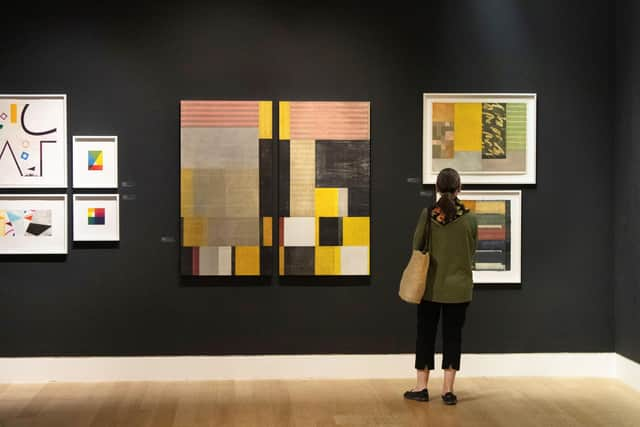
Red Field is a big carborundum print in Rae’s Inverness show and she is represented by two prints in the same medium, but with Arctic subjects, in the RSA’s exhibition Chaos and Control: Printmaking in Scotland Now. The title is perhaps a slightly odd reflection on the challenges of printmaking, but the subtitle is plain enough. The show is a wide-ranging survey of contemporary printmaking. The introduction and indeed the show itself offer a commentary on this, indeed on one of the great success stories of the arts in Scotland, the pioneering establishment of open-access printmaking workshops.
They began in 1967 with Edinburgh Printmakers, the first of its kind in the UK, and the model was followed first in Glasgow in 1972, then in Aberdeen and elsewhere across the country. But it all started on a small scale in one room in Edinburgh’s Victoria Street.
The range of work on the walls here and the range of the places in which it has been produced confirms the success of the workshops, and the numerous printing techniques displayed also reflect the wonderful range of skills these workshops can now deploy.
The imagery displayed is, too, as diverse as the techniques. Richard Marsden for instance uses the severity of black and white etching to create an austere, tonal geometry, while Michael Agnew uses the same geometric starkness to unify what seems to be a representation of his studio inhabited by his own mental clutter. Chris Allan uses the richness of pure drypoint to give vivid life to his prints of brambles and bullfinches.
Ade Adesina is master of linocut and among several here, Contemplation – a beautiful, black and white reflection on what looks like a 17th-century still life of flowers – is particularly striking. Paul Furneaux is likewise master of the techniques of Japanese woodcut and shows it here in several characteristic works. In her beautiful Gifting Tree, Anupa Gardner shows herself equally adept with woodcut though in a style closer to the western tradition.
In two poetic pictures of Orkney skies at night, one in summer and one in winter, Victoria Crowe uses the classic technique of stone lithograph to great effect. Robert Powell’s etched work always repays close scrutiny and here, in Out of Eden, Eve’s serpent surreptitiously looks in on a douce couple quietly taking tea.
If there is much more to admire here, it is important also to go through to the Academicians’ Gallery, where there is a display of a dozen or so prints by Frances Walker, a leading figure in this whole print renaissance.
Closely involved from the beginning with what began as Peacock Printmakers in Aberdeen, she has built on the inimitable strength of her drawing to become one of the finest printmakers Scotland has produced and the works on the wall here demonstrate that admirably.
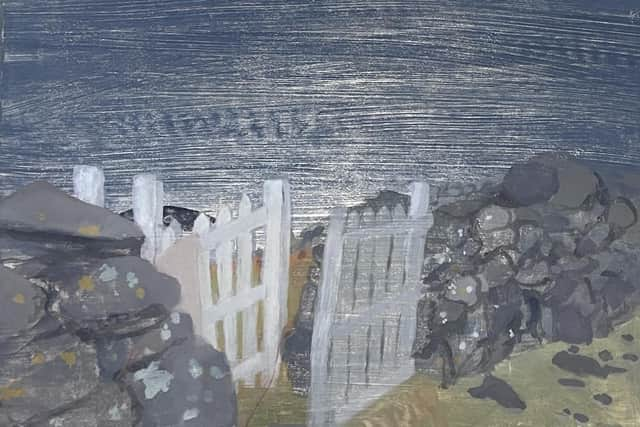
Skye Gate for instance is a lovely monotype of a silvery white gate standing against a sea thet is grey but also touched with silver. Snow Squall, Grytviken, where in a typically bold touch the scene is almost obscured by the blowing snow, is a record of the artist’s voyage to the Antarctic some years ago. But the strength of her drawing and its aptness for etching is beautifully displayed in works like Sand, Seaweed and Shore Pool, or Landscape Tracks 1, both works from 2022.
The artist was a student of William Gillies at Edinburgh College of Art. One shouldn’t mention a lady’s age, but in the context of this, the RSA’s bicentenary year, it is worth remembering that she has lived through very nearly half that time and is still working.
Dame Barbara Rae: Time Lines runs until 1 August; Chaos and Control: Printmaking in Scotland Now until 26 July; Frances Walker: Recent Prints and Rarities until 26 July
The Scotsman’s arts newsletter is now sent twice a week - subscribe today
Want the latest Scottish headlines sent directly to your phone? Sign up to our new WhatsApp channel here