
Art reviews: Catwalk: The Art of the Fashion Show | The Biba Story: 1964-1975
Not too earnest, not too flippant, the V&A’s exploration of catwalk history gets the tone just about right, writes Susan Mansfield
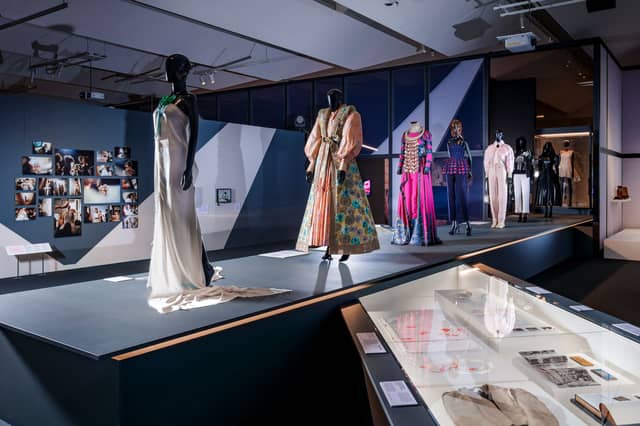

Catwalk: The Art of the Fashion Show, V&A Dundee ★★★★
The Biba Story: 1964-1975, Dovecot Studios, Edinburgh ★★★★
To experience fashion at its most outrageous, its most performative and provocative, you need the fashion show. Top designers invest almost unimaginable quantities of time, effort and money in creating what one interviewee in the new exhibition at V&A Dundee calls “12 minutes of absolute romance”.
It’s fashion at its most extravagant and ephemeral. In six months, it will be surpassed by a new season. In putting together Catwalk: The Art of the Fashion Show, V&A Dundee and their partners Vitra Design Museum in Germany are doing something counter-cultural for the industry. Fashion, by it’s very nature, is not much interested in its past.
Nevertheless there is a story to tell, and this exhibition sets out to do so, encapsulating 125 years of catwalk history. When couturier Charles Frederick Worth decided to use models to display clothes in his Paris salon in the late 19th century, though he might not have known it, the fashion industry would never be the same again.
The exhibition includes one of the first films of a catwalk created by the Worth label in 1928; models parading down the mirrored staircase of Coco Chanel’s atelier in 1939; an outfit from Dior’s seminal “New Look” show from 1947. In these decades, fashion shows were practical, even sedate, showcasing fine clothes for those likely to buy them.

By the time designer Emanuelle Khanh said: “Couture is dead; I want to design for the street” in 1964, everything was changing. Ready-to-wear lines were surpassing couture and the focus was on a young audience. Mary Quant models laughing and dancing to live music on the catwalk were a world away from Balenciaga’s stony faced women a decade previously. The locations grew wackier by the year, and the clothes increasingly fantastical.
By the 1980s, fashion was embracing celebrity, and supermodels such as Cindy Crawford and Naomi Campbell were more famous than the labels they worked for. As fashion became bigger and bigger business, so the ostentation grew. If there is an apex, it might be Karl Lagerfeld’s Autumn/Winter show for Chanel in 2017/18 in Paris’ Grand Palais, at the culmination of which a real 35-metre rocket was launched, stopping just before it hit the glass roof.
Alexander McQueen became the leading proponent of the fantastical and dystopian. His No.13 show (Spring/Summer 1999) concluded with a model on a rotating platform in a white dress being sprayed with paint by two robots. Hussein Chalayan brought social conscience by creating Afterwords, a show exploring the migrant experience, and mavericks such as Martin Margiela subverted the glitz by creating shows in a thrift store and a disused metro station.
READ MORE: Art reviews: Dear Earth | Extraction
Ambitiously, the exhibition attempts to cover all of this, as well as opening up the world of backstage. We hear from hair stylist Sam McKnight and make-up artist Val Garland, and briefly from a single model, Eunice Olummide. The backstage photographs of Robert Fairer are evocative: one of the most poignant is the vacant corridor after a John Galliano show, plastic bags scattered like tumbleweed.
Three-quarters of the way through the show, we get an actual catwalk, featuring a sequence of mannequins in clothes by Lagerfeld, Galliano, McQueen and more. But they are strangely inert; while photography and film seem to capture the mood better, there is a sense in which the fashion show is no longer really about the clothes. The styling, the brand, the event of it have surpassed what anyone wears.
Connections to Scotland are celebrated, from the Fashion Theatre designed for the 1938 Empire Exhibition in Glasgow by architect Margaret Brodie, to the Dior shows staged in 1955 at Glasgow Central Hotel and at Gleneagles as charity fundraisers. Dior returned to Scotland in 2025 for Maria Grazie Chiuri’s Mary Queen of Scots-inspired Cruise show at Drummond Castle, and Chanel hosted a show at Linlithgow Palace in 2012. There are outfits by designers with Scottish connections such as Christopher Kane, Nicholas Daley and the late Pam Hogg.
It’s hard to get the tone right for a show like this. Too flippant and you risk glossing over the very real issues of excess, over-consumption, and the sense that the world being portrayed is entirely out of touch with the lives of ordinary folk. (Is it me, or is there something a little distasteful about Chanel staging a show in a fake supermarket (2014) because it captures “the Pop Art of everyday life”?)
But if it were too earnest, the presentation would be at odds with the subject matter. In the end, V&A gets it about right, suggesting touch-points between high fashion and cultural history while tacitly accepting that there is also a fair amount of silliness. This viewer left feeling somewhat uncomfortable, but also brushed with the glamour of being as close to a fashion show as she is ever likely to get.

One of those permitted to make sketches for magazines and newspapers at the couture shows of the 1950s and early 1960s was Barbara Hulanicki, who launched her own fashion business aiming to make stylish clothes accessible to ordinary young women. Her company, Biba, is a brief, blazing moment in British fashion, celebrated by the current show at Dovecot Studios, The Biba Story: 1964-1975, created by the Fashion and Textile Museum.
The Biba story is a short one, beginning in a former chemist’s shop in Kensington and, ten years later, opening a seven-floor department store. Two years after that, Hulanicki parted company with the board over creative decisions and lost the rights to the label. Within months, it had vanished. Nonetheless, it is a story worth telling.
Hulanicki launched Biba in 1963 as a mail order company, with her husband Stephen Fitz-Simon. When a Bardot-inspired pink gingham dress, retailing at 25 shillings (about £20 today), featured in the Daily Mirror in 1964, it sold 17,000 units.
From its tiny shop in Kensington, Biba garnered a celebrity following including Cher, Yoko Ono, Twiggy and even Princess Anne. Employees included the 15-year-old Anna Wintour. But the real secret of its success lay in the fact that a young woman on a moderate wage could buy an entire outfit complete with accessories and still have enough money for a night out on which to wear it.
With bulk turnover and low profit margins, it prefigured the much later explosion in budget fashion. Its Kensington High Street shop was one of the most profitable stores, per square metre, in the world. And it was all done with so much style. Hulanicki styled the environments as carefully as she did the clothes, adapting art nouveau interiors, adding loud music, dim lighting and Victorian furniture.
Hulanicki looked to the past for inspiration: 1930s gangsters and starlets, artists like Mucha and Klimt. She made successful high street versions of catwalk styles, such as Yves Saint Laurent’s 1940s-inspired Libération collection from 1971. While the printed fabrics in psychedelic colours are a product of their time, the velvet trenchcoats, elegant shift dresses and knee-high boots would not look out of place on the streets today.
In 1973, Hulanicki opened Big Biba in a seven-story former department store, which hosted live bands in its roof garden, boasted a 500-seat art deco styled restaurant and sold homeware and even groceries as well as clothes. Despite serving a million customers a week at its height, it lasted just two years, but the brand still occupies a gargantuan place in the memory and imagination of British fashion.
Catwalk: The Art of the Fashion Show runs until 17 January 2027; The Biba Story: 1964-1975 until 27 June.
The Scotsman’s arts newsletter is now sent twice a week - subscribe today
Want the latest Scottish headlines sent directly to your phone? Sign up to our new WhatsApp channel here
Comments
Want to join the conversation? Please or to comment on this article.