
Art reviews: Claire Barclay | John Bellany | James Cumming
One of the great things about the RSA’s 200th anniversary programme is the way exhibitions have appeared in unexpected locations, writes Susan Mansfield


Claire Barclay: b.e.i.n.g.b.u.o.y.a.n.t, The Wyllieum, Greenock ★★★★
John Bellany: Anchored, Scottish Fisheries Museum, Anstruther ★★★★
Symbols of the Mind: James Cumming and his students, Fire Station Creative, Dunfermline ★★★★
Celebrations for the Royal Scottish Academy’s bicentenary have stretched far and wide across Scotland this year, bringing together a diverse range of partner exhibitions from Gairloch to Kirkcudbright in the RSA200: Celebrating Together programme. Some of these shows have been made possible by loans from the RSA collections, while others have been drawn under the organisation’s big colourful umbrella because they feature RSA members.
Claire Barclay, for example, is the first artist to be shown at the Wyllieum in Greenock who has been commissioned to make work in response to the space and context. Filling the main gallery space, which has floor-to-ceiling views of the Clyde, she weaves ideas, materials and a sense of place while gently acknowledging the influence of both George Wyllie and Joseph Beuys.
Barclay’s work operates on a range of scales, and this body of sculptures functions on all of them, from the expanse of a ship’s sail down to a cultured pearl. If both Beuys and Wyllie excelled at placing and repurposing objects, bestowing on them a talismanic sense of meaning, Barclay channels her energy into materials and their resonances.
A huge canvas sail, stained gold by red oxide paint, tumbles down one wall. There are rusty metal panels, engine oil, scallop shells suspended on ribbons of fabric. A second sail, this one white, a patchwork of canvas pieces, hangs against the windows, suspended from twine tied in sailors’ knots and weighted at one corner by a lifebuoy-ish ring.
Components of machinery are cast in bronze, natural sponges dangle on fine wire, patterns are drawn in salt crystals. If you look through a porthole-like window in a box on the floor, you will see cultured pearls. Everything is made with consumate skill and placed with precision; nothing is accidental.
We are not invited to decode this rich assemblage of objects as much as gather its resonances: the industrial past of the Clyde; the hobbyist sailors who use the water today; the natural and man-made; the traditional and the engineered. In a space on the edge of land and water, the work seems to move between the two, like the tide, like a boat at anchor, tethered but buoyant.
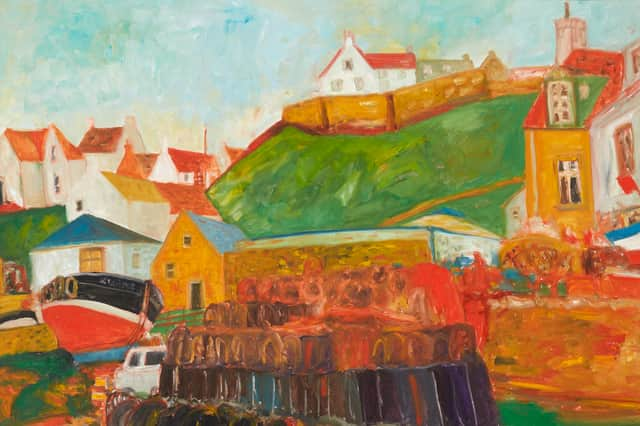
Few artists typify the lure of the sea as much as John Bellany, who seemed to arrive fully formed with his own psychically charged artistic language honed in the fishing communities of Port Seton, where his father was a fisherman and boatbuilder, and Eyemouth, where his mother grew up.
One of the great things about RSA200: Celebrating Together is the way exhibitions have appeared in unexpected locations, like the Scottish Fisheries Museum in Anstruther, which feels like exactly the right place for Bellany, itself a veritable rabbit warren housing all kinds of maritime treasures.
It’s a chance to show two paintings which have been gifted to the museum, Anchored (1999), showing the trawler Bonaventure LH111 moored at Eyemouth, and an untitled 1966 work of the quayside at Golspie. To these, the RSA has added St Abbs (In Memorian John Houston), a fine example of the brighter, light-infused colours of Bellany’s later work, and Haven (1984), a limited edition portfolio of lithographs alongside poems by his contemporary Alan Bold.
It was a great pleasure to see this rare work, a coming together of two imaginations, neither afraid to dwell on the dark, the mythic, the apocalyptic, even death itself; Bellany was painting skull-head figures long before his own brush with mortality. Perhaps his profound understanding of fishing communities is about life lived on the edge: hardiness, vulnerability, superstition. Thoughtful displays created by the museum about Port Seton and the Eyemouth Disaster shed a fresh light on the heartland of his imagination.

Meanwhile, Fire Station Creative in Dunfermline is marking the life and legacy of James Cumming, born in 1922 near this very spot. Cumming went to Edinburgh College of Art aged 16, but his studies were interrupted by war, and he spent five years in the RAF Volunteer Reserve. After graduating, he was an influential and much loved teacher at ECA for more than 30 years, teaching John Bellany, among many others.
Cumming, in the words of his daughter, the art critic Laura Cumming, was “a life-long one-off”. His work does not sit easily in any of the recognised streams of post-war Scottish art. When offered a travel scholarship at the end of the 1940s, he did not head for Europe but for the Western Isles, where he stayed for two years, forging an imaginative world and an artistic language which stayed with him for years. There are just two of his Hebridean paintings in this show, but it makes one hungry to see the others: semi-figurative works built up in layers of translucent colour, strange, mythic and yet grounded in reality.
Later, he explored other subjects and styles: a fascination with microscopy which produced dazzling colourful works such as Poised Encounter; delicate abstracts which seems to be based around shapes seen from above. His RSA Diploma work is the masterful, careful Table Assembly with Rusted Tins, poised between representation and abstraction. His last great work was a community mural for the Low Port Centre in Linlithgow, represented here in a photograph and some meticulous preparatory studies.
In truth, there are only a small number of key works here, most of them drawn from the gift made to the RSA from his studio after he died, not enough to explore the various developments of his career in any depth. But the show is nonetheless worth seeing because it brings out of the shadows an important figure whose work is little shown or studied today.
Alongside Cumming’s work is a selection of paintings - and tributes - by some of those he taught: Barbara Rae, Sandy Moffat, James Fairgrieve and Stuart Mackenzie. You could scarcely pick four artists more different from Cumming, and from one another. That is surely the sign of a great teacher, to encourage students to follow their own path, and to do so with excellence.
Claire Barclay: b.e.i.n.g.b.u.o.y.a.n.t and Symbols of the Mind: James Cumming and his students both run until 1 November; John Bellany: Anchored until 30 November.
The Scotsman’s arts newsletter is now sent twice a week - subscribe today
Enjoying the Arts & Culture journalism on scotsman.com? Make it easier to find by selecting us as a preferred Google source
Want the latest Scottish headlines sent directly to your phone? Sign up to our new WhatsApp channel here
Comments
Want to join the conversation? Please or to comment on this article.