
Art reviews: Joyce W Cairns | Stanley Cursiter


The RSA’s Joyce W Cairns retrospective shows her mastery has not faded, writes Duncan Macmillan
Joyce W Cairns: A Personal Odyssey, Royal Scottish Academy, Edinburgh ★★★★
Stanley Cursiter: A Painter of Distinction, Lyon and Turnbull, Edinburgh ★★★★
Joyce Cairns is a distinguished painter, but though, like all reputations, hers may rise and fall, her place in history will always be secure. She was the first woman to be elected president of the RSA and served with distinction in that office from 2018 to 2022 and so through the difficult years of the pandemic. Her election was the more notable because the RSA’s earlier track record with women artists was not remarkable. Founded in 1826, it remained an exclusive men’s club till 1944 when the sculptor Phyllis Bone became the first woman to be elected a full academician.
Now, appropriately, Joyce Cairns PPRSA — Joyce W Cairns as she is known, to avoid confusion with another distinguished artist, Joyce Gunn Cairns — is celebrated at the RSA with a major retrospective. Its title, Joyce W Cairns: A Personal Odyssey, was chosen long before the current blockbuster made the Odyssey fashionable. In fact, it echoes John Bellany: A Scottish Odyssey, a title Bellany used several times, but the conjunction is apt, although Bellany's preoccupation with the sea perhaps identified him more closely with Odysseus. There are however also echoes of Bellany, tributes perhaps, in Cairns’s work. Like his constant gannets and fish, for instance, she seems to have birds as familiars in her art. Bellany also appears frequently in his own painting and Cairns is actually a constant presence in hers. It is this that suggests these often turbulent pictures reflect on the storms and perils that, like Odysseus, she has navigated in her life.
Born in Edinburgh, from 1966 to 1970 Cairns studied at Grays School of Art in Aberdeen, returning there to teach in 1976. She retired in 2004, but stayed in the city, or rather in Footdee, known locally as Fittie, the city’s quaint, or perhaps better, idiosyncratic, former fishing village, distinct from the city itself. The village’s one-time kirk served as her studio and the village itself is often the context of her later paintings.
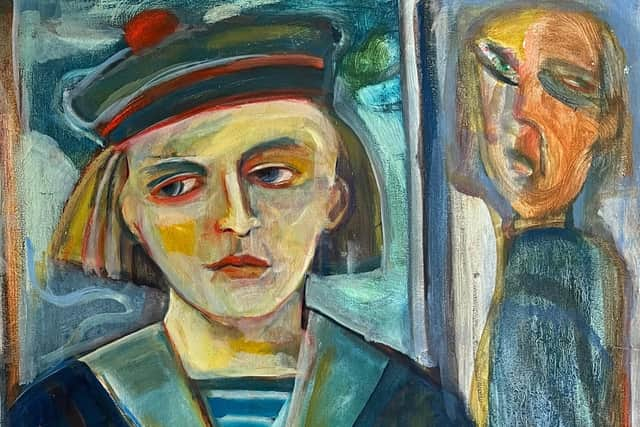
Being unfamiliar, her early work, some of it done in the south before her return to Aberdeen, is of particular interest here. The mood is already dark and self-portraits prominent. There are echoes of contemporary English art, notably a sexually ambiguous homage to Keith Vaughan and a beautiful, pencil self-portrait with a pheasant which seems to echo Lucian Freud. Other works from this time, like Requiem for a Soul, or Pursued, Conquered and Assimilated, are dark and impressive. They are also pretty inscrutable, but the general theme seems to be her own emotional history. Several are divided into panels like medieval or renaissance altarpieces. In the latter picture, too, these panels seem to be a narrative. In the central panel the artist is in front of a house while a ghostly owl-like shape swoops over her head. In the final panel it appears to have devoured her. There is a similar conjunction of a self-portrait with a sinister presence in Kafka’s Insect as the artist juxtaposes herself with the monstrous fly in his short story, The Fly. From the early 1980s, too, The Bell Jar, again in panels like an altarpiece, appears to be another dark and problematic self image with a literary reference. At the centre, a naked woman, presumably the artist, is trapped in the eponymous jar. Both image and title seem to refer to Sylvia Plath’s novel of unhappiness and mental distress.
In a dark and powerful self-portrait from 1982, while the overall surface pattern brings a new unity to the image, there is still a reference to an altarpiece in the background. The Inheritance from the same date actually is in the form of a triptych with Van Eyck’s Eve in one side panel and what looks like the ghost of Adam in the other. Foreground detail, however, identifies the triptych as actually the three-part mirror of a glass topped dressing table with the artist’s reflection in the central glass. It is a many-faceted metaphor of introspection.
In the 80s Cairns’s art changed direction, or at least its turbulence began to be externalised in images of war. She was born two years after the Second World War’s end, but while her father had served in the army with distinction, the war had apparently left a shadow over her mother’s life and so a kind of post traumatic stress hung over the family. At her mother’s death in 1983, she gained access to various memorabilia and records of her father’s wartime experience. This gave her an opportunity to confront in a more concrete way ghosts, or memories that previously had only haunted her and she then embarked on a series of paintings that started from this legacy.
One big picture, They Said the War was Partly to Blame, appears to be an epitome of these memories and their impact on her. The composition is again framed by a mirror suggesting introspection, but this time it has five panels. The view towards the sea from Fittie, including the church that was her studio, is reflected across the five panels. She herself is at the centre. In front of her a sink is draining in a swirling vortex of blood and this vortex then extends to encompass the rest of the composition. She herself seems to reappear both as a girl guide and as a nurse. (She worked briefly as nurse before art school.) A soldier, perhaps her father, various dead Germans and other figures swirl around her, including her familiar bird. Here it seems to be a parrot. Predominant blues and greens make the whole image seem uncanny. Pictures like Shoreline Encounter, or Ship to Shore, also appear to follow the theme of the dislocation of war with echoes of the brothel scenes of Georg Grosz and the imagery of Max Beckmann, but also perhaps of the seamier side the port city where she lived.

Subsequently however, her art clarified and its base in the discipline of her drawing became more explicit. The result is seen in the beautifully constructed large picture painted in 1990 called The Drying Green. It sits both thematically and actually at the centre this show. Clinging to a metal clothes pole, she is again at the centre of the composition. Washing lines radiate from the pole and as though suspended from them are a brothel scene, lovers embracing and a German soldier whose arm seems to have gone through a printing press. She herself is glimpsed again through an open door standing naked in a bath tub. There is much else too, all against the background of Fittie and the open sea. Similarly grand compositions followed. Sword Beach, for instance, is quite specifically a wartime scene, indeed a history painting. Scenes of war still haunt her, too. Even recently in Tiny Tots Annual, 1954, a portrait of herself as a little girl, there is a howitzer shell among the toys. But the most recent work here, a powerful print of a lovers’ farewell, made this year, shows her mastery has not faded.
In a quite different mood, we will always be indebted to Stanley Cursiter for his time as director of the National Gallery, where he was responsible for acquisitions like Gauguin’s Vision After the Sermon and for launching the idea of the Scottish National Gallery of Modern Art. He was however also a distinguished painter. Lyon and Turnbull are showing a range of his works including fashionable interiors, paintings of his native Orkney and, too, Princes Street on Saturday Morning, an example of his pioneering although short-lived interest in Futurism.
Joyce W Cairns: A Personal Odyssey until 2 September; Stanley Cursiter: A Painter of Distinction until 24 August
The Scotsman’s arts newsletter is now sent twice a week - subscribe today
Enjoying the Arts & Culture journalism on scotsman.com? Make it easier to find by selecting us as a preferred Google source
Want the latest Scottish headlines sent directly to your phone? Sign up to our new WhatsApp channel here
Comments
Want to join the conversation? Please or to comment on this article.