
Art reviews: Naeem Mohaimen | Andrew Cranston & Lorna Robertson | Aqsa Arif & more
Naeem Mohaiemen’s film about the Kent State and lesser known Jackson State shootings resonates with the world today, writes Susan Mansfield


Naeem Mohaiemen: Through A Mirror Darkly, Hunterian Gallery, Glasgow ★★★★
Andrew Cranston & Lorna Robertson: Painting, our mutual friend. Glasgow Print Studio ★★★★
Aqsa Arif: Beneath the Ivory is Molten Brown, Street Level Photoworks, Glasgow ★★★★
Ayesha Jones: The Backbone, Street Level Photoworks, Glasgow ★★★
Joanna Piotrowska: A moment of darkness at noon, The Common Guild, Glasgow ★★★★
The show might have left town with regards to the Glasgow International Festival, but many of the exhibitions which opened for GI in the city’s year-round art spaces will run well into the summer.
One of the headliners for GI, and something of a coup for the Hunterian Gallery, is the first showing outside London of Through A Mirror, Darkly, the new three-channel film by artist Naeem Mohaiemen, an Artangel commission which screened in the capital last year.
Mohaiemen’s film-making and photography sits somewhere between art, documentary and history. This film examines a flashpoint in the United States in May 1970 when four students protesting against racism and the war in Vietnam at Kent State University, Ohio, were shot and killed by the National Guard. Then, 10 days later, in a much less well publicised incident, two young Black men were shot during protests at Jackson State College, Mississippi, allegedly by local police.
The three-channel film weaves together archive footage with interviews Mohaiemen has conducted, and creates a rich, layered sense of the moment with the music of the day, clips from the movie The Deer Hunter, and even President Nixon washing his hands of the whole affair.
READ MORE: Glasgow International reviews: Jasmine Togo-Brisby | Rehana Zaman | Kate Cooper | Tanoa Sasraku
It’s made with a great deal of thought and intelligence, complicating the picture rather than offering a linear, authoritative version. But certain clear questions emerge: why do people remember the Kent State killings more than the ones at Jackson State? What does it mean to create a memorial, personally or politically? Like a lot of the films in this year’s GI, it’s long (100 minutes), but well worth seeing the whole thing.
Curator Dominic Paterson has created a show from the Hunterian collection in the rest of the gallery (including a piece by Richard Hamilton which uses a photograph from the Kent State shooting), and has worked with a group of students to create a protest-themed ‘zine. A collage of pages from the Glasgow University student newspaper, the Glasgow Guardian, offers a snapshot of the live issues there in 1970: Tariq Ali speaking to an audience of 1500, a call for equal employment opportunities for Black students.
What strikes hardest, though, is how closely the theme of Mohaiemen’s film resonates with the world today. Two generations later, another divisive president involves himself in foreign wars, student protests are outlawed at some institutions in fear of losing all state funding, and young Black people continue to die at the hands of the state. One might have hoped for more progress.
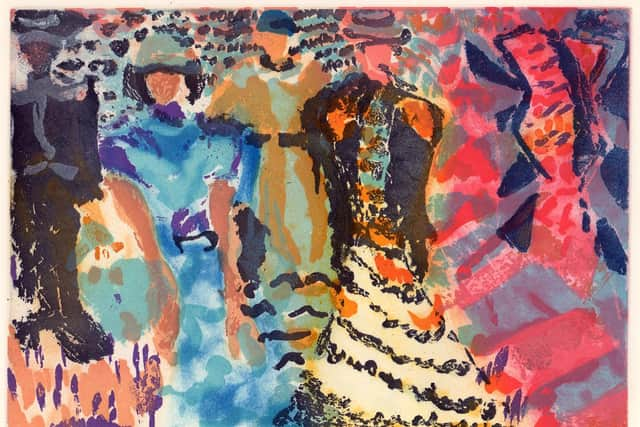
Glasgow Print Studio presents a quiet coup of its own with a show by painters and life-partners Andrew Cranston and Lorna Robertson. Their works are interwoven on the walls, creating a subtle dialogue between their two distinct but complementary practices, and between painting, drawing and printmaking. Much of the work by both artists was made on a series of residencies at GPS over the last year.
It’s always a pleasure to see work by Cranston, whose paintings have gained significant traction in the art market in recent years. This is a chance to see him working across a range of print media too. Both artists seem to revel in the expressive qualities of monoprint. Cranston’s etchings are superb at detail and atmosphere: It’s later than you think depicts golfers at dusk; Why Did You Stop Here? is surely the much-missed fish pond from the Chambers Street Museum, rendered perfectly down to the last koi. The one really large Cranston painting in the show is a beautiful light-saturated rendering of boats and a harbour in peach and gold.
Robertson’s paintings often feature stylishly dressed figures, interiors and elements of still life and, like Cranston’s, suggest partial narratives. But the forms seem to emerge and dissolve within the finished image, denying any easy reading of the work. She achieves the same conceal/reveal effect in a very different way in the high-contrast medium of woodcut.
READ MORE: Glasgow International reviews: David Wojnarowicz | I Only Have Apple Juice | Bettina Grossman & more
At Street Level Photoworks, Scottish Pakistani artist Aqsa Arif makes a series of works inspired by the Pompeii Lakshmi, a first-century Indian ivory statuette discovered in Pompeii in 1938. Far from home, she is misnamed – she is a Yakshi, a nature spirit, rather than Lakshmi, the Hindu goddess – and has also been confused with Greek and Roman dieties such as Aphrodite and Venus.
The Romans were adept at the idea of hybridising the gods and mythological figures of the countries they colonised, a theme Arif expands on with a series of sumptuous photographic prints on fabric. The finest of them are on velvet, gorgeously patterned and edged with beads and sequins.
This luscious aesthetic expands to the film which dramatises the journey of lost Yakshi/Lakshmi. It’s a poignant look at issues of displacement and identity, and a reminder that this has been going on much longer than many would have guessed.
The other half of the Street Level space houses the first solo presentation of The Backbone, by West Midlands-based artist Ayesha Jones’. The work is the story of Jones’ journey with idiopathic scoliosis, taking that as the starting point for an in-depth research project about the ways in which women are misunderstood, misdiagnosed and dismissed within the healthcare system.
The project includes a range of different kinds of photography, from candid shots documenting aspects of her own life and treatment, to studio portraits of other women with the condition and even imagery from media x-rays. There is a great deal to read, too. While it makes many important points, it’s not an easy show to see. Tonally, it’s not clear whether it’s telling a set of personal stories or giving the audience a lecture.
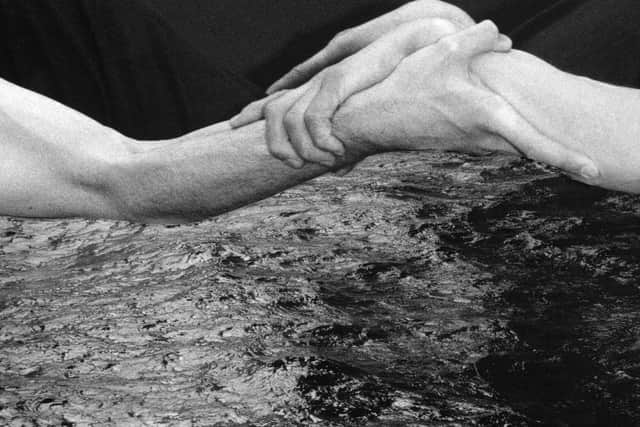
Photography is also central to the work of Polish-born, London-based artist Joanna Piotrowska, whose first show in Scotland is at The Common Guild. However, her concern in this show, A moment of darkness at noon, is to create something much more like an immersive installation, with areas of the walls and floor coloured a rich, Yves Klein-esque blue, and silver gelatin prints mounted on plinths.
Most of the images are collages, some are halfway to becoming sculptures: one is partly obscured by a carved wooden curtain; another has a swathe of gauzy fabric attached. Several feature glass beads and flower shapes. One sports a Mickey Mouse magnet.
We’re told the show is part of an ongoing exploration of the unconscious through memory and dream, the tools of Jungian psychoanalysis. Certainly, many of the images have an uncanny, dream-like quality: a fully clothed figure lies on a beach, close to the waterline; a woman’s face is cradled by a pair of hands in a way which could be intimate or sinister; two buildings mirror one another, one classical in style, one bureaucratic.
It’s all executed with loads of style and poise. What it might mean is less clear, but that might be the point. Plumbing the depths of the subconscious is perhaps not likely to result in an easy interpretation.
Naeem Mohaiemen: Through A Mirror Darkly runs until 11 October; Andrew Cranston & Lorna Robertson: Painting, our mutual friend until 1 August; Aqsa Arif: Beneath the Ivory is Molten Brown and Ayesha Jones: The Backbone until 30 August; Joanna Piotrowska: A moment of markness at noon until 18 July
The Scotsman’s arts newsletter is now sent twice a week - subscribe today
Want the latest Scottish headlines sent directly to your phone? Sign up to our new WhatsApp channel here