
Art reviews: Origin Stories | Gray’s School of Art: 140 Years
As the Origin Stories show at the RSA demonstrates, charting how artists influence each other can be a slippery business, writes Susan Mansfield
Origin Stories, Royal Scottish Academy, Edinburgh ★★★★
Gray’s School of Art: 140 Years - Never make a head bigger than a melon, Aberdeen Art Gallery ★★★★
Wherever you live in Scotland, you’re unlikely to miss the extensive programme of events marking the Royal Scottish Academy’s bicentenary. At its Edinburgh base, the year gets underway not with a big historical show from the collection (that comes later) but with Origin Stories, an intricate exhibition exploring the importance of its role in the teaching of art in Scotland.


A smaller parallel show, Generation, explores a similar theme with regard to architecture. Curated by architect Richard Murphy, it teases out the varied figures who have been influences for him, and showcases the work of 17 young architects who worked with him then went on to launch their own practices.
Origin Stories sets out to trace lines of connection, teacher to pupil, from the Trustees Academy and RSA Life School in the 19th century to young artists emerging from art school today. As part of his ongoing research, curator and RSA Head of Collections Sandy Wood has interviewed many current academicians about the teachers who influenced them, and their own roles in teaching.
The show draws out figures such Robert Scott Lauder, a pupil and later a director at the Trustees Academy, who nurtured a group of painters in the mid 19th century the star of which was William McTaggart. In time, he too became a “visitor” at the Life School, ushering in a looser, more expressive style of painting.
William Gillies, arguably an even more central figure to the teaching of art in Scotland due to his length of tenure at ECA, was taught by David Macbeth Sutherland, David Alison and Penelope Beaton, in turn teaching many artists including Elizabeth Blackadder, James Cumming and Frances Walker.
Even among these, however, tracing precise lines of influence is a tricky business. All the more so as the 20th century progresses and art education undergoes a shift away from traditional methods to a student-focused approach which encourages each artist to find their own individual voice. Almost all of those interviewed were cautious of owning any “influence” on their style, speaking instead of the importance of observing others’ practices, similar sensibilities, or a word of encouragement at just the right time.
Thus is it possible to see connections in the approach of Will Maclean and Dalziel + Scullion, or of Dalziel + Scullion and Elvey Steadman, one of the youngest artists in the show, who has made a film inspired by her time in Florence on an RSA John Kinross Scholarship. But the media and styles are quite different.
It makes sense to learn that Stuart Mackenzie was taught by Elizabeth Blackadder and James Cumming, given his evident passion for drawing and rigorous observation. Marian Leven was taught by Fred Stiven at Gray’s School of art, but how one gets from his box constructions to her light-touch abstraction is less obvious to plot.
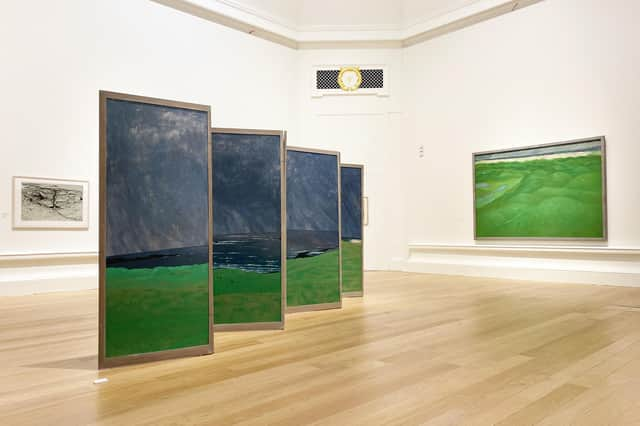
Though it dances delicately round the question of influence per se, it is a fascinating show handpicked from the RSA collection. It’s a joy to see out in the wild works such as Frances Walker’s ambitious eight-panel painting Atlantic Watch, arranged as a free standing screen.
Likewise Sylvia Wishart’s Hoy Sound, Alexander Carrick’s bronze family group, James Pittendreigh Macgillivray’s bust of Glasgow Boy George Henry, Ann Henderson’s no-nonsense female nude in Woman and Chair, paintings by Robert Scott Lauder and Robert Henderson Blyth, drawings by Elizabeth Blackadder and Bill Scott.
The suggestion that it might be possible to trace in this show - and therefore in the RSA - an evolution of a Scottish style is, perhaps, overambitious. Many teachers at art schools are not academicians, and some of the most significant, such as Fra Newbery, the founding father of Glasgow School of Art - who is represented here by his wonderful 1927 painting Day Dreams - was never actually voted into membership. That said, it is possible to draw out certain factors which recur: the importance of drawing; a particular kind of relationship to place which comes through even as the medium shifts.
While pinning down specific influences is often a slippery business, the show reveals how artists find their way. As Henderson Blyth and Cumming edge towards the modern, David Alison looks back to Raeburn and Velazquez. McTaggart, earlier than all of them, ploughs his own extraordinary furrow in an age where much of Britain was entrenched in Victorian narrative painting. While teaching no doubt contributed to his development, it’s also clear that talent will strike out on its own if it has to to find its voice.

Meanwhile, at Aberdeen Art Gallery, a major exhibition celebrating 140 years of Gray’s School of Art is also tracing artistic lineage, of which the school has plenty. While Gray’s was founded in 1885, the starting point for the show is the move from the city centre to its new purpose-built home by the river Dee, designed by Michael Shewan and opened in 1966.
A number of works in Gray’s School of Art: 140 Years celebrate both the school and the building: a large painting by Andrew Cranston, referencing Gray’s in 1968; Joe Fan’s painting of the light-filled mezzanine as a place of dreams and imagination; Allan Watson’s Floating Forms - Five by Five which abstract the form of the building itself. A few years ago, it was threatened with redevelopment, and this show makes a point of celebrating the specialness of Gray’s modernist home.
The rest of the show is loosely thematic, though in truth there is no clear through-line for the viewer to follow, nor is it always apparent where the different sections begin and end. It is less academic than Origin Stories, and - although many of the works have come from the school’s archive - less archival. Curators Dr Judith Winter and Sally Reaper are more concerned with the living archive that is the art school itself.
The joy of the show is in exploring, and there are plenty of gems to find: Andrew Cranston’s The Rape Field, made at a time when he was exploring Colour Field painting, Persian miniatures and RB Kitaj; Calum Innes’ Self Portrait: Objects of Desire, dicing with surrealism and symbolism before he discovered his signature rigorous abstraction; several works by Ian Mckenzie Smith in which he makes the transition from figurative painting to abstraction right before our eyes.
There are wonderful things like Joyce Cairns’ early painting The Drying Green, a big and complex composition inspired by Aberdeen’s Footdee and influenced by the German avant-garde, Frances Walker’s monumental Surfers’ Tracks, and Sylvia Wishart’s Harbour Window. These three works also come into conversation with contemporary women artists, Marie-Chantal Hamrock, Lyndsey Gilmour and Amy Benzie, and Claire Roberts responds to the work of Barbara Balmer.
There are three paintings by Alexander (Sandy) Fraser, head of painting until 1997, charting a career from the experimental Blue Piggery (1969) to the precision of Still Life with Parrot (2006) and the poignant Exit Music (2015) brought to the show from its spot in the Fine Art office at Gray’s.
It’s an expansive yet intimate celebration. The subtitle, “Never make a head bigger than a melon”, is a piece of advice given by Sylvia Wishart in a drawing class in 1968, a shared joke woven into the history of the community. There are some shared sensibilities between the artists, for sure, but what shines out more is the sense of a community which allows individual talents to flower.
At a time when art education is under threat in the UK in a way that scarcely seemed possible a decade ago, it is a reminder what art schools do best, which is to provide artists with the space, the tools and the company which enables them to grow or struggle or stumble their way into the thing that is theirs: to find their voice.
Origin Stories runs until 8 March; Gray’s School of Art: 140 Years until 12 April
The Scotsman’s arts newsletter is now sent twice a week - subscribe today
Want the latest Scottish headlines sent directly to your phone? Sign up to our new WhatsApp channel here.
Comments
Want to join the conversation? Please or to comment on this article.