
Art reviews: Rachel Maclean & Ela Orleans | The Listening House | Past, Present, Future
The installation Rachel Maclean and Ela Orleans have created for this year’s Sonica festival poses questions about the future of AI that are both terrifying and tantalising, writes Susan Mansfield
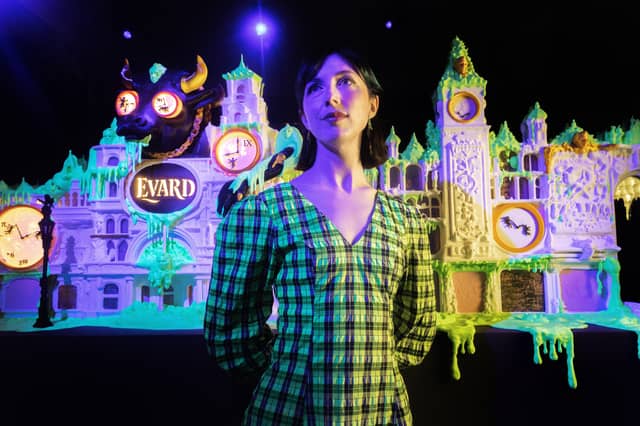

Rachel Maclean and Ela Orleans: They’ve Got Your Eyes, Buchanan Galleries, Glasgow ★★★★★
The Listening House, Pollok House, Glasgow ★★★★
Past, Present, Future: The RSA in the Borders, Hawick Museum ★★★★
At a time when art installations increasingly come with sound, Glasgow’s biennial Sonica Festival sits at an increasingly broad intersection of visual and audio. As if to illustrate how seamlessly the two now intersect, this year’s festival features the Scottish premiere of a new film by Rachel Maclean, with a soundtrack by composer and audiovisual artist Ela Orleans.
Whether your starting point is art or music, this a major new work, a co-commission with FACT Liverpool. They’ve Got Your Eyes explores the tricky subject of AI in Maclean’s signature lush, immersive, fantastical style. Big cinematic sound from Orleans coupled with ultra-slick HD animation gives this project a Disney vibe, but darker, smarter, a hundred times less safe.
Maclean’s tech bros are two rival Victorian gentlemen-inventors, both of whom discover ways to generate fairies. The fairies themselves become generative by (literally) digesting books and regurgitating (again, literally) content on demand, first small household objects, then buildings, streets, palaces.
Although the creations are occasionally flawed - the man who asks for an aqueduct gets a much smaller hybrid “aqua-duck” - the two men become quickly entrenched in an AI arms race, trying to outdo one another with ever more elaborate structures, never suspecting that their exhausted fairies are also reading them, clumsily at first, but with increasing sophistication.
What makes it all horribly clever is that both Maclean and Orleans have used AI, Maclean by creating AI models trained on her own image and archive, and Orleans to help make the soundtrack - sweeping and orchestral but with built-in glitches. Maclean’s script is part Victorian pastiche part AI-bot speak: “That’s a great question!” a fairy swoons. “Thank you for naming that frustration!” The artists have harnessed what some perceive to be a runaway technology and forced it to ask questions about itself.
After the 20-minute film, the viewer is invited to view sculptures of some of the film’s AI-constructed buildings, posing a further layer of questions about which came first, who generates what, what is “real”. Maclean and Orleans aren’t setting out to solve the problem of AI. The conclusion is left wide open - be that terrifying or tantalising - about who will end up in charge.
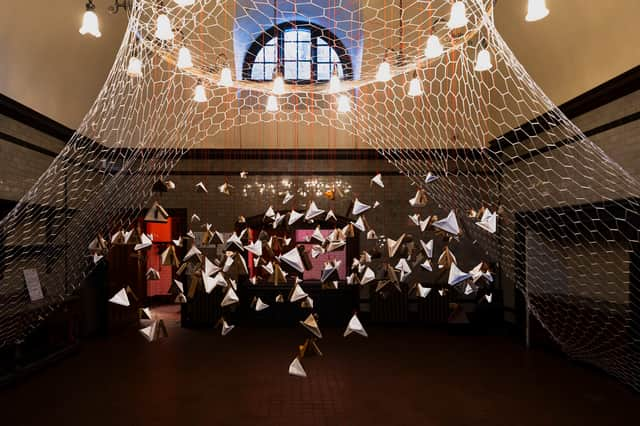
Another inspired Sonica project is The Listening House, which opens up Pollok House, the 18th-century mansion in Glasgow’s Pollok Park which has been mothballed since 2023. As well as attending specific performances, visitors can wander from room to room exploring sound and light installations by Scottish and international artists.
At the foot of the spectular double staircase is Unearthed, a sculpture by Dutch artist Sara Vrugt. High above are the roots of a tree whose life was cut short by environmental change, then a mirroring layer of tiny bells. Us humans are invited to lie on the floor under it - suggesting, perhaps, a more appropriately submissive relationship to nature - and listen to the soundtrack by Ensemble Klang and the tinkling of (alarm) bells above.
Though powerful, it’s gentle and whimsical like 153 Returning Birds, the new work by Geneva-based Ban Lei. His installation consists of birds of different sizes are made from tiny bellows with whistles attached; vsitors are invited to “play” them, gently, conjuring up a chorus of little voices.
Paul Russell’s Richochet is a work you hear before you see: eight algorithmically generated bouncing balls careen around a basement room setting off reactions from 24 incandescent light bulbs and an eight-channel sound board. It’s an exploration of grief, challenging the cliche that one can “bounce back”, though more energetic than elegiac. Viewers can also take a turn at the desk and help control it, though I never figured out how.
In a nearby room, Lomond Campbell’s “muonophone”, a musical instrument which responds to subatomic particles in the atmosphere, warbles and beeps eerily to itself. It is a beautiful piece of retro styling which looks like it should have come straight out of the BBC Radiophonics Workshop of the 1960s.
Jett Ilagan’s sonic_{imprints} is a sound and light installation informed by the artist’s research into the lives of Filipino migrant workers. It’s discombobulating, like wandering through an unfamiliar city in a strange country at night while severely jetlagged.
Inverso Mundus is a multi-channel video installation by artist collective AES+F that explores in the contemporary world the medieval concept of reversing the established order: manual workers sit at the boardroom table; riot police look after wounded protesters.
Across the hall, French artist Boris Labbé presents Ito Meikyū (Thread Labyrinth), a VR world inspired by his travels in Japan and Japanese art and literature. Don the headset and wander at will as rooms give way to more rooms. You might find yourself drawn to stay longer than you intended - rather like at The Listening House itself.

From one grand 18th-century house to another: Wilton Lodge, now Hawick Museum, which is currently hosting Past, Present, Future: The RSA in the Borders. It’s one of a constellation of shows in the RSA 200: Celebrating Together programme, made possible by loans from the RSA collection alongside works from the museum’s own collection and loans from the artists themselves.
It has a rich network of connections on which to draw, from Galashiels-born Anne Redpath, to William Johnstone, the great Scottish pioneer of abstraction, who grew up in the Borders and returned to live there after his retirement. There are Borders landscapes by William Gillies (based at Temple, but arguably close enough) and a handful of 19th century works including a watercolour of Smailholm Tower by Horatio McCulloch.
It’s true that the Borders links are stretched at times: Elizabeth Blackadder’s only connection seems to be that her family name hailed from Berwickshire. But it’s splendid to see Victoria Crowe’s large, magical painting Into an Older Land, and a big 1993 painting by Hawick-born Andrew Cranston, Trail of the Lonesome Pine, a gloriously assured composition in which human figures and buildings are small details in great fields of abstract colour.
There are groups of works by current Borders-based artists, George Donald, James Fairgrieve and John Mooney, and a group of intriguing abstracts by Selkirk-born Alfons Bytautas. Sculptor Jake Harvey, based near Newton St Boswells, presents a number of stone pieces, including the delightful Fallen Moon, and Poacher’s Tree made in welded steel, alongside In the footsteps of James Hutton, a collection of polished rocks gathered from places Hutton visited when developing his Theory of the Earth.
What is most remarkable, however, is the way the show embraces artists across generations. There is a significant group of works by Borders-raised David Cass, whose paintings, often on found objects, highlight themes relating to climate change, and Duns-based sculptor and maker Richard Goldsworthy, who presents Palace Walls, a body of wooden sculptures inspired by a visit to Seoul in 2019. Neither are RSAs (yet), but both have benefited from RSA grants and travel opportunities meaning that the network of connections reaches into the future too.
Rachel Maclean: They’ve Got Your Eyes ends 25 October; The Listening House ends 4 October (check www.sonic-a.co.uk for opening times); Past, Present, Future: The RSA in the Borders ends 5 October
The Scotsman’s arts newsletter is now sent twice a week - subscribe today
Enjoying the Arts & Culture journalism on scotsman.com? Make it easier to find by selecting us as a preferred Google source
Want the latest Scottish headlines sent directly to your phone? Sign up to our new WhatsApp channel here
Comments
Want to join the conversation? Please or to comment on this article.