
Art reviews: The Rupture: No Condition is Permanent | Tai Shani: M.I.A.S.M.A.
The best works in the major new group show at Talbot Rice encapsulate ambiguities and communicate feelings in ways which are immediate and graspable, writes Susan Mansfield

The Rupture: No Condition is Permanent, Talbot Rice Gallery, Edinburgh ★★★★
Tai Shani: M.I.A.S.M.A., Jupiter Artland, near Edinburgh ★★★
In February 2016, the novelist Ali Smith announced her intention to write a quartet of novels which would respond to the times in which they were written. The publishing process would be truncated to allow for immediacy. The Seasons Quartet, published between 2016 and 2020, went on to address topics such as the Brexit referendum, the first Trump presidency and the covid-19 pandemic.
Talbot Rice Gallery’s new show, The Rupture: No Condition is Permanent, feels like an attempt to do something similar in art. Gallery director Tessa Giblin and Carol Yinghua Lu, a curator based in China, came up with the idea shortly after the speech made by Canadian premier Mark Carney at Davos in January (“We are in the midst of a rupture…”), and the process of exhibition-making went into overdrive to stage this show in the same year. Further iterations will follow in China and the Philippines in the spring.
Artists welcomed the idea, in some cases pulling out all the stops to make new work for it. The result is a sprawling show, physically and conceptually, with a high number of durational videos which make it time-heavy. Some works are more effective than others, some address the theme more presciently. But whatever happens, one must salute the basic endeavour.
Thematically, The Rupture takes its lead from Carney’s speech: what has been ruptured is our trust in systems and structures, laws, international bodies, global superpowers. If these things can no longer keep us safe, small and mid-size countries must look for new coalitions around shared values. A rupture is a loss, but also an opportunity to find new ways forward.
Art is not politics, of course. It’s less about marshalling arguments, and less about conclusions, but it can capture something like wistfulness down to a T. The Conservatory (Saint-Denis) is a film by Palestinian artist Tarik Kiswanson, made at a music school in the Paris banlieu where the children of immigrants pick out Beethoven’s Ode to Joy - the European anthem - on a piano. Their faltering notes are the backdrop to the first part of the show, encapsulating everything from our yearning for simpler times to the hope placed in Europe by these new citizens to keep them safe and give them what they need.
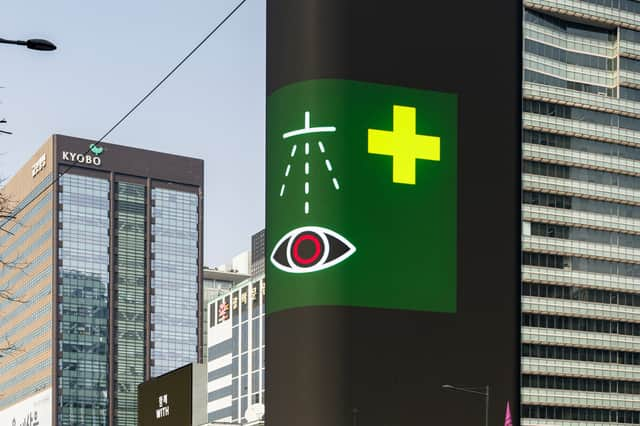
Nearby, Eoghan Ryan’s Terrible Simplifiers (the words come from the 19th-century Swiss historian Jacob Burckhardt, anticipating a new type of demagogue) shows the languauge, shapes and colours of road signage breaking down and shifting into something much more slippery. The scale of the work turns the White Gallery into a kind of public square.
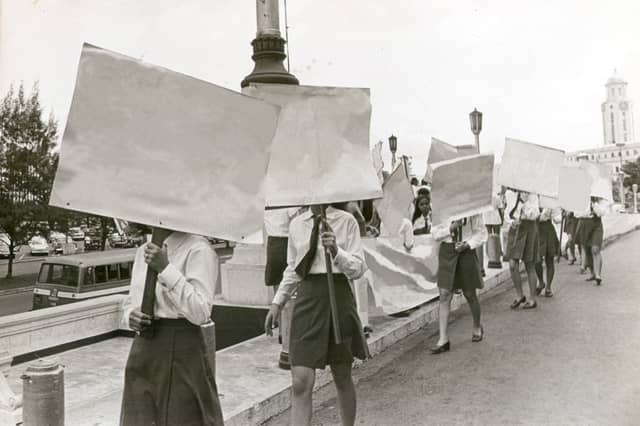
Jasmina Cibic’s Dawn Chorus brings us the songs of birds which defy borders and colonising powers - they are singing outside in the quad as well - and Kiri Dalena’s Erased Slogans transform photographs of protests from the Philippines into timeless symbols of dissent by erasing the slogans on the placards. Li Yifan’s two films shift the focus to China, where the GenZ children of migrant workers are more concerned for their rights than their parents were.
The Round Room hosts Security Guarantees by Zhanna Kadyrova, from the Ukraine Pavillion at this year’s Venice Biennale, charting the 6,000-km journey across Europe of her concrete sculpture, The Origami Deer. The work is a reminder that, three years after gaining independence, Ukraine relinquished its nuclear arsenal in exchange for security assurances from the US, UK and Russia (the widely ignored Budapest Memorandum). Wishful Thinking, by Roman Khimei and Yarema Malashcuk, is another work from Venice, in which top Ukrainian theatre actors play Russian soldiers, old and infirm in an imagined future, remembering their part in the invasion.
The two major film works in the Georgian Gallery, Astra Taylor’s 88-minute Examined Life and Carey Young’s Appearance are accomplished, but their relationship to the theme of the show is tangential. Two more modest works hit the nail on the head.
Claudia Zeiske’s Combat Cooking began as a gesture of solidarity with Ukraine. In a world with no shortage of conflicts or those affected by them, she has since cooked recipes from more than 20 countries including Palestine, Iran and Sudan. Her recipe book, illustrated by students from Edinburgh College of Art, is a powerful symbol of shared humanity coming together around a dining table.
At the last work in the show, by Palestinian artist Taysir Batniji, visitors are invited to take away a bar of soap inscribed in Arabic with “No condition is permanent”. The aphorism is intended to bring hope, quite literally a salve, but a question mark lingers: for the people of the Occupied Territories, perhaps more than most, rupture has become a long-term condition. The longed-for change is yet to show its face.
The best works here encapsulate ambiguities and communicate feelings in ways which are immediate and graspable. They stand out in a show so packed with content one can occasionally feel swamped. Perhaps it is best understood as a space for thinking: enjoy the range on offer, then spend more time with the works which will best help you understand the tortuous present.
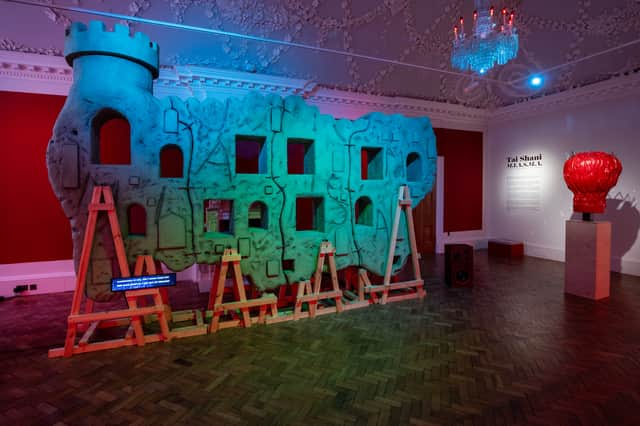
Another artist looking for ways to address the current moment is Tai Shani, whose new installation M.I.A.S.M.A. (Moral Injury in the Apocalyptic Sunsets of Modernity disAssociation), is currently at Jupiter Artland, the park’s first international co-commission. Shani is looking at the present through the lens of Sophocles’ Antigone, having reworked the play into a 70-minute song cycle and sculptural installation: this is another show which is demanding in terms of time.
Antigone’s story is about resistance: a refusal to accept that her brother, Polynices, can’t be mourned or buried after being branded a traitor by their tyrannical uncle Creon. Shani’s densely poetic text, made into a relentless musical score by Aga Ujma, is sung, spoken and chanted by a 12-strong Chorus whose voices emanate from a lurid green wall, part archaeological artefact, part B-movie film set.
A “psychological portrait” of Antigone faces a huge, blood-red head wearing a crown of glass fragments. But, while she bares her soul, Creon has no face. Without eyes or ears, he refuses to see or hear another point of view. Around the room are 12 “masks” made from blown glass, each stuffed with artificial flowers, plastic eyeballs, dolls’ hands stabbed with tiny daggers. Blood red walls and tinted windows bathe the room in a sulphurous glow.
There is so much here it feels a little crowded, and such a broad range of reference points it can be hard to get your bearings, from high tragedy to Halloween kitsch. The centre of the work is the written text, which weaves contemporary references into the myth - I caught mention of wildfires, and “dark forces that threaten our precious way of life” - but you have to be concentrating on the subtitles to get them.
There’s a passionate argument here about what happens when dominant powers refuse to recognise the basic dignity of a human life and how, if and at what cost that can be resisted. But, to paraphrase another famous tragedy, the work is full of sound and fury: its lack of precision diminishes its impact.
The Rupture: No Condition is Permanent runs until 13 February; Tai Shani: M.I.A.S.M.A. until April.
The Scotsman’s arts newsletter is now sent twice a week - subscribe today
Enjoying the Arts & Culture journalism on scotsman.com? Make it easier to find by selecting us as a preferred Google source
Want the latest Scottish headlines sent directly to your phone? Sign up to our new WhatsApp channel here
Comments
Want to join the conversation? Please or to comment on this article.