
Art reviews: Veronica Ryan | Adrian Balseca | Francis Dosoo & more
Veronica Ryan’s show at Mount Stuart on Bute is delicate, thoughtful and domestic in scale, writes Susan Mansfield


Veronica Ryan: The Weather Inside II, Mount Stuart, Bute ★★★★
Adrián Balseca: In the Forest Ruins, Dundee Contemporary Arts ★★★
Francis Dosoo: Portrait of Dorothy Gale, Dundee Contemporary Arts ★★★
The Wonder Store II, Methil Heritage Centre, Leven ★★★★
Less than a month after the opening of the show they curated for Scotland + Venice at the Venice Biennale, the contemporary art team from Mount Stuart were back home on Bute hosting an opening for Veronica Ryan, the latest artist to be invited to respond to the house, grounds, collection and history.
Ryan, a sculptor who won the Turner Prize in 2022, is one of a generation of Black women artists receiving long overdue recognition for their work, and her sensitivity towards materials and keen ear for stories makes her ideally suited to explore this neo-gothic house full of art, objects and craftsmanship.
In these sumptuous interiors, artists use different strategies to carve out a space for their own work. Ryan’s interventions are quiet and subtle. Take the pale pink ottoman in the Lady Bute bedroom – it looks like it’s part of the furnishings, until you look more closely and see that the buttons are not buttons but tiny pockets of seeds wrapped in lace. Or the cushion on the bed, delicately decorated with lace and seeds, or the pillar of pink Himalayan salt which looks almost like a marble ornament.
The biggest group of works is Jumbie Feast, in which seeds, fruit and objects are placed on a table in the conservatory in the Montserrat tradition of laying a table to welcome the ancestors. Seed pods, cashew nuts and a mango are stitched into hand-made bags, alongside stones and sea glass found on Bute. Even the material transformations are subtle: a lace doily or a handful of nuts is cast in bronze, bright red thread adding a tiny pulse of colour.
The huge Monkey Puzzle tree near the house, from which Ryan has cast small branches in bronze, is a reminder, perhaps, of plants brought from the colonies, displaced, forced to flourish elsewhere. She also noticed, and made casts of, the family heraldry found on the drain fixtures on the outside of the house.
It’s all delicate, thoughtful, domestic in scale, fragmented rather than linear, with precious and ordinary things placed side by side. They’re in conversation with what is around them, but they are not vociferous. The viewer must seek them out, give them time to unfold their meanings. They need to be allowed to resonate, be metaphor and not metaphor, and make us look again at our surroundings. The gamble is that, for some, they will be too easy to overlook.
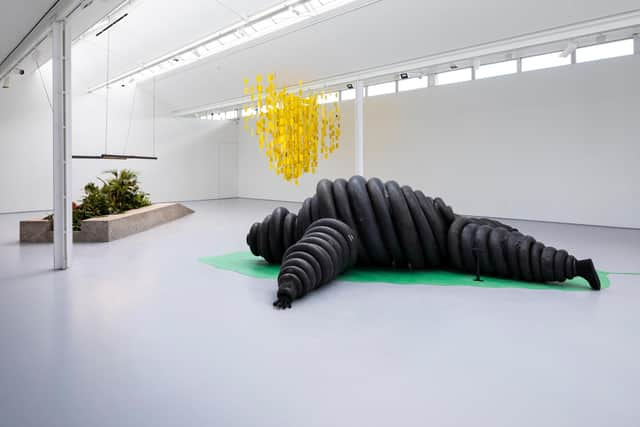
DCA is currently hosting the first show in Scotland, In the Forest Ruins, by Ecuadorian artist Adrián Balseca. For the last 15 years, his research-based practice has focused on extractivist economics, as practised by Western countries on Latin America, where it continues to impact environmentally, politically, socially.
In this show, the particular focus is on rubber, first extracted in the Amazon basin in the 19th century, then cultivated in vast plantations across colonised lands in Southeast Asia. Some of it even got here, to Dundee, where Michelin’s vast factory at Baldovie made tyres until 2020.
Central to the show is ‘Blackbendum (Meal Deal)’, a version of the Michelin Man made of black inner tubes (his official name is Bibendum) collapsed on his face as if bloated by over-consumption. On a giant banana leaf, his ringed shape bears more than a passing resemblance to chontacuros, traditional Amazonian palm weevils, which are baked and served as a local delicacy. At the same time, we are reminded of Michelin’s links to high-end gastronomy.
Elsewhere, Balseca looks at Michelin’s marketing, for example in the Michelin Guide to the British Isles, first published in 1911, neatly pivoting in 1990 to become The Michelin Green Guide to Scotland. In ‘Consumption Traps: A Guide’, pages from the 1911 guide have been printed, laser-cut and turned into a mobile, painted with glue to become sticky fly traps.
Other images from Michelin advertising are embossed or printed into rubber car mats. There is a “garden” of equatorial plants inside a structure shaped like a car ramp, and a film, The Skin of Labour which shows the raw product dripping from incisions in trees into dangling rubber gloves.
The messages, though, are disappointingly simple: extractivist capitalism is bloated and ugly and keeps its audience hungry through clever marketing. While this is the kind of art which can impart information and even inspire change, these works seem to be focused on finding different ways to tell us what we already know.
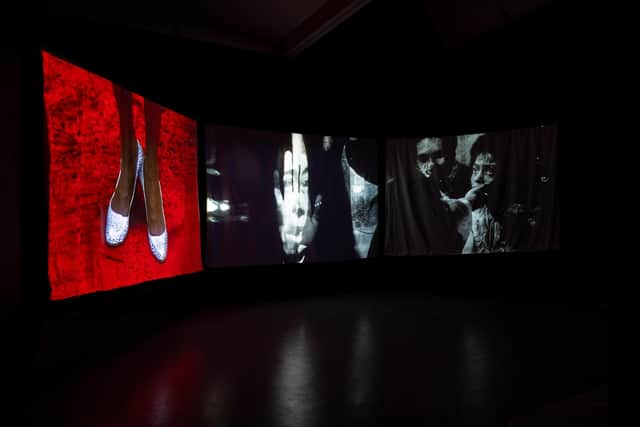
In the next door gallery, Scottish artist Francis Dosoo, who has performed for 10 years as a DJ, now applies the same mixing and layering techniques to working with film. Portrait of Dorothy Gale takes as its starting point the 1978 adaptation of The Wizard of Oz, The Wiz, in particular the extraordinary performance of the young Diana Ross as Dorothy.
Dosoo contends that Ross drew on some of the personal journey of transformation she was undergoing at the time, and taps into his own interest in spiritual mysticism to suggest that this film – and perhaps film in general – is a kind of portal to reach (in the words of physicist Werner Heisenberg, who is quoted in the show) “beyond the surface of things”. Put another way, The Wizard of Oz is a quest story in which the journey is more important than what is (spoiler alert) revealed at the destination.
I’m on board with most of this, but the images and clips – from The Wiz and other films – which dissolve, layer and merge on the three large screens don’t take me there. Perhaps this is one of those cases where the artist’s journey with the material is vivid and transporting, but also personal and unique to him.
Meanwhile, Robert Mach is working wonders again at Methil Heritage Centre with the Wonder Store II exhibition, supporting the building and the community by bringing in world-class art.
The show opens with photographs and film relating to Julie Brook’s sculpture, Tide Line, on the coast at Cellardyke. There’s a painting by John Houston (born in Buckhaven), plus two drawings from his days at Buckhaven High School, and a fine small painting by Caroline Walker, who grew up in Dunfermline.
Internationally acclaimed glass artist Keiko Mukaide, who also lives in Fife, has contributed a “glass painting”, and created an installation exploring the seasons in Japan versus the seasons in Scotland, drawing Japanese characters in ink made from coal. There are paintings and objects from Reinhard Behrens and glorious ceramics by Simon Ward.
The show also includes some beautifully flowing charcoal drawings by James R Barclay, the art teacher at Buckhaven High School who inspired Robert’s brother David, and pop artist collages by Alan Wyllie, whose noirish femme fatales stalk the lanes of brutalist housing schemes in Glenrothes.
And there’s poetry by Eleanor Livingstone, former artistic director of the StAnza Poetry Festival and another Buckhaven alumna, recorded by Games of Thrones’ Clive Russell, who is – wait for it – another Fifer. The creative wonders of the Kingdom know no bounds.
Veronica Ryan: The Weather Inside II runs until 18 October; Adrián Balseca: In the Forest Ruins and Francis Dosoo: Portrait of Dorothy Gale until 2 August; The Wonder Store II until 29 August
The Scotsman’s arts newsletter is now sent twice a week - subscribe today
Want the latest Scottish headlines sent directly to your phone? Sign up to our new WhatsApp channel here