
Art reviews: Wael Shawky | Mercedes Azpilicueta | Aubrey Levinthal
The quality and ambition of Wael Shawky’s films is undisputed, but what exactly are they trying to communicate, wonders Susan Mansfield
Wael Shawky, Talbot Rice Gallery, Edinburgh ★★★★
Mercedes Azpilicueta: Fire on the Mountain, Light on the Hill, Collective, Edinburgh ★★★
Aubrey Levinthal: Mirror Matter, Ingleby Gallery, Edinburgh ★★★★
For the Egyptian Pavillion at the 2024 Venice Biennale, Wael Shawky made Drama 1882, an ambitious film of a staged musical play about a watershed moment in the country’s colonial history. In 1882, the anti-imperial Urabi uprising in Alexandria was crushed by the British, who carried out a destructive naval bombardment of the city and went on to occupy Egypt until 1956.
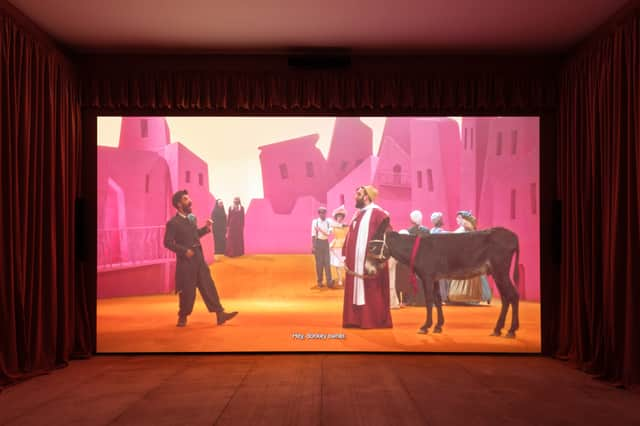

The work is now being shown at Talbot Rice Gallery, in partnership with the Edinburgh International Festival, along with a 2015 film, Cabaret Crusades III: The Secrets of Karbala, the concluding part of Shawky’s epic Cabaret Crusades trilogy.
Both of these are extraordinary works. Drama 1882, filmed in an outdoor theatre in Alexandria, is a kind of opera in classical Arabic, composed, choreographed, designed and filmed by Shawky. There’s a huge cast, including some superb singers, and a real donkey. As productions go, it would put some big-budget EIF shows to shame.
The performances are highly stylised, the movement masque-like, the costumes and sets seem to come from a mythic Middle East from the Arabian Nights, the men in fezes, the women with water jars on their heads. The text, however, as far as I can work out from the English subtitles, seems to be a fairly straight re-telling of the events.
The crusades film has similarly lavish production values, covering, in two hours, events from 1145 to the Sack of Constantinople in 1204. The characters - real historical figures - are represented as marionettes made from hand-blown Murano glass, wearing exquisitely hand-stitched costumes. A collection of the marionettes is on display in the gallery, and they are fascinating.
On a set of rotating concentric circles, at times lit by real match-sized flaming torches, it has a kind of mythical strangeness which is quite compelling. However, at two hours long, I suspect most people will make do with a fragment. Again, the text seems like a historical retelling, drawing on books such as Amin Maalouf’s 1986 book The Crusades Through Arab Eyes.
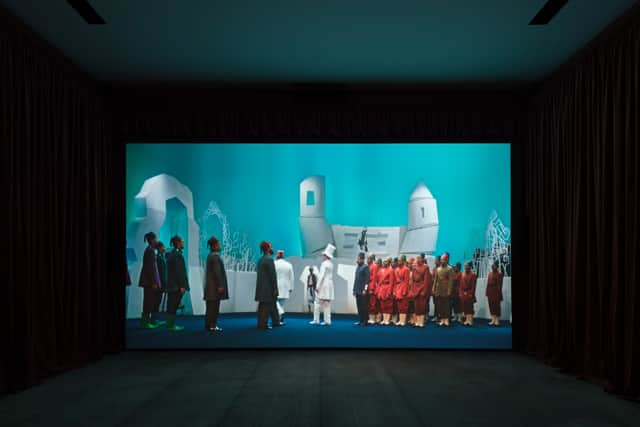
The quality and ambition of these productions is undisputed, and it also makes sense that Talbot Rice is showing them in its anniversary year, in recognition of its founder, Byzantine and Islamic specialist David Talbot Rice. And yet there is an unanswered ‘why?’
If Shawky’s aim is to offer an Arab perspective on 1882, and draw connections to the colonial roots of conflicts in the Middle East today, why tell the story in this mythical, masque-like manner which makes everything - including the high-handedness and brutality of the British - feel unreal?
To modern eyes, the crusades already look outdated and monstrous, motivated on the Western side by religious fanaticism, expansionism and greed. For those interested in an Arab perspective, books like Maalouf’s can give a much more nuanced exploration of the complexities.
Shawky’s motivations remain opaque. There is a small series of drawings in the upper gallery which he made while working on the crusades epic which are spontaneous and intriguing, and one feels briefly a little closer to the questing creativity behind it all. But the films are hermetically sealed units which operate on their own terms. The viewer might have the temerity to wonder what they are saying, but the viewer is clearly incidental.
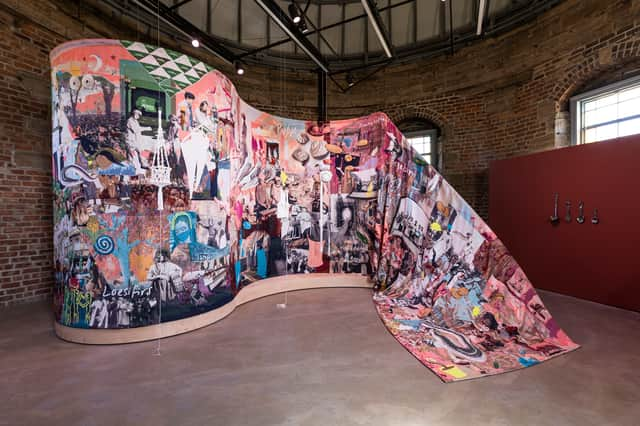
Continuing the theme of protest in art echoing through Edinburgh at the moment from Steve McQueen’s Resistance at Modern Two, Mercedes Azpilicueta connects two important moments in women’s collective action a century apart, one in her native Argentina, and one in the Netherlands, where she now lives.
In 1917, as wartime food shortages took hold, working-class women of the Jordaan area of Amsterdam attacked and robbed ships loaded with potatoes for the UK. The names of those behind the Potato Riots seem now lost to time, but Azpilicueta has unearthed archive photographs of contemporaneous women and woven them into an impressive Jacquard tapestry, Potatoes, Riots and Other Imaginaries (2021), adding words of the local dialect (pijtijem, boender) and other motifs like shrimp, cakes and daschunds.
Into this, she further weaves stories from the Argentinian women’s movement Ni Una Menos (Not One Less), which spread through South America after 2015, speaking out against gender-based violence and in favour of reproductive rights. It was influential in the legalising of abortion in Argentina in 2020. Azpilicueta includes her own personal photographs from the protests and screenshots of text message exchanges with her mother and sisters.
There’s also a soundtrack which uses songs and chants from both protests but I couldn’t get much from that because I speak neither Dutch nor Spanish. Alongside the tapestry, she presents new textile and ceramic pieces which will be used in a performance on Calton Hill on 22 August, and promises to reference the radical history of the hill itself.
Placing the two stories alongside one another is fine as far as it goes, but I’d to see it go further: how are they similar? How are they different? What does each have to say to the other? The other objects are clearly well made, but the connections to the tapestry are unclear. They seem to be waiting for the performance to animate them.
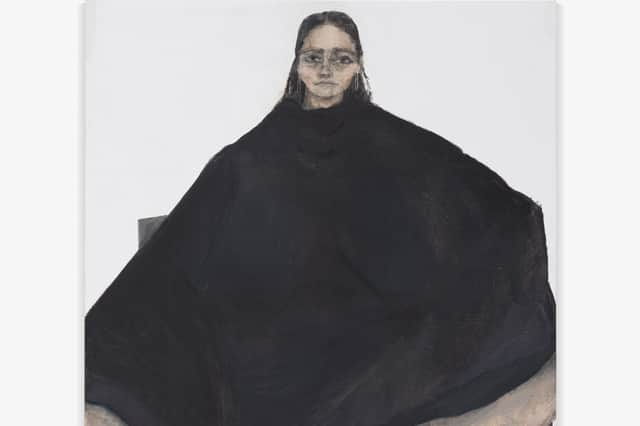
The domestic surfaces again in the first major UK show by Philadelphia-based painter Aubrey Levinthal at Ingleby Gallery (we got an early glimpse of her work in the gallery’s Bonnard show in January).
Levinthal is a considered and committed painter. Her project seems to be to get under her own skin and paint what that feels like, whether that’s the introspective moment captured in Lunch Break or the intimacy of sleep observed. In one painting, she even observes herself sleeping.
She likes to play with scale, painting her tiny self sitting at the edge of an immense studio table, and with perspective: tables are often flattened as if seen from above, while the objects on them are in profile. She works with a delicate palette of greys, greens and pinks, but sometimes likes to add a block of much denser colour, a black sweater, the red edge of a table.
Paint is laid on in thin washes and scraped back; sometimes the paintings have an aura of transparency. But all this happens within a framework which is commited to realistic detail: a street of parked cars, a vase of pink tulips, a clear tupperware lunchbox. In Descending Subway (Stairs), hanging cleverly on the stairs, she balances the downward motion of the descending figures with a view upwards through a grille towards the lighted windows of the city at night.
Recently, she has been painting quiet interactions between people: the “drop-off women” at the school gate in the painting of the same name, three small boys on a couch, engrossed in something one of them is holding. The two women in Laps Around the Square are so close to one another each is like the other’s shadow. Why are they walking laps, one finds oneself wondering?
Levinthal’s are almost always quiet pictures, but they reel you in, with their hook in real life and the line tracking back into what lies beneath the surface. She reminds us that domestic life can be strange, and also that it’s well worth looking at.
Wael Shawky until 29 September; Mercedes Azpilicueta until 7 September, with a performance on Calton Hill on 22 August; Aubrey Levinthal until 13 September.
Comments
Want to join the conversation? Please or to comment on this article.