
Duncan of Jordanstone Degree Show, Dundee review: 'digs deep into inner landscapes'
The best work in this year’s Duncan of Jordanstone Degree Show manages to be personal while also remembering its audience, writes Susan Mansfield


Duncan of Jordanstone College of Art & Design Degree Show 2026, Dundee ★★★★
Some fine weather at last, and summer on the horizon? It must be Degree Show season. As usual, it’s up to Duncan of Jordanstone College of Art & Design in Dundee to get the ball rolling, with some 427 students graduating in a wide range of courses. In the Fine Art disciplines, it’s a show strong on skill and no slouch on conceptual acuity.
Personal experience is often the starting point for degree show work, and that’s no surprise: mostly, this is the work of young people who are still discovering who they are. In terms of art, though, the best work does more than dig deep into one’s inner landscape, it remembers the audience too.

Agnes Borland Sinclair’s work is made in response to her mother’s serious illness, but her impressive tent installation, Seeking Comfort, invites everyone in. The concept is simple: the words attached to the outside are about unhealthy (but very human) ways of coping - doom-scrolling, having a cheeky pint - while in the cosy, red-pink interior, it’s about better ways - comfort through love, care, connection, art.
Hannah Ritchie pays tribute in painting and photography to her mother, who lives with MS. Her large painting of a pair of hands, delicate yet awkward in their movement, is poignant and ambitious.
Mature student Matthew Tilbrook lives with chronic illness, but that is only a seed in his sculptural work. He makes spheres suggestive of planets and celestial bodies and has a deep interest in the properties of different materials such as clay, wax and bronze, pushing them as far as they will go, and then exploring their flaws.
Due to illness, Jennifer Trotter often has to view the world through windows. She turns this perspective into Beyond the Frame, a beautiful installation of old window frames through which films reveal wild landscapes and contrasting hospital interiors. Gemma Carpenter has worked with a group of volunteers living with unseen autoimmune conditions, and makes the invisible visible in vigorously colourful figurative paintings using the metaphor of fungal spores.

Kate McIntosh’s paintings and intaglio etchings explore the relationship between an adult and an ageing parent. Her subtle but evocative compositions offer glimpses of the figure through a door or in a mirror. This is some of the best work here. Ailsa Dunn’s painting is more deliberately portraiture, highlighting relationships between women, particularly mothers and daughters.
Emma Neill is a fraternal twin, and her paintings of herself and her sister are a series of diptychs, rich with patterns and images of pairs and doubles. Only the cat seems to be a singular entity. Liam Mcgee’s painting explores being an identical twin, and the layered nature of identity as it is worked out in relation to, and apart from, a significant other.
Other students delve into relationships with place and culture. Ruth Gibson looks at the rural West Highlands through film, photography and painting on fabric using dyes made of lichen. Louisa Grieve looks at our relationship to Gaelic by personifying the language as a woman, Gig Hilda, an anagram of Gàidhlig, and inviting people to write letters to her, which are often profound and moving. Visitors are invited to add their own.
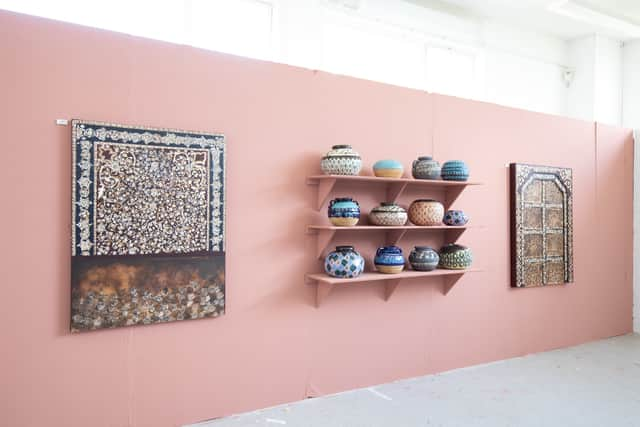
Rory Duff also captures the West of Scotland in his paintings, weaving together place and relationship, using a strong colour palette and adding a sprinkling of the surreal. Zahraa Dar delves into connections with her Pakistani roots, in paintings and ceramics.
Jess Simpson’s paintings explore her home town of Glenrothes, and the contrasts which reveal themselves when you return as a young adult to the place where you grew up. Kat MacCulloch negotiates the territory of memory in photography and writing, incorporating amongst her own analogue photographs prints and slides from her family’s past. Printmaker Nina B looks at Scotland’s New Towns in The Overspill, layering images which heighten the contrast between the once progressive architecture and a present sense of decay.
READ MORE: Royal Scottish Academy 200th Annual Exhibition, Edinburgh review: 'a wonderful miscellany'
Luke Kelman has been looking hard at the motorway overpasses on his bus journeys to and from Dundee. This has led to a large-scale metal floor sculpture, field recordings and a series of reliefs which incorporate elements of photography. Georgia Cooper has gone looking for hidden stories in the city, found patterns and turned them into musical scores which are then recorded on piano or sung.
Some students have created immersive installations, like Lauren Evans’ newsagent’s shop, the Daily Males, which explores the epidemic of violence against women and children. There are newspapers featuring real headlines from the Daily Mail, a scratchcard booth for the “Women’s Lottery of Safety” and a cash register sculpted in carboard. Hollie Grindlay looks at the misogyny hidden in nightclub culture in a throbbing space with an impressively sticky floor.
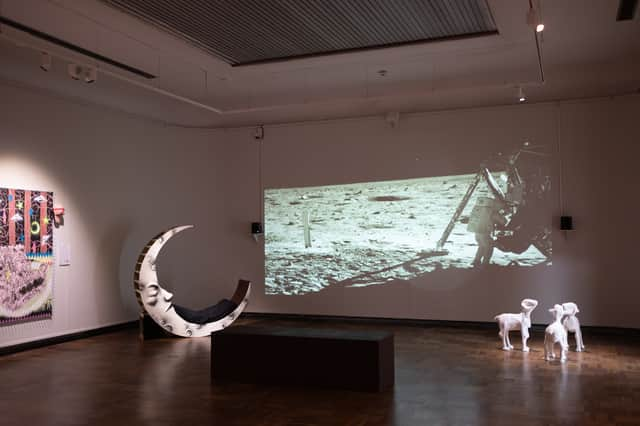
Kirsty Scott’s installation To the Moon, looks at sleep, and the work culture which would rather we didn’t, with a moon-shaped seat to recline in and a rather beautiful black and white film. Daniel Mccourt’s film features images and patterns randomly generated by the software he has built. His woven rug neatly makes a link between the loom and the first computer.
Alexander MacPherson’s work, The Anthropo, is energised by his concern for the planet. Every inch of the space is filled with images; even his mountains are covered with people. The more-is-more aesthetic feels entirely suited to evoking a crowded, careless population, wedded to their motor vehicles.
Vicki Scaife’s figurative drawing, Dianne Kelly’s wearable sculptures and Laurie Lindow’s meticulous ceramic universe are all worth looking out for. Isabel Roles has the makings of a fine expressive abstract painter, and Mya Wilson’s abstracts are cool and precise, inspired by Brutalist architecture and concerned with form and colour and light.

Hector Laidlaw presents an insightful film about loss, which references (among other things) Tupperware and UFO cults, wrapped up in a lo-fi aesthetic (part of it was made on VHS video). Alexandria Tully asks questions about realism and perception by presenting two sets of sculptures of heads, one made in silicone and the other 3D printed. Jock Macdonald paints tower blocks on an ambitious scale, and sculpts them in (appropriately) concrete.
In one of the last rooms I visit, Eve Simpson provides a helpful footnote on the subject of personal work. Her show, My Last Artwork, is a journey of self-discovery conducted by imagining her own funeral, complete with eulogies. There is a sense in which degree shows are an ending as well as a beginning. The college years are over; now the fledglings must fly the nest and test their ideas out in the wider world.
Until 31 May
The Scotsman’s arts newsletter is now sent twice a week - subscribe today
Want the latest Scottish headlines sent directly to your phone? Sign up to our new WhatsApp channel here
Comments
Want to join the conversation? Please or to comment on this article.