
Earth Matters, Edinburgh review: 'a fully fledged celebration of James Hutton'
This wide-ranging group show is a celebration both of the pioneering geologist James Hutton and of soil as a living, vibrant, intriguing entity, writes Susan Mansfield

Earth Matters, Inverleith House, Edinburgh ★★★★
I don’t know how geologists are marking the tercentenary of James Hutton, the Scottish “father of modern geology”, but artists are having a field day. Ilana Halperin’s excellent show at the Fruitmarket is just one of several referencing Hutton, while Earth Matters, currently at Inverleith House, is a fully fledged Hutton celebration.
The “earth” of the title is not the planet, it’s earth, soil, dirt, the stuff under our feet. Earth, after all, is central to everything at the Botanics, where spring is bursting into life outside the gallery windows. In fact, it’s central to all of life, and as threatened by pollution and environmental change as any of the planet’s resources.
Curated by Susanna Beaumont in partnership with Amy Porteous of the Botanics, Earth Matters is an ambitious show which blends the work of 30 contemporary artists, makers and designers with historic and scientific material. It’s a bit like a dance, where there is just enough structure to hold in balance a sashaying mix of objects and practices.
If there is a visual starting point, it is the illustrations for Hutton’s masterwork, The Theory of the Earth, by his friend and travelling companion, John Clerk of Eldin. They are part of a small archival section, along with a caricature of Hutton by John Kay and the handwritten manuscript of Hutton’s last - and unpublished - book, Elements of Agriculture, arguably his “earthiest” work.
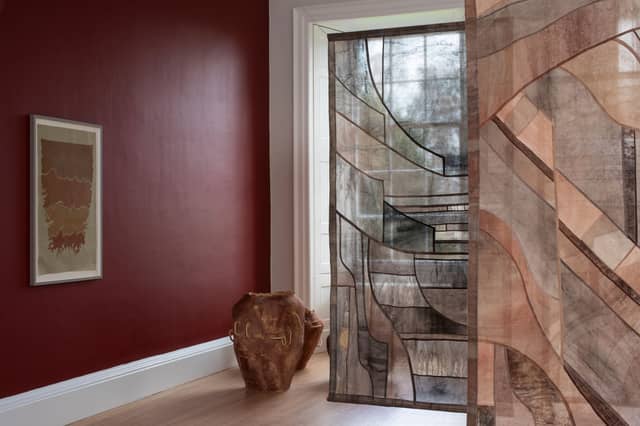
This is one example of how carefully the show is balanced: too much of this would turn it into a museum display. But these works share a space with The Unconformities, three textile hangings by Louise Bennetts, coloured with soils and directly referencing Clerk and Hutton, and with a new range of vessels called Huttonware by Edinburgh ceramicist George Perry, inspired by the dishes Hutton himself might have used.
There is a woodblock print by Ilana Halperin coloured with inks made from soil on Hutton’s farm, a painting of the rocky East Lothian coast by Graeme Todd, and a group of large hand-made vessels by Maria McStay, a recent graduate of Edinburgh College of Art, embedded with crushed East Lothian stone.
Great care has been taken throughout, not just in selecting the artists and works - some are loans, some are new commissions, a few were discovered through an open call - but in the presentation. Forms or motifs quietly echo between works. Wall colours are matched to the shades of Scottish soil. Even the stairway is lined with illustrations from Henry Stephens’ 18th century farming manual, The Book of the Farm, and clay sconces by Cara Guthrie.

Upstairs, the first room gets right into the earthiness of earth. In Under the City, Stefanie Ying Lin Cheong, a jeweller by training, transforms a handful of earth from her Glasgow tenement garden by adding tiny precious stones and turns its microcritters into amulets. Stevi Benson’s handcut paper work, Interwoven, traces the lines of normally invisible mycelial networks on a large scale. Constanza Dessain cracks the problem of how to illuminate the rotting and decaying properties of soil with a series of works made on glass using cyanotype chemicals and kitchen compost, decomposing rather beautifully in real time.
Next, a room on peat, once regarded only as a traditional fuel, now a valuable and protected resource for carbon storage. There’s a peat stack by ceramicist Crunch Willoughby, and a series of spades and peat-cutting implements made from local clay by Aberdeen-based Kevin Andrew Morris. Sekai Machache’s photograph Light Divine Sky II is perhaps a bit of a tangent: it’s main role here is to conjure the world of the Flow Country, which it does, but it delves into so much else as well - hidden histories, Black identity, colonisation. That said, it looks superb, both on the wall and on the banners on the front of the building.
READ MORE: Art reviews: Joan Eardley | Mona Yoo
Tania Kovats, whose usual territory is water, has created The Book of Earth, by painting directly on to Scottish Soil Survey Maps. Sadly, visitors to the gallery can’t turn the 82 pages and must make do with the ones which are visible, but they make a perfect illustration of what an artist can bring to the conversation: a kind of free-flowing, emotional, imaginative discourse which moves between past, present and future.
At times there is so much here, so many different things - archive photographs, texts by Darwin, Rachel Carson - there’s a danger of overwhelm. Each time, however, the curators pull it back from the edge. If you’ve seen too much, sit down on an earth-and-straw bench made by Glasgow-based Kelly Murray and out of the window at the blossoming magnolias.
Careful thought has been applied, again, as to how much to include on the global crisis in soils. There’s much could be said, but too much would tip the whole show into something else. Instead, it’s applied with the lightest of touches, sprinkled into the wall texts. Few of the works reference it directly. Becky Little and Tom Morton’s River of Earth is one of the few that does: a spiral of rocks decreasing in size, taken from eroding coastline in Buckhaven, end in a single, beautifully polished stone, like a full stop.

In some cases, the viewer supplies their own subtext: Carol Rhodes’ painting, Airport Hotel and Airport, reads like a gentle rebuke about the encroachment of the modern world on green space. Wilhelmina Barns-Graham’s September, Orkney and Joan Eardley’s July Fields start to look like expressions (although they might not have used the words) of endangered biodiversity.
Alberta Whittle’s painting, The Soil Reclaims Her Children, despite a rather portentous title, has the sad-happy tone of childhood memory, recalling her grandparents’ garden in Jamaica. There’s something similarly elegiac about Clare Wood’s painting of fallen flower petals, Today and Tomorrow, and Fiona Young’s still life photography, which have the “memento mori” quality of the Dutch Old Masters.
While some works are quietly sad about the subject of earth, plenty are celebrating it as a vibrant material for making. Those working in clay emphasise wild and local clays, from Nancy Fuller’s St Austell Kame to Adam Johnston’s Raeburn Vases, made in collaboration with Scotland’s one remaining brickworks. The group of lidded pots by Viv Lee and Jonathan Wade, made using foraged clays and found objects on and near Hutton’s farm, are quirky and joyous.
Beaumont and Porteous have succeeded in bringing together a broad range of work by wildly different practitioners at varying stages of their careers, held in balance in the service of a common theme, yet held tightly enough that there is room for oddities and tangents. In applying the scientific and environmental with the gentlest of touches, they have succeeded in creating a show not doom-laden but celebratory, of James Hutton, yes, but also of soil itself as a living, vibrant, intriguing entity.
Until 1 November
The Scotsman’s arts newsletter is now sent twice a week - subscribe today
Want the latest Scottish headlines sent directly to your phone? Sign up to our new WhatsApp channel here
Comments
Want to join the conversation? Please or to comment on this article.