
Edinburgh Art Festival reviews: Eva Rothschild | Katie Paterson | Anne Hardy

Three exhibitions by a trio of mid-career female sculptors are among the highlights of this year’s Edinburgh Art Festival, writes Susan Mansfield
Eva Rothschild: The Void Presses The Wall, Fruitmarket Gallery, Edinburgh ★★★★
Katie Paterson: Afterlife, Collective, Edinburgh ★★★★★
Anne Hardy: Feelings, Talbot Rice Gallery, Edinburgh ★★★★
The female presence is particularly strong at this year’s Edinburgh Art Festival, across painting, photography and sculpture. If we focus just on the last of these, three of Edinburgh’s leading contemporary art spaces are presenting work by a trio of mid-career female sculptors.
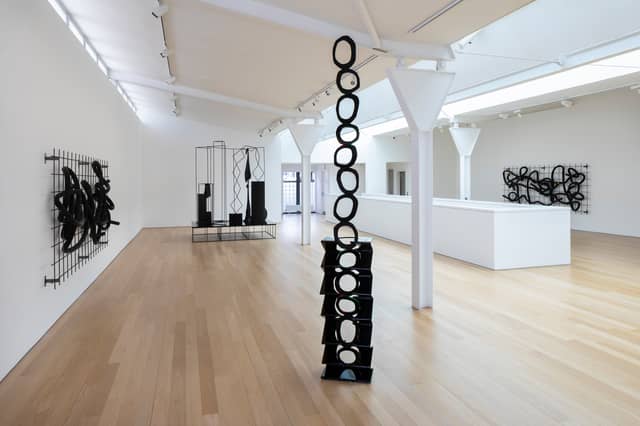
Eva Rothschild’s show at the Fruitmarket Gallery is her biggest in the UK for two decades, presenting a major body of new and recent work. In this show, the act of making is an ongoing dynamic inquiry into physical properties: what happens if this balances on top of that? If I take this and add that to it? Does it look hard or soft, light or heavy?
In fact, the exhibition as a whole is an inquiry: what if I put this next to that? How does it interact with the space around it, or with the presence of human beings?
We see this perhaps most clearly in the downstairs galleries. Several hoodies strung together and coated with resin stretch from the ceiling and pool on the floor (Rothschild is good with titles: this is called Houdini). The Cloud is made of bent coils of rebar, covered here and there with coloured plaster, but hangs as light as air.
Festival, an inverted pyramid made from bamboo, cardboard and hand-dyed fabric, manages to be both large and ephemeral. The Grit is a big rock with a stack of mattresses on top, reaching up to the ceiling. It’s the fairytale of The Princess and the Pea writ large, domestic in scale and a little absurd. It’s one of the few works to which metaphor easily attaches, although one feels that is largely in the eye of the beholder.
The upper gallery is dressed in a palette of black and white. Sculptures assemble together in works like Hangouts, many of them highly formal: cross sections of pillars, draped fabric, minimalist geometric shapes. Amphi, made for her Venice Biennale show in 2019 where she represented Ireland, is a construction of spray-painted blocks intended as a kind of Agora. Wall-based works of extruded rubber wound into jesmonite grids are about the size and height of graffiti tags.
The fusion vibe can be somewhat disorientating - classical yet streetsy with a dash of minimalism, and in the case of works like Pilgrim, almost totemic. Rothschild mixes traditional art materials like bronze and plaster with everyday ones like rubber tubing, mattresses, hoodies and padlocks (New Romantix).
In a new film, Safe, shown in the Warehouse space, she expands her investigation into sculptures and bodies by filming local lads interacting with a ziggurat-shaped climbing frame she designed for a park in Dagenham. Their bodies twist around the rigorous geometric form as if the sculpture itself was coming to life.
There’s no climbing in this show, but there does perhaps need to be a willingness on the part of the audience to participate in Rothschild’s dynamic inquiries by considering what her works do and how they make us feel. A passive viewer might find that the works are passive too.

Katie Paterson’s installation Afterlife, at Collective, is all about materials too, in a different way. Commissioned by Sorcha Carey, Collective’s director, when she was curating the Folkestone Triennial last summer, it’s a gathering of 197 amulets, sourced and 3D-scanned in museums around the world, then remade using new materials which reflect the fragility of the planet: coral from the Great Barrier Reef, charcoal from wildfires, polystyrene fragments recovered from the Mariana Trench, and so on.
Small talismanic objects from different world cultures, designed to sit in a hand or be worn as jewellery, are displayed in a bespoke dimpled table designed by Berlin-based architects Zeller & Moye, and made by Scottish company Sylvan. Despite the ubiquitous notices to the contrary, the desire to touch them is almost irresistible.
It’s a show where looking isn’t enough, you need to know more, and fortunately there is a detailed exhibition guide which explains the background to each amulet and the material in which it has been remade. Thus, a netsuke of two birds with beaks touching is made from plastics found in the stomach of a baby albatross in Antarctica; an amulet of the solar system from ancient Rome is remade in space junk.
They are organised into sections: extraction, pollution, biosphere and so on, but the message is the same. Each one is a pocket-sized reminder of the damage dealt to the planet by human kind. But here’s the magic. While they have a cumulative power, instead of leaving us feeling lectured to, the objects - invested over so much time with hopes and meanings - seem to embody our fragility, our desire to do better. Paterson has taken a severe lesson and wrapped it up in hope and compassion.
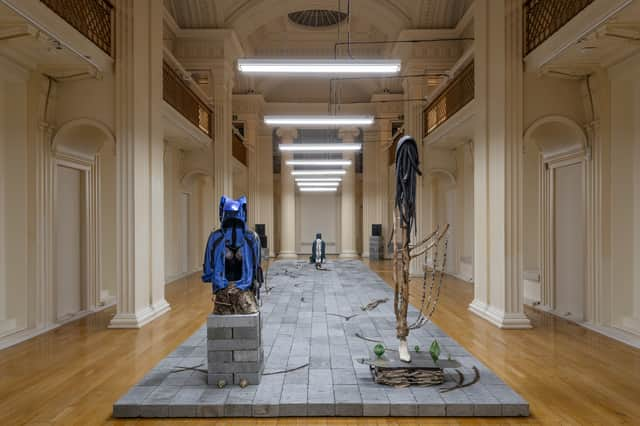
Anne Hardy’s new installation, Feelings, at the Talbot Rice Gallery, presented in association with the Edinburgh International Festival, occupies the Georgian Gallery while the other rooms are closed for refurbishment. Perhaps better known for creating large-scale staged interiors which she recorded in uncanny, evocative photographs, she is now making 3D installations for the viewer to experience directly.
At the centre of these are sculptural figures made from a cast and sculpted bronze and ceramics combined with found materials, tree branches and metal armatures. Being (Interloper) is kneeling, clothed in jeans and a hoodie, holding out her ceramic hands. She also has a scaley dragon’s tail. Being (Warrior) has a tree-trunk torso and a motorcycling helmet for a head. Being (Guardian) has Medusa-like hair made from rubber tubing and tree branches for a body.
They are powerful things; Hardy combines attention to detail with a skill at placing a small number of components to evoke a humanoid presence. These figures read like the inhabitants of a ruined future, mutants or cyborgs who are the last inhabitants of a ravished world. Being (Interloper) kneels with tiny cast objects - seedpods? pebbles? - lined up in front of her as if in a kind of ritual. They look both strong and vulnerable.
Between the figures are branches cast in bronze - Lovers consists of two branches, precisely intertwined - and earth marks on the floor, which suggest snatches of communication or traces of movement. In the balcony space upstairs, there are solar systems fashioned in bent wire and car aerials and sculptures which look like deconstructed shoes.
All of this is about transformation: a few ordinary objects which become something much greater thanks to the power of the imagination. Less successful is the attempt to make all this “immersive” (a current watch-word in contemporary art) by adding a soundscape of waves, rain and eerie bird calls, and a constantly changing lightscape activated, for no reason I can find, by weather systems in Texas.
Hardy’s sculptures show a valuable ability to balance detail and restraint. It would be worth applying the same to the show’s “immersive” elements, to weigh up what is needed to stimulate the viewer’s imagination and what is simply a distraction.
Eva Rothschild: The Void Presses The Wall runs until 11 October; Katie Paterson: Afterlife until 6 September; Anne Hardy: Feelings until 27 September
The Scotsman’s arts newsletter is now sent twice a week - subscribe today
Enjoying the Arts & Culture journalism on scotsman.com? Make it easier to find by selecting us as a preferred Google source
Want the latest Scottish headlines sent directly to your phone? Sign up to our new WhatsApp channel here
Comments
Want to join the conversation? Please or to comment on this article.