
Glasgow School of Art Degree Show 2026 review: 'clear ideas, well executed'
This year’s enormous GSA Degree show will leave you bewitched, bewildered and footsore, writes Susan Mansfield


Degree Show 2026, Glasgow School of Art ★★★★
Of all the Scottish degree shows, Glasgow School of Art is the one for which you most need a comfortable pair of shoes. About 160 Fine Art graduates are showing their work over five floors in the Stow building, and since no more than three of them field artist statements, you can expect to be bewildered at times as well as bewitched, and definitely footsore.
The work starts as soon as you arrive in the car park. Eve Giltinan Allais’s posters use the visual language of CAPTCHA sequences (“tick all images which show traffic lights”) to encourage people to use their eyes and look around them in real life. Sometimes, stand-out degree show work is like that: one clear idea, well executed.

In Note to Self, Arabella Goff has collected the digital notes people make on their phones and typed them on a manual typewriter. They paper the walls of her space, from poems to shopping lists, health tips to preparatory notes for a break-up conversation, by turns funny, poignant and confiding.
Amr Alsirawan, a Syrian artist who came to Scotland some years ago as a refugee, has built a space in which we are all invited to consider the fragmentary nature of memory and what it means to belong. Bea Arden’s installation is based on research around Bottom Bank Mill in Marsden, which was a Luddite hotspot, and includes hand-stitching, jacquard weaving and a soundtrack of Luddite songs performed by members of Glasgow University choir.
Alexander Pelouch uses painting, sculpture and installation skills to create a kind of horror cinema, but the film he presents is more thoughtful than ghoulish, exploring the idea of the monstrous and how it can be used to marginalise those seen as different.
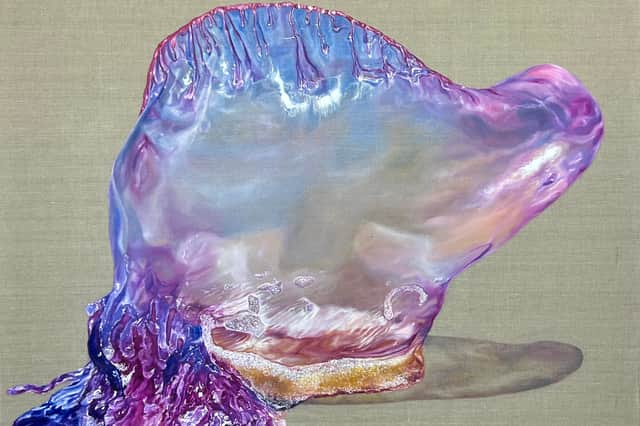
Painting is plentiful but variable. High points include Chloe Grimes-Biltis’s luminous paintings of poisonous jellyfish and Evie Robinson’s explorations of West African communities and stories, fusing figurative elements with pattern and bright colours. Connor Draycott says he pursues obsessions in his work, currently the Falkirk Triangle, once a hotspot for UFOs. Perhaps more important than the content is his evident skill at handling paint.
Sophia Kalmijn’s delicate acrylic paintings trace a journey across Spain on foot. Erin Dixon’s figurative painting is inspired by underappreciated women in folk and psychedelic rock in the 1960s. Mia Cameron and Ellie Suri are also promising figurative painters.

It’s impressive to see students who have found their own painting language and use it confidently, such as Milana Wonke, who combines mythical elements with an exploration of power, politics and surveillance. Ruth Babington’s language is colour, expressed through precise patterns of grids and circles, though there is a lovely sense of fluidity alongside the precision.
Scale is often a factor, from Ines Hügle’s huge hand-drawn frieze, Snake in a Stable, to Hannah-Sophia Guerriero, who dares to go small, making her work as much about the nature of space itself.
Several artists explore our relationship with technology. Joe Neil combines striking sculpture with a live AI-generated feed of images and patterns based on local weather data. Claire Mackenzie looks at technological paranoia in a series of accomplished works which combine digital and analogue elements.
Abbey Lindlay (if I’ve understood this right) fed the line “I’m just calling to say I love you” into X’s AI engine Grok to see what images it would generate. Finlay Highton’s drawings capturing transitory spaces are made using architectural drawing machines, balancing the automated aspects of the process against the input of the artist’s hand and brain.
It seems to be a year for kinetic sculptures at GSA. Robyn McCrae’s Coward features pairs of textile cow sculptures pulling apart, tug-of-war style, on strips of red fabric ribbon, a metaphor for much in human and political life. So too, perhaps, is Tom Reid Gomes’s machine, which sends a ping pong ball cascading down a series of wires to hit an ink pad and bounce onto a piece of paper. Ursula McIlwain’s slowly turning wooden machine catches the sand from an hour-glass in a series of wooden spoons and drops it onto the floor.

Photographer Rita Rogers is interested in the relationship between photography and power. Her body of work, Rehearsals, about simulated environments for military training, is particularly evocative. Xiyue Zhang charts three generations of women in her family across Liao Yang, China, Montreal and now Scotland in photographs while Elena Edwards created her thoughtful body of work after visiting her grandmother’s birthplace in the Seychelles.
There is plenty to enjoy here: Suzi Cooper’s colourful felt collages (for all the world like the Fuzzy Felt sets I had as a child) addressing various live social and political issues (check out the felt riot police); Dylan Hope’s sculpture exploring the notion of spying on one’s neighbours; and Jack Myles’ cut-out dioramas and Abby Rogers’ stop-motion animation are also well worth stopping for. Taba Jean Reid is not afraid to lean into the strangeness of folklore.

Annie Faichney’s film, Caol Áit (Thin Place) is a welcome immersion in the natural world. Jordan MacRae’s For the Islands I Sing uses George Mackay Brown’s voice over beautiful new 16mm footage of Orkney. Kerry MacAskall’s A Garden in Transit is rather charming, and Jasmin Robertson’s work is actually a garden, Spiral Field, which she is tending in the grounds of the Stow Building.
But, truth be told, by the time I’d reached the fifth floor and happened upon Mia McKechnie’s replica of her family sitting room at Christmas, complete with trinkets, board games and It’s A Wonderful Life on the telly, I would have been happy to take up residence on her sofa until someone kicked me out at the end of the run.
The Glasgow School of Art Degree Show 2026 runs until 7 June, with Fine Art in the Stow Building, other disciplines across the Gartnethill Campus and an online showcase at www.gsashowcase.net.
The Scotsman’s arts newsletter is now sent twice a week - subscribe today
Want the latest Scottish headlines sent directly to your phone? Sign up to our new WhatsApp channel here
Comments
Want to join the conversation? Please or to comment on this article.