
The RSA Annual Exhibition: 200 years of showcasing Scotland's best contemporary art
For two centuries, the Royal Scottish Academy’s Annual Exhibition has provided a showcase for Scotland’s best contemporary art, writes Susan Mansfield
On a chill February day in 1827, the first Annual Exhibition of the Scottish Academy (the “Royal” came a decade later) opened its doors to the public. In two rented galleries at 24 Waterloo Place, Edinburgh, the show presented 282 works by 57 artists.
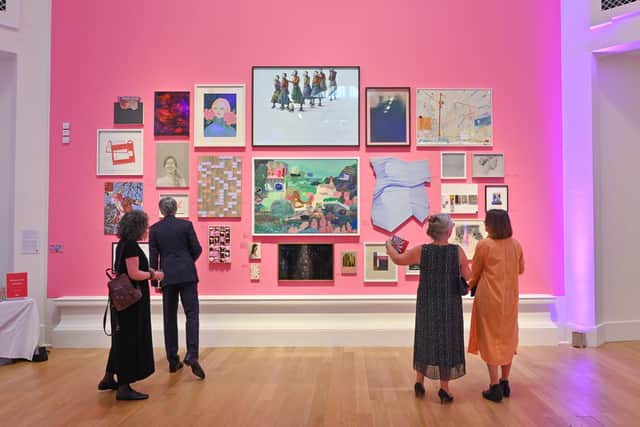

It was a radical occasion: a platform for the contemporary artists of the day to present and sell their own work. “It was very much a breath of fresh air,” says Robin Rodger, documentation officer at the RSA. “Contemporary art exhibitions were something of a novelty at the time. Holding an annual exhibition was number one in the Academy’s original four objectives because there was a perception by Scottish artists that there was no opportunity for them to exhibit their work.”
The RSA has held true to that aim for 200 years, never missing a year through various changes of venue and two world wars. Even in the Covid-19 pandemic, the Annual show continued online, and it is the largest and longest running exhibition of contemporary art in Scotland.
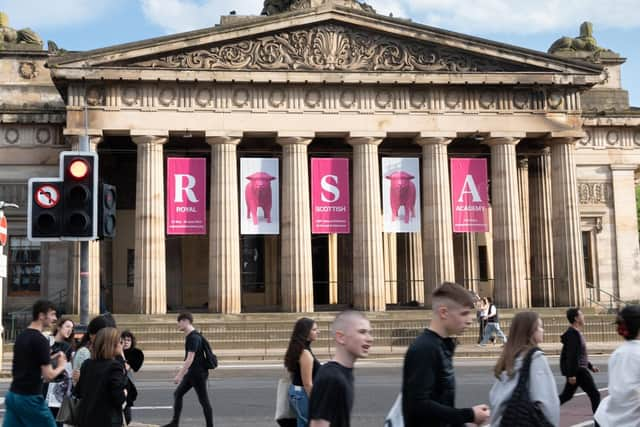
In 2026, the Annual, occupying the entire RSA building on the Mound, will be at the centre of a year of bicentenary celebrations. The convenor for art is sculptor Annie Cattrell, working with a team which includes Anne Bevan, Edward Summerton, Ilana Halperin, Helen Flockhart, Dalziel + Scullion and photographer Norman McBeath. “It will be a very busy show, undoubtedly,” she says, “physically intense, but I think everybody is up for something very exciting.”
Cattrell’s theme, In Time, connects the RSA’s bicentenary with the tercentenary of James Hutton, the “father of modern geology”. “I’m trying to make the connection between the foundation of the RSA, a celebration of those origins and artistic agency, and the foundations of rocks, the subsoil of what we build on. It’s the bedrock of something which allows everything else to happen.”
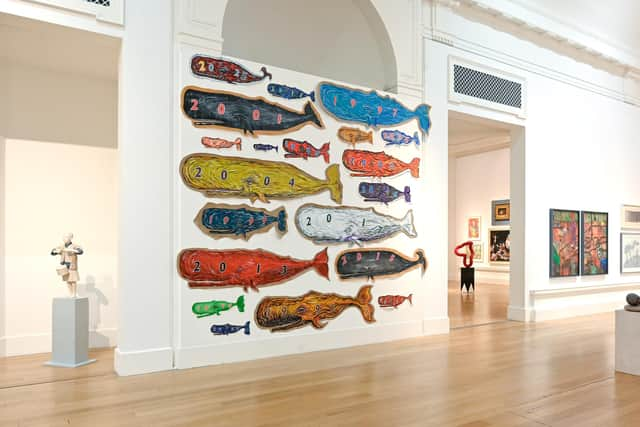
Artists responding to the theme include RSA members Wendy McMurdo, Jake Harvey, Kenny Hunter and Alison Watt, along with invited artists Martin Creed, Cathie Pilkington, Stephen Skrynka and James Geurts, while Sam Ainsley RSA will design the banners for the building’s frontage. The architecture exhibition, convened by Fergus Purdie, will invite architects to design an imagined alternative building for the RSA at another location in Scotland.
From that first show in 1827, the Annual Exhibition grew quickly. Two years later, in 1829, its profile was raised when the Academy borrowed Rubens’s painting The Adoration of the Shepherds. Found to be too big for both the doorway and the stairs at Waterloo Place, it had to be lowered in through the cupola. That show also included a painting by William Etty, who had caused controversy at the Royal Academy in London with his nudes. In conservative Edinburgh, however, it seemed to pass without incident.
In 1837 and again in the 1870s, Scottish artists whose work was rejected by the Academy staged their own exhibitions amid complaints of lack of space. In 1866, the great Romantic painter Horatio McCulloch “corrected” a work by a younger artist, George Reid, who would later bring European realist ideas to the Academy to challenge the prevailing Romanticism.
In 1891, William McTaggart, one of the most important artists of his generation and a member of the governing council, walked out, withdrawing his work from the Annual show when fellow artist David Farquharson was threatened with being struck off by the Academy after failing to submit work for the Annual for two years. In the event Farquharson did return to show at the RSA, but McTaggart never did.
In 1914, the show made headlines when suffragette Maud Edwards attacked Sir John Lavery’s portrait of King George V with an axe, and was arrested.
In the 1960s, while students at Edinburgh College of Art, Alexander (Sandy) Moffat and John Bellany staged exhibitions of their large-scale figurative paintings on the railings next to the RSA building, challenging an art establishment which Moffat later described as having “an overall atmosphere of timorous respectability”. Later, however, both were admitted to membership.
“In many ways, the Academy might have been slightly slower as a body to embrace contemporary developments, although individual members did do so in their work,” Robin Rodger says. While it took until 1944 for the RSA to admit its first woman Academician, Phyllis Mary Bone, and until 2018 to elect a woman President, Joyce Cairns, he points out that the open exhibition was open to men and women from day one, and Miss Patrickson, who ran a painting school in Edinburgh, was among the first exhibitors in 1827.
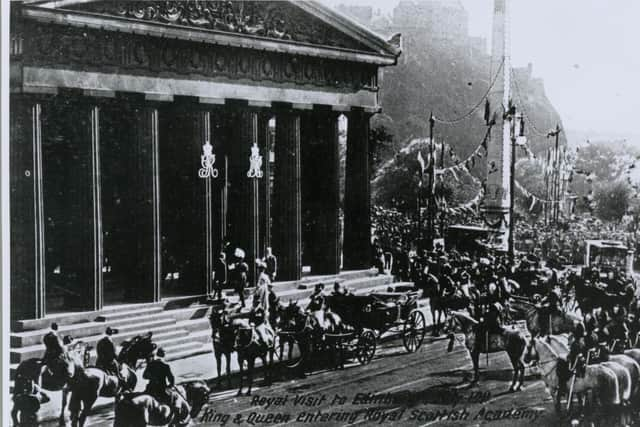
A rare early photograph of the Annual show from 1860 shows the paintings hung salon-style, floor to ceiling. Robin Rodger says: “A couple of days before the opening, the President and Council would come round, look at the exhibition and make changes. Invariably, you’d get people whose noses were out of joint. The council minutes record members sending letters of objection to having their work moved from what they perceived to be a prestigious position.”

Until the pandemic, the selection of work for the Annual took place with the works being paraded one by one in front of a selection panel who voted on their inclusion. The Varnishing Day Lunch just before opening is another tradition which continues, although no one has “varnished” for decades, often concluding with a song by a musically talented member.
Most importantly, the Annual Exhibition does what it set out to do 200 years ago: it provides opportunities for artists to show their work. Will Maclean became an associate member while still a young art teacher and says it was invaluable: “If you were an associate, your work was accepted automatically, so from early on I knew I would have the opportunity to have work shown and I could work towards that.”
He also got involved, early on, in the selection and hanging committees for the Annual. “You sat on the selection panel and the work came past and you voted on it – that was a learning experience for a young associate. To begin with you were a gopher, a tea boy. I worked with older members, people like Robin Philipson, John Houston, Elizabeth Blackadder, I learned so much from them. Much later, I had a shot at being convenor, always a big challenge, quite an experience.”
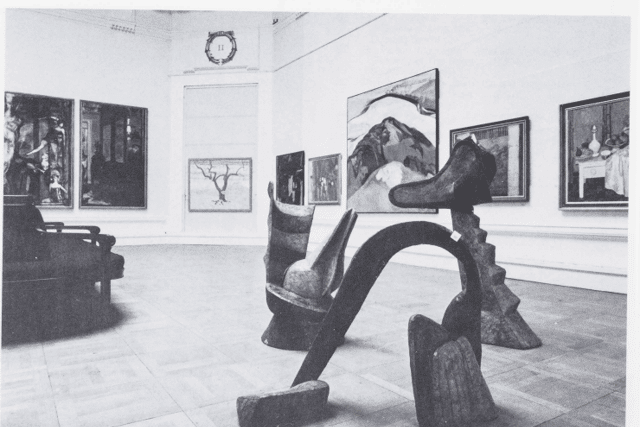
Annie Cattrell remembers having her work selected for the Annual Exhibition while still a student in the 1980s. “There was quite a gap in those days between finishing college and getting a first solo show, so it gave these opportunities and this visibility to us all, and a chance to meet people from other colleges and find out what they were making work about.
“Now, with the complexity of public funding for artists, the RSA is actually one of the main funders of opportunities. It’s a community of people who have a common belief system in agency for artists, a creative institution that embraces people’s carrying on as artists and fulfilling their ideas. Scotland is a small landmass but, my goodness, doesn’t it punch above its weight?”
The 200th Annual Exhibition of the Royal Scottish Academy is at the RSA, Edinburgh, from 9 May until 14 June. This feature was produced in association with the RSA
The Scotsman’s arts newsletter is now sent twice a week - subscribe today
Want the latest Scottish headlines sent directly to your phone? Sign up to our new WhatsApp channel here
Comments
Want to join the conversation? Please or to comment on this article.