
Turner Prize-winner's Glasgow 2026 work an invitation to 'look again' at the Clyde


With ‘Superstructure’, Jasleen Kaur looks looks at how different layers of Glasgow’s history intersect, writes Katie Nicoll
As part of Glasgow 2026 Festival - the ten-week, city-wide celebration of culture, creativity and communities running alongside the Commonwealth Games - the festival team and I have been working with Turner Prize-winning artist Jasleen Kaur, a major international voice with deep roots in Glasgow, to develop a new commission responding to the River Clyde and its layered histories.
From the outset, the ambition has been to create something embedded in the everyday life of the city - work that is encountered rather than announced, and that reveals itself over time. Jasleen’s proposal, Superstructure, reflects her distinctive approach to sculpture, language and public space, taking shape as both a subtle intervention and an invitation to look again at a stretch of river many people pass through daily.
Installed along the north bank of the Clyde between Tradeston and the Kingston Bridge, Superstructure exists as eight sculptural forms that operate like weathervanes or wayfinders. Each carries a fragment of text that shifts in the wind, continually reorienting across the city. Meaning is never fixed; Jasleen’s phrases briefly align with buildings or sightlines before drifting apart again, opening up new and unexpected associations.

Movement, which is a recurring thread in Jasleen’s work, is central here - of language, of people, and of the city itself. The sculptures resist stillness, reflecting her interest in how space is continually shaped through use, memory and encounter. This responsiveness is both conceptual and material, shaping how the work sits lightly within its surroundings.
The Clyde is at the heart of Jasleen’s enquiry. It is, all at once, a scenic route, a site of leisure, a way to move through the city during the Games, and a powerful marker of Glasgow’s industrial and maritime past. Through this commission, she traces how these layers intersect - from shipbuilding and global trade to the legal and financial systems that enabled them, and how that continues to shape the city today.
The title Superstructure reflects this dual focus, a term Jasleen draws on to point both to the physical forms along the river and to the wider political, cultural and ideological systems that underpin them. In her framing, the Clyde becomes more than a geographical feature: it is a space shaped by labour, migration and empire. Histories that remain embedded in how the city is organised and experienced.
Research has been integral to the work’s development. Jasleen has drawn on ongoing conversations with Louise Welsh and Jude Barber, particularly their Who Owns the Clyde project, which charts the river’s shift from a shared natural resource to an economic asset during the Industrial Revolution. She carries these questions of ownership, access and value through into the sculptural text.
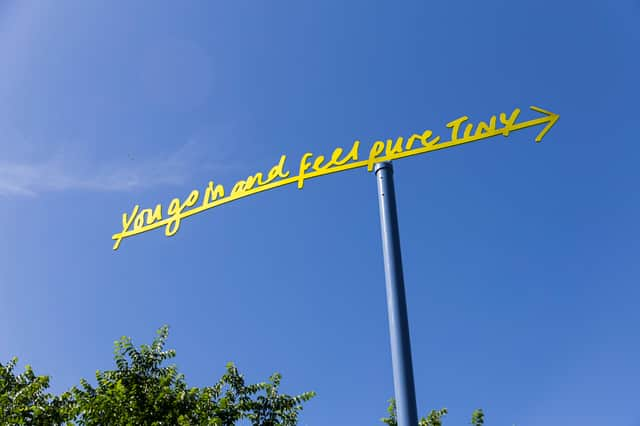
The phrases - including “I WAS HERE B4U” and “THIS SHOULD BE PUBLIC” - are characteristically direct and fragmentary, echoing Jasleen’s interest in everyday language. Positioned within the riverscape, they act as interruptions, prompting reflection on who the city belongs to, who it has been built for, and who has the right to claim space within it.
The work is also informed by Jasleen’s engagement with the writing of geographer Doreen Massey, whose ideas of space as relational and dynamic resonate strongly here. In this framing, the Clyde is not a fixed line but a convergence of stories, movements and lived experience.
At the same time, Superstructure sits gently within the existing rhythms of the river, something Jasleen was keen to hold onto. It can be encountered on foot or by bike, revealing different aspects over repeated visits rather than demanding immediate attention. The materials reflect this sensitivity: aggregate bases that echo the pavement, and galvanised, powder-coated aluminium that allows the text elements to move easily with the wind.

Glasgow 2026 Festival creates opportunities for artists like Jasleen to respond to the city at a moment of international focus, while inviting Glasgow’s communities and visitors to gather. While the Commonwealth Games bring global attention, the festival is rooted in its local context, foregrounding the histories and lived experiences that shape the city.
READ MORE: Glasgow International reviews: David Wojnarowicz | I Only Have Apple Juice | Bettina Grossman & more
In commissioning Superstructure, we were particularly interested in how Jasleen’s practice could connect larger narratives of industry, empire and infrastructure with the quieter, more personal experience of moving through Glasgow.
Ultimately, the work is intended to become part of the city - something people live alongside and interpret over time. In line with Jasleen’s approach, it resists fixed conclusions, instead creating space to pause, to notice, and to reflect on how we come to occupy the places we pass through every day.
Katie Nicoll is Senior Events Producer at Glasgow 2026
The Scotsman’s arts newsletter is now sent twice a week - subscribe today
Want the latest Scottish headlines sent directly to your phone? Sign up to our new WhatsApp channel here
Comments
Want to join the conversation? Please or to comment on this article.