
Venice Biennale: Why Scotland's return to world's biggest art festival matters
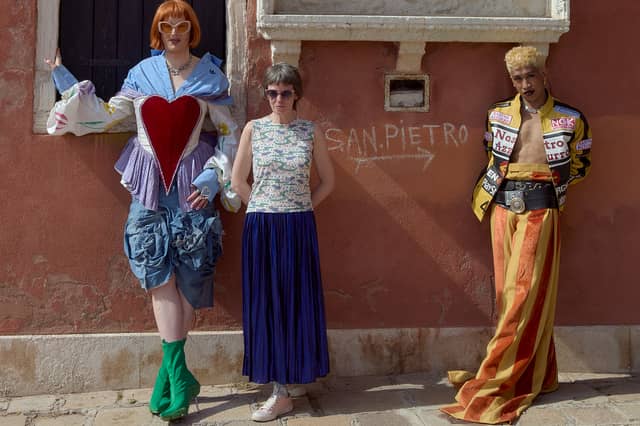

The work created by Bugarin + Castle for this year’s Venice Biennale asks important questions about who is heard and who is silenced, writes Emma Nicolson
Venice does something to you. I have been there many times, in many different contexts, and it never fails to surprise. No cars, just narrow streets and water, and a feeling of having stepped slightly outside ordinary time. Every two years, that quality makes it the perfect place to encounter art that challenges how you see the world. The Biennale is not just an exhibition. It is one of the most concentrated moments of international exchange anywhere on the planet, drawing close to 700,000 visitors across its six-month run, and for any nation to have a presence there is to be part of a conversation that matters.
In 2026, Scotland returns to that conversation. And I think the timing could not feel more important; for the artistic community, for visitors to Venice and to those we are working with in Scotland to bring the project together.
Scotland + Venice has, since 2003, ensured that artists working here have a real and visible presence on one of the world's most significant cultural stages. Following a pause for review, it returns now with a renewed commitment through to 2030, backed by strong support from across Scotland's arts sector. People here understand what is at stake in showing up, and what is lost when you don't. I have been closely involved in bringing this year's project to life, and I believe that what we are presenting is among the most ambitious and resonant work Scotland has sent to Venice.
This year's Biennale is curated by Koyo Kouoh, a Swiss Cameroonian curator of extraordinary vision, founding artistic director of the Raw Material Company in Dakar, and most recently executive director of the Zeitz Museum of Contemporary Art Africa in Cape Town. She was the first African woman to head the Venice Biennale. She died suddenly in May 2025, aged 57, during the process of bringing it to life, and the exhibition opens this year as a posthumous realisation of her vision. That loss is felt deeply across the international arts world.
The title she chose, In Minor Keys, is an invitation to listen differently, to attend to quieter, layered narratives shaped by histories that have too often been overlooked. That her collaborators have honoured and realised that vision gives the exhibition a particular and profound weight. It is a framework that feels right for what Scotland is bringing to the table.

The artists representing Scotland as a collateral event are Davide Bugarin and Angel Cohen Castle, both graduates of Scottish universities, whose work moves across sculpture, performance, sound and costume, drawing on both Scottish and Filipino histories. I have followed their practice with growing admiration, and what they have made for Venice is unlike anything Scotland has previously presented. Their new commission, Shame Parade, grew out of a sound-mapping project in Manila North Cemetery, a place where the daytime fills with voices, traffic and karaoke, and nights fall into a deep, particular quiet. It was there that the artists encountered something unexpected: the word charivari, embedded in Philippine sound restriction legislation. The same term, with the same rough roots, that once described the collective noise used across medieval Europe to publicly shame those who defied social norms, pots and pans, improvised instruments, a communal racket that enforced conformity as much as it expressed dissent. That this legal and sonic thread connects medieval Scotland with contemporary Manila is the kind of discovery that only comes from genuine, sustained research. And it is exactly the kind of connection that art can make visible.
In Bugarin and Castle’s work, sound becomes a way of thinking about power, about who is heard, who is silenced, and how voice can be both controlled and reclaimed across centuries and continents. That is not a small idea. And right now, it feels like a necessary one.
What is easy to miss, from the outside, is the scale of what making this kind of work involves. A recent film shoot at Stirling Castle brought together performers, crew, costume and make-up artists, musicians, stunt doubles and stunt horses, the latter filmed on the mainland rather than the Isle of Bute where the production is based, since stunt horses, it turns out, cannot be insured on islands. And that is before you consider the early career artists and curators travelling to Venice through the project's professional development programme. Scotland + Venice is not just an exhibition. It is also a meaningful opportunity for a wide range of people, at many different points in their careers. We are also working with a Professional Development Cohort who are custodians of the work; coming from universities and colleges across the country. They will bring back their experience to their roles and their communities in Scotland too, from Bute to the Highlands as well as the central belt.
We are living through a genuinely uncertain time, shaped by conflict, economic fragility and environmental anxiety, in a world where divisions are hardening and honest conversation feels increasingly difficult. In that context, art is not decoration and it is not escapism. It creates a space where we can sit with complexity rather than flee from it, where difficult histories can be examined without being weaponised. Bugarin and Castle's work does exactly that. Identity here is not a fixed label. It is lived experience, shaped by history, by geography, by who holds power and who does not.

Part of what makes this project distinctive is where it has taken root. Developed in partnership with Mount Stuart on the Isle of Bute, it is a reminder that some of the most ambitious artistic practice in Scotland can come from outside its cities, with the time, space and institutional support to do so.
The work will return to Scotland after Venice and tour, ensuring that audiences at home can encounter it too. It will open at Mount Stuart in summer 2027 so yet more people can engage.
At a time when international connections can feel increasingly fragile, cultural exchange is not a luxury. It is how we stay curious about the world, how we push back against the narrowing of perspective that fear and division tend to produce. For more than 20 years, Scotland + Venice has made sure that artists working here are part of that wider conversation.
Its return now in 2026 is good news and we are beginning to plan for our 2028 edition, a call out will be shared soon. And it is a reminder that compelling ideas don't always come from the places with the loudest voices. Sometimes they begin on an island. And from there, they travel.
Emma Nicolson is Head of Visual Arts at Creative Scotland
The Scotsman’s arts newsletter is now sent twice a week - subscribe today
Want the latest Scottish headlines sent directly to your phone? Sign up to our new WhatsApp channel here
Comments
Want to join the conversation? Please or to comment on this article.