
Victoria Crowe at 80: 'For me, art has always been a way of trying to understand life'
With two major exhibitions marking her 80th birthday at this year’s Edinburgh Art Festival, Victoria Crowe talks to Susan Mansfield about how her work has evolved during her long and successful career
“I’ve been thinking about the whole idea of what you do at 80,” says Victoria Crowe. We are sitting in her kitchen a couple of weeks before the opening of Victoria Crowe at 80: Decades at the Scottish Gallery, and Shifting Surfaces, the parallel exhibition of tapestries inspired by her work at Dovecot Studios. “What you do at 80 is almost the same as what you do at 20, but with a huge gap of experience in between.”
In this gap, Crowe has become one of Scotland’s - and the UK’s - most acclaimed painters. And because artists don’t really do retirement, the Scottish Gallery show is made up largely of new work, following a decision to revisit the Pentlands landscapes she was drawn to when she first moved to Scotland in the late 1960s.
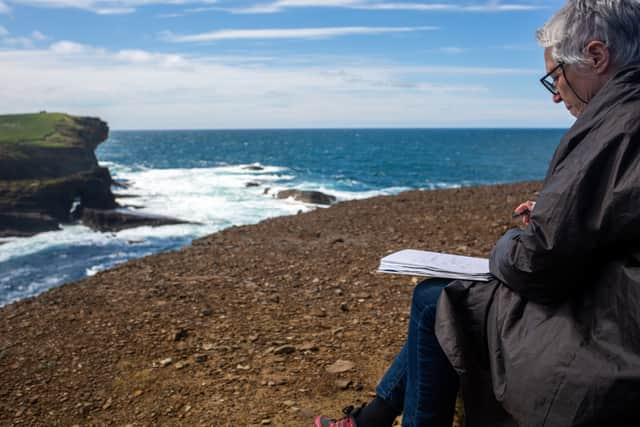

“I had a sketchbook from 1969 and thought it would be interesting to go back to these early things, to look at who I was then, who I am now. It was half exciting and half in trepidation because you’ve always got that fear that your best work is your early work and nothing has happened since!” She laughs softly.
Crowe was 23, newly graduated from the Royal College of Art, when she and her husband Michael Walton moved north to take up teaching jobs at Edinburgh College of Art. They settled in the hamlet of Kittleyknowe near Silverburn, 1,000 feet up on the edge of Pentlands. Having grown up in Kingston upon Thames, she had never seen landscapes like these.
“I can remember standing in the freezing cold waiting for the early bus to Edinburgh. The moon was still in the sky, the hills were right behind me and there were all these incredible patterns, it was such a powerful experience. These things become part of your inner resource that you reflect on.”
She was, and still is, fascinated by the patterns of snow melt on the hills: landscape as abstraction. She would have liked to be an abstract artist, she says, and the new work is more abstract, while still being richly descriptive. Works like Higher Reaches and Thaw, Traces, Distance probe at the edges of the visible, the ungraspable point at which hill becomes sky.
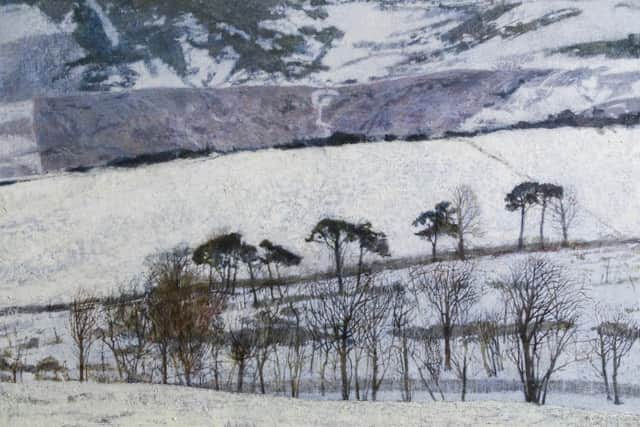
There’s a sense in which Crowe’s paintings are always about what is beyond sight. Her shimmering snowscapes and firey sunset trees are never illustrative, they are always about something more, portals into a realm of ideas, feelings, memories. She has relished the chance to paint portraits because of the opportunities to discuss ideas with her subjects, people like psychoanalyst RD Laing, physicist Peter Higgs, medical scientist Janet Vaughan, who was part of the first medical team into Belsen. There is a rigorous, questing intellect in her work, a drive to understand some of life’s biggest questions.
It was her interest in liminal spaces which took her to Orkney in 2022, on a residency supported by the RSA and the Pier Arts Centre. “I’d heard about the white nights of the northern summer. I really wanted to experience that because, when landscape is at the end of the day, in the twilight, in a liminal state, it’s incredibly powerful.
“At first, I thought, what am I doing here? I can’t paint clouds! But I was making notes in my sketchbook, and I’d written down ‘they’re like great snowfields in the sky, illuminated from within’. Suddenly, I knew how I could paint them - it was like losing yourself in a landscape. In one way or another, I’ve been painting about [Orkney] ever since.”
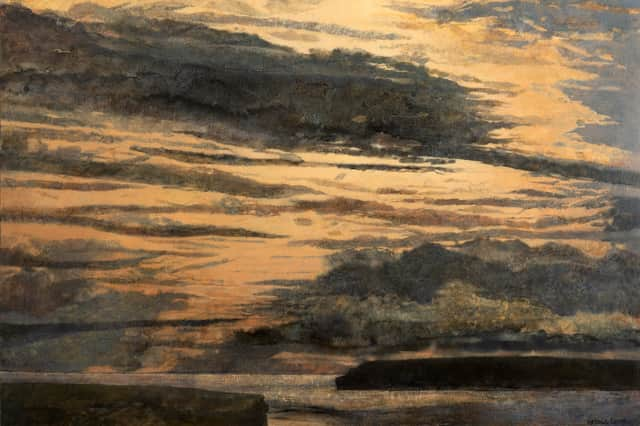
She was delighted when she had the opportunity to work with weavers at Dovecot Studies to create two large tufted rugs based on her Orkney skyscapes. “I found the only way I could get the luminosity was to paint in an almost pointillist way so they had to be small, but I thought it would be wonderful to see them on a bigger scale. It was like recreating the splendour of the night sky.”
There is also a group of paintings in the Scottish Gallery show gathered from the past six decades: early landscapes from Kittleyknowe, and later work from Italy, and Venice, where she kept a studio for nearly 20 years. There are also two paintings from her series A Shepherd’s Life, done in the 1980s, about her neighbour, shepherdess Jenny Armstrong, which was shown at National Galleries Scotland: Portrait in 2000.
“It’s almost like looking back at your life,” she says, thoughtfully. “I think life evolves and changes, and the work has evolved and changed. I do feel a sense of a journey travelled, and that is quite a satisfying thing. I always find it hard when people say: ‘Have you got any more paintings about the shepherdess?’ and I’m thinking: ‘No! Come on now, guys, that was 40-odd years ago, I’m a different person now!’”
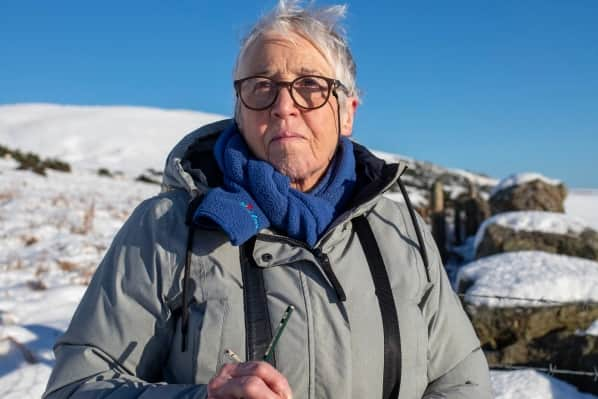
Also included are paintings of her daughter Gemma and son Ben, who died in 1995 aged 22 from a rare form of mouth cancer. “These things all feed into your life and they all affect your work,” she says. A bright portrait of Ben at 19, leaving for university, is echoed in another painting three years later, the same profile fading into shadow next to a vivid moon.
“Art and drawing have always been, for me, a way of trying to understand life. There have been so many issues that I can deal with through painting that I can’t necessarily deal with through close friendships or whatever else. Art is the method of communicating both to myself and other people.”
The paintings from this time often include objects, sometimes photographs or fragments of other paintings, powerfully infused with meaning, whether or not the specific resonances are known to the viewer. However, in her most recent work, the objects have gone. “It’s odd, because I don’t find the need to put then in now. It’s more about sensation, experience, reflection. I think you can still speak about the condition of being alive in this world with any references [to people].”
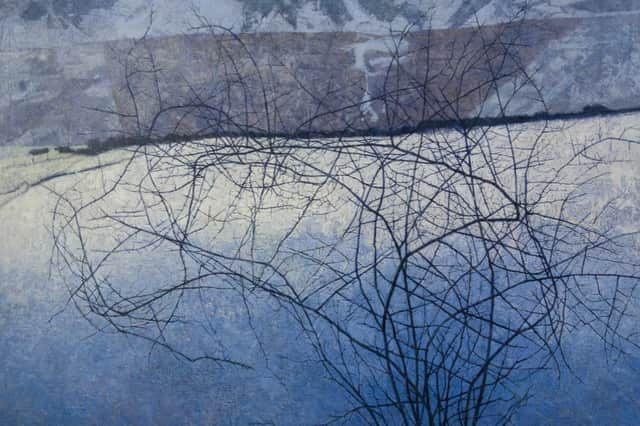
Crowe’s work is often described as beautiful, and rightly so. But it’s possible to be distracted by beauty, and not pick up on the darker references - which are most certainly there - to grief, war, climate change.
“I think it’s an interesting dichotomy that runs through a lot of the stuff I do. You can look at those pale trees, for instance, and the truth is they’re still there and they’re still beautiful, but the terrible truth also is that there is always destruction going on. Beauty is nothing to do with nice or gentle feelings, it’s deeply important for the human condition. Art can be very, very political, whether it’s promoting quiet reflection or angst and sarcasm and humour. It’s all part of the same function.”
Collaborative projects, such as Winterreise: A Parallel Journey, in which opera singer Matthew Rose sang Schubert’s song cycle accompanied by a film made from images from Crowe’s paintings, have helped her understand her work in new ways. “It gave me the chance to look at the subtext of my own paintings,” she says. “It was almost like guiding people through a much bigger vision. I think if I went to art college now I’d want to do something like film or video, something to expand the images.”
What drives her on is “curiosity”. “I want to do more with music and with poetry, more with extending the idea of what painting can be about for me.” So what you do at 80 is, indeed, a lot like what you do at 20, because the big unanswered questions remain, but there are always new ways of trying to understand them.
Victoria Crowe at 80: Decades, is at the Scottish Gallery, Edinburgh, from 31 July until 30 August; Victoria Crowe: Shifting Surfaces, is at Dovecot Studios, Edinburgh, from 28 July until 11 October, both as part of the Edinburgh Art Festival, see www.edinburghartfestival.com Feature produced in association with The Scottish Gallery
Comments
Want to join the conversation? Please or to comment on this article.