
Book of gender critical essays pulled from National Library display after staff complaints

The book was not included in the Dear Library exhibition
A book of gender critical essays was not selected for inclusion in a display of literature chosen by the public to mark the National Library of Scotland’s centenary following complaints from library staff.
The Women Who Wouldn’t Wheesht, which opposes former first minister Nicola Sturgeon's gender self-ID law, is understood to have received four nominations in a public vote.
However, it was not put on show as part of the venue’s Dear Library exhibition after being deemed by the library's staff LGBT network to have "significant risks to the library's relationships with authors and other stakeholders" due to the "heightened sensitivity and potential for division" following the Supreme Court judgement over gender recognition.
The concerns were raised in a paper written by national librarian Amina Shah.
In April, a UK Supreme court ruling stated “woman” and “sex” in the Equality Act 2010 refers to biological sex.
The book, co-edited by Scotsman columnist Susan Dalgety, includes more than 30 essays from authors including JK Rowling, former MP Joanna Cherry, MSP Ash Regan, and former prison governor Rhona Hotchkiss and charts a five-year campaign to protect the "sex-based rights" of women in Scotland.
The library marked its centenary year this summer with a new exhibition launching next week dedicated to the importance of libraries. Billed as a “love letter to libraries”, Dear Library features the favourite books of celebrities, including Ian Rankin, Pat Nevin, Val McDermid and Alan Cumming, as well as books nominated by the public that had “shaped their lives”.
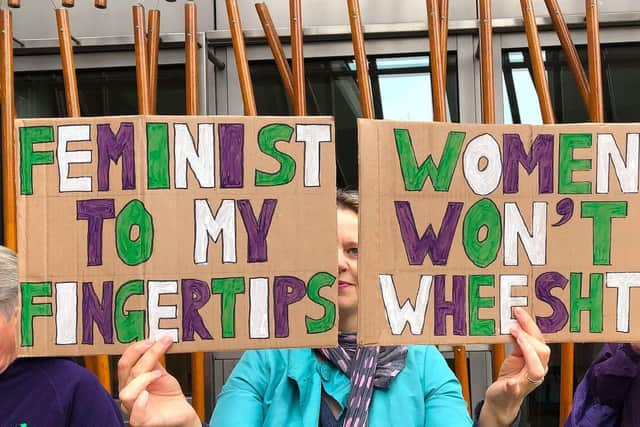

Ms Dalgety and co-author Lucy Hunter Blackburn said in a letter to Ms Shah that they understood their book was one of the “most nominated”, yet had not been selected for display following an "equality impact assessment”. They said they had obtained this information through a Freedom of Information request.
They warned the decision not to include the book was “a betrayal of the principles which are core to your role and the place of the Library in our nation's cultural and intellectual life”.
A total of 523 individual titles were submitted by the public and 200 were selected for display.
The editors wrote in the letter to Ms Shah: “The material disclosed makes clear that you, and some of your senior colleagues, allowed activists on your staff to characterise the very existence of the book as harmful, hateful and akin to racism and homophobia. By conceding to this internal lobbying, not only have you allowed this defamatory misrepresentation to go unchallenged, but you have in effect endorsed it.
“Surely, the role of the National Librarian is to ensure the Library is a place where ideas, debate and discussion take place. Yet rather than treat this book as a book, you have allowed it to be treated as a dangerous object, not safe for public display in Scotland's national library.”
They added: “It is clear from the papers released that the library has discriminated against this book purely for the position it takes on questions of sex and gender identity, a position now confirmed to be in line with the Equality Act 2010.”
Ms Dalgety and Ms Hunter Blackburn called for Ms Shah and chair of the Library, Sir Drummond Bone, to meet them and explain “why our book was deemed too harmful to the Library to be treated like any other”.
The editors also referred to an “internal minute from the LGBT staff network” which talks about "the group behind" the book being "explicitly exclusionary", but claimed books offering the opposing viewpoint were allowed to be part of the exhibition.
They wrote: “You felt unable to stand up to these threats from some of your staff, who also invoked the risk of further disruption from external activists, other parts of the local literary establishment and possibly your funders. In response, you sacrificed our book, and your principles.
“This act of cowardice removed from your exhibition the voice of one of the first two women of colour to be elected to the Scottish Parliament since 1999. It has treated the voices of women victims of male violence, already frozen out by the political process, as too shameful to share.
“These are women who have changed the course of politics not just in Scotland but in the UK, and who spoke up for many who felt less able to do so. All these women have been smeared and their words excluded from the exhibition by your decision.”
A spokeswoman for the National Library of Scotland said: “Anyone can visit our reading rooms and access this book as well as the 200 other titles that were not selected for display. A full list of those publications is available as part of the exhibition.
“Libraries are vital places where people can access all kinds of publications for free, and form their own opinions.”
She added that the decision had been taken not because of "the content of the book itself or the views expressed".
A Scottish Government spokesperson said: “While ministers have no role in booking or curation decisions taken by individual venues or institutions, the Scottish Government supports individuals’ rights to freedom of expression and we are clear that there is no place for any form of discrimination in Scotland.”
Comments
Want to join the conversation? Please or to comment on this article.