
Borders Book Festival review: 'Moffat's last festival also his finest'
From Pam Ayres rolling back the decades with her comic poems to politicians and diplomats weighing in on defence policy, this was an outstanding last Borders Book Festival from outgoing director Alaistair Moffat, writes David Robinson


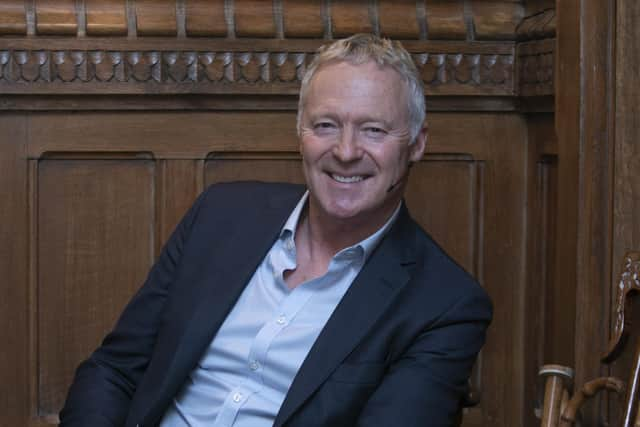
By now, hangovers permitting, Alistair Moffat and his hard-working team at the Borders Book Festival may be looking back at this year’s festival and working out what worked and what didn’t on his 23rd and final festival as director. Let’s start with the positives. This is a festival that opened with a former prime minister. There have been a lot of those recently, and as Rory Bremner pointed out in a scintillating set on Saturday night, seven of them in ten years makes it particularly hard to answer that one question you’re usually asked if you turn up at hospital with a head injury.
But as well as Gordon Brown, the festival opened on Thursday with all five shortlisted authors for the biggest literary prize in Scotland talking about their novels. The Walter Scott Prize for historical fiction needed the support of the Duke of Buccleuch and his late wife to get off the ground in 2010 but it was something else that started in Moffat’s brain.
“We’ve got to have a festival in the Borders,” Moffat said back in 2004 when it all began in the 90-seat Wynd Theatre, “because this is the home of the bestseller”. Indeed it is: as Walter Scott’s great-great-great-great-grandson Matthew Maxwell Scott, chairing the event, pointed out, in 1814/15 his ancestor sold more novels than everyone else in the UK put together. This year’s £25,000 prize was won by Alice Jolly for The Matchstick Girl. It would, she said, be transformative: she had had to crowdfund four of her previous books.
Stuart Maconie has been a Beatles fan ever since he was four, when his mother took him to see them at the ABC in Wigan. My favourite of his stories was about George Harrison’s two weeks visiting relatives in Illinois in 1963 where, although famous in the UK, he was still unknown. He loved everything about the US, and his relatives got him to play along with a local band who were really impressed and wanted him to stay. Maconie pitched the idea of a programme about Harrison’s fortnight as an unknown Beatle in America to Radio 4, but – absurdly – they turned it down.
The news that we only have 8,000 drones compared to the 15 million Russia can produce a year would have come as no surprise to Penny Mordaunt (herself a former Defence Secretary, even if for only 83 days) and Peter Ricketts, formerly Britain’s top diplomat and the UK’s first national security adviser. Although both were originally down to talk about different subjects (tradition in Mordaunt’s case, the Second World War Foreign Office in Ricketts’s), in Q&As both were insistent about the urgent need to boost defence spending.
Given his past jobs (which include being a former UK ambassador to France), Ricketts was surprisingly forthright, warning that the US is no longer a reliable ally and that a National Rally triumph in next year’s French presidential race could stymie any prospect of the UK moving closer to the EU. As Mordaunt pointed out, coming 31st out of 32 in fulfilling our pledges to Nato isn’t a good look. “If we don’t believe in our defensive alliances, our enemy won’t either.”
Before Saturday’s outstanding event with Tim Willasey-Wilsey, I had never heard of Baron William de Ropp, MI6’s secret agent right at the heart of the Nazi Party. Thanks to him, we knew not only the details of what would become Operation Barbarossa years before Hitler attacked the Soviet Union but that the engines powering the Luftwaffe would be no match for those in the Spitfire or Hurricane. No less intriguing is the astonishingly true story Alexander McCall Smith told about the dwarf Cossack valet gifted by Stalin to our ambassador in Moscow, and taken with him to his new job in Washington DC where the valet fell foul of Guy Burgess and was sent back to the Isle of Bute to work as a driver.
And the negatives? I couldn’t find any. Challenging topics, political insight, fascinating stories, packed tents rocking with laughter (Pam Ayres rolling back the decades with her comic poems was a treat, while Bremner – invariably a highlight – was never better): Alistair Moffat’s last Borders Book Festival as director was also his finest.
The Scotsman’s arts newsletter is now sent twice a week - subscribe today
Want the latest Scottish headlines sent directly to your phone? Sign up to our new WhatsApp channel here
Comments
Want to join the conversation? Please or to comment on this article.