
Drifting North, by Dominic Hinde review: 'pulls no punches'
Exploring Scotland’s relationship with energy, Drifting North is an illuminating read if not always a cheerful one, writes Susan Mansfield
In 2019, journalist and sociologist Dominic Hinde was living in Berlin and writing a book about climate change when he had a cycling accident which left him with debilitating brain trauma. When he returned to work three years later, now at the University of Glasgow, the book idea had been overtaken by events, but another was starting to form. Advised by doctors to limit foreign travel, he decided on a long hard look at Scotland.

One could make a case, after all, for this country as the birthplace of the modern world’s love affair with fossil fuels. Scotland is the home of one of the earliest large-scale coalfields, of James Watt and the steam engine, Adam Smith and the founding of market capitalism. Not long ago, Aberdeen was the oil capital of Europe. As he puts it: “Scotland is where it began, and maybe where it ends too. We helped to build the world of carbon capitalism and now we have to unbuild it.”
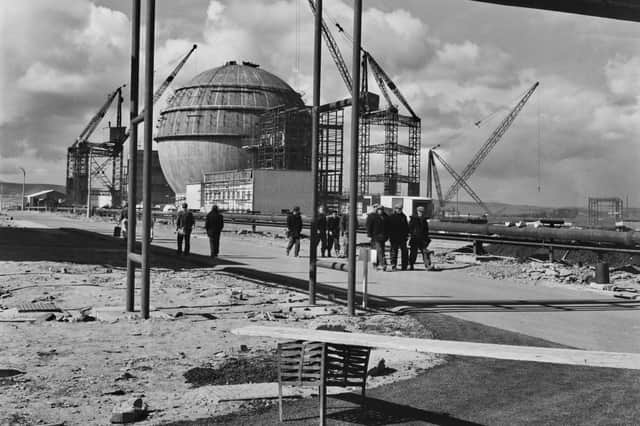
Over a period of more than two years, Hinde zig-zagged across the country in his elderly Honda, from Dounreay - touted in the 1950s as the herald of a bright new energy future - to the coal belt of North Lanarkshire, from Aberdeen to Benbecula, low-lying and already vulnerable to rising sea levels. The book is part conversational travelogue, part chronicle of his ongoing battle with illness. It’s also a frank summarising of our ambivalent relationship with energy, past, present and (perhaps) future.
His old-fashioned shoe-leather approach is welcome; he meets crofters, roughnecks, scientists and activists (though, strangely, he never gives surnames, even when they are academic authorities or elected politicians). Perceptive first-hand observations make the stories come alive, even if he doesn’t always succeed in accessing key sites; most associated with the oil industry keep their doors firmly closed, and this in itself is interesting.
Hinde pulls no punches with his conclusions, whether he’s talking about climate change predictions (the likelihood of breaking through the two-degree barrier on global warming) or the possibility of a resulting half-metre sea-level rise inside 80 years. He’s equally frank on the ways in which many parts of Scotland have not recovered from post-industrial malaise. He adds that this is, in part, due to the country’s failure to capitalise Norway-style on its connection to oil, letting the wealth flow out into private hands.
Those working for regeneration might find this picture somewhat harsh, and I don’t entirely recognise his description of Glasgow, which seems to owe much to the 1980s, when bleakness and deprivation made it the ideal backdrop for French director Bernard Tavernier’s dystopian drama, Death Watch. But it’s true that the once ubiquitous slogan “the best small country in the world” has been quietly dropped.
Hinde recalls an assignment he had as a young journalist to report on a speech by Barack Obama in Berlin when, as a presidential candidate, he promised action on climate change to a cheering crowd. The point is that the climate crisis has moved on, but so has our attitude to it. The problems feel much less solvable today.
For all that, there are some positives. Orkney is pioneering offshore wind power, and exploring hydrogen-sourced energy. Disused hulks of oil rigs in the North Sea are turning out to be ideal bases for offshore wind farms. In fact - Hinde tells us this almost in passing - Scotland currently produces more electricity than it can use. But there are caveats, chief among them the obvious (when you think about it) fact that renewables simply do not create the same numbers of jobs as coal or oil. The link between energy solutions and economic regeneration is not straightforward.
Drifting North is an illuminating read, if not always a cheerful one. It needs the movement of the narrative - the fact that we know we’ll soon be back in the Honda and on to another story - to lift the mood in what is often a dark reflection on our past and present, and to keep alive a vestige of hope for the future.
Drifting North, by Dominic Hinde, Manchester University Press, £20
The Scotsman’s arts newsletter is now sent twice a week - subscribe today
Want the latest Scottish headlines sent directly to your phone? Sign up to our new WhatsApp channel here.
Comments
Want to join the conversation? Please or to comment on this article.