
Hollie McNish on teens, taboos and mining poetry from the facts of life


Holly McNish tells Fiona Shepherd about using her poetry to bring difficult subjects into the light
Hollie McNish takes requests. “I’ve had so many people at gigs asking ‘Have you written anything about peri-menopause or are you waiting for your menopause?’’’ she says brightly. “There’s quite a lot of people waiting for those poems so I’m hoping that it starts soon.”
Careful what you wish for, McNish. “I’ve never felt so much pressure to be a bit older or start a process,” she admits. “To be honest, I am dreading it but I’m glad people are talking about it more.”
All joking/dread aside, the Reading-born, Cambridge-based McNish is a notoriously open poet, rightly popular for her ability to capture the everyday, however light or dark, in relatable language. Asked what inspires her, she replies “Everything. It’s like an obsession and it’s been like that since I was a teenager. I don’t know why though. I don’t think ‘I want to write a poem about that.’ I just start writing a poem in my head and get really excited.”
Few subjects, it seems, are off limits, from menstruation to motherhood, onanism to oral sex. McNish once wrote a poem about orgasm inequality to be filmed for Durex. “They wanted me to sit on a bed and read the poem,” she says. “Fair enough, but it was a single bed which immediately makes you think it’s a kid’s bed and it had fluffy toys all over it to give it a ‘feminine touch’. Don’t get me wrong, people can have teddies but I really don’t think we should do poems about orgasm inequality and infantilisation on a single bed covered in teddies.”
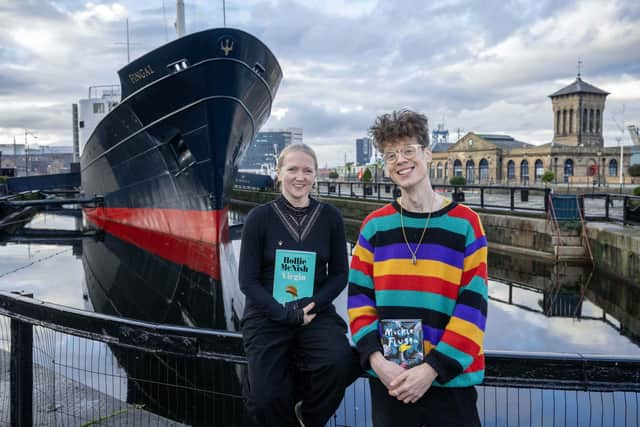
McNish is known for tackling the topics that dare not speak their name in her poetry and prose, demystifying and detoxifying as she goes. As her own daughter has grown up, fresh frontiers have emerged and her latest collection, Virgin, reflects her concerns about the pressures on teenage girls to “do it”.
“When you are that age you are so vulnerable to everyone telling you what to do,” she says. “I was overhearing conversations and realising that girls are still being told that it will probably hurt the first time and that pain is normal and a sign of non-promiscuity and all this bollocks that has been pushed for centuries by creepy adults. Schools are still teaching about penetrative sex before they even teach the word ‘vulva’ and won’t mention masturbation but do a whole thing about wearing condoms, starting with sex with another person rather than your own body and your own comfort and consent.”
Hence, more requests. “There are a few poems in Virgin that I have specifically put in because teachers asked me ‘Do you have a poem that I could read to teenagers, especially teenage girls, about the fact that anal sex isn’t the norm for most people and you don’t have to do it if you don’t want to?’” But with great linguistic power comes great responsibility. McNish is aware of the irony that the very poems she has written about teenagers can be too explicit to read to pupils.
McNish’s main memories of her own adolescence – routinely mined for tender and funny material – revolve around school and friends. “That’s awful that I didn’t say my parents but that just shows that you are the starter in your child’s life before they move on to the main course,” she says. “At that age, it’s just the pressure to fit in. I look back at photos and everyone is wearing a grey tracksuit because you would be ridiculed for wearing anything else.”
McNish, born to Scottish parents, started writing poetry from a young age. “But only a few,” she says. “My mum found a poem I’d written when I was seven about how angry I was not being allowed to have a cat. I’d insulted my family by rhyming ‘cat’ with various swear words. I wrote quite a lot about the Loch Ness Monster when I was younger ‘cos my family was quite influential in pushing anything Scottish on me.”
In her teenage years, she was seduced more by music, television, sport and industrious about her schoolwork. “I was writing poems but I don’t know if I would say I was really into poetry. I wasn’t in my bedroom reading Sylvia Plath but I loved song lyrics. I wrote loads of rhymes about all the physics equations to try and learn them.” On the day we speak, her daughter is sitting her GCSE Physics. “Yeah, I wish I’d kept them because they would be quite helpful…”
McNish has been a full-time poet/performer now for over a decade, publishing a series of collections, including the Ted Hughes Award-winning Nobody Told Me, playing with form as much as content, where poetry sits comfortably beside memoir and musings, wit is wielded with scalpel precision and immediacy and accessibility is prized over dense lyricism. She is a poet for those who think they don’t like poetry and a tonic for those who know they do.
She is also a regular at the Edinburgh International Book Festival and this year will take part in three events: her own Virgin book launch, guesting with journalist and author Poorna Bell and taking part in wellbeing powwow the Compassion Salon with Marti Balaam, Gavin Francis and her partner, Edinburgh Makar Michael Pederson.
For McNish, it is another opportunity to bring social taboos into the light, discussing grief and empathy. Meanwhile, she has already started working on a new collection called Bread and Roses, which tackles notions around nationality, migration and multiculturalism, inspired by her anti-racist war veteran granddad. “There are a lot of politicians at the moment talking about how England is not multicultural and it absolutely does my head in,” she says. “Even in my family we have different religions, different beliefs that are already multicultural. But there’s also quite a lot of food in it because I spend most of my time cooking, so it’s a sort of cooking/poetry/stories book.”
Virgin by Hollie McNish is published by Fleet, £14.99. Hollie McNish is appearing at the Edinburgh International Book Festival on 22 August (solo), and twice on 23 August, first at 11:45am (with Marti Balaam, Gavin Francis and Michael Pederson) then at 2pm (with Poorna Bell and Sam Baker)
The Scotsman’s arts newsletter is now sent twice a week - subscribe today
Want the latest Scottish headlines sent directly to your phone? Sign up to our new WhatsApp channel here
Comments
Want to join the conversation? Please or to comment on this article.