
Robert Macfarlane at Edinburgh Book Festival: 'when you put yourself in remarkable places, surprising things happen'
One of the greatest nature writers of his generation ponders the uncertain future of the world's waterways in his new book Is A River Alive? Interview by Susan Mansfield
Robert Macfarlane holds up his hand on the Zoom screen to show me a strip of red fabric knotted round his right wrist. It was put there by Rita Mestokosho, an Innu poet and activist, before he set off on a 100km kayak journey down the Mutehekau Shipu (or Magpie) river in Northern Quebec. She told him: “Only time or the river will remove it”.
“It has this rather awkward knot,” he says, tugging on it to show me. “So when you’re sleeping or resting something digs into you. At the beginning I thought that was annoying, but later on I thought it was brilliant. It’s a reminder, like the pebble in the shoe, it reminds me what I learned on that river.”
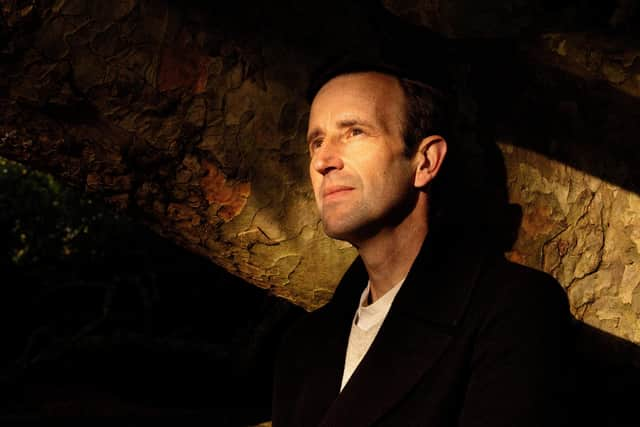

Writing his latest book, Is A River Alive?, involved a lot of learning, about the parlous state of rivers in the UK and around the world and about the growing Rights of Nature movement which seeks to grant them legal status, a kind of personhood, so they can be better protected. But the learning he’s really talking about here is experiential, the hard-to-explain ways in which his perspective shifted during the writing of this book about the natural world, about life itself.
It’s his most personal, most passionate book, fuelled with an urgent, driving energy. He is not a neutral observer, he is writing to convince the reader. “I remain very much involved, legally and in terms of activism, with all of the rivers, all of the people in the book. This book has continued to flow through me and through my life and shape it and I think it will do so probably for the rest of my life.” He points to his only tattoo, on his wrist next to the red fabric, the Cuneiform characters for “river” from the epic of Gilgamesh, which forms a kind of bubbling undercurrent to Is A River Alive?
The book charts three extraordinary journeys: a hike into the Los Cedros cloud forest in Ecuador, after a mining consortium which would have destroyed it was successfully challenged under Ecuadorian law; the kayak voyage down the mighty Mutehekau Shipu, where river guardians are currently fighting a vast hydro dam development; and a journey through Chennai, India, where the river Adyar is “as close to death as any river I have seen in my life” from industrial pollution. If a river is alive, of course, it can also be killed.
It’s a book which “wears the question at its heart on its sleeve”. I ask him to what extent he knew the answer before he set out. “I think I began in a false sense of certainty,” he says, thoughtfully. “It was only later I realised that I had begin in doubt. The question mark mattered, this wasn’t a declaration. It was a multi-year, multi-continent grappling with a very complex set of questions. I was aware I was dealing with a vast and ancient philosophical conversation about what constitutes life.”
It took him out his comfort zone, because the personhood of rivers challenges “conventional western” ways of thinking. The book isn’t a marshalling of arguments, it’s an account of experiences, a shift which happened in the imagination, perhaps, one might say, the spirit. It finishes with an epiphany on the Mutehekau Shipu which is (even for Macfarlane) hard to put into words. One review in a science magazine described parts of it as “fundamentally unscientific”.
“It doesn’t come easily to the rationalist mind. One is wary of woo-woo. There is a tussle between philosophical traditions which twists through the book. I learned to feel my own intellectual inheritance of rationalism. I think by the time the third journey [in Quebec] began I rapidly lost any sense of embarrassment at the idea that one might relate to a river as a friend or a force or a being. The more I met people and ideas which challenged that hard shell of certainty and began to dissolve it, the more fascinating it all became.”
Make sure you keep up to date with Arts and Culture news from across Scotland by signing up to our free newsletter here.
Macfarlane has been described as “the great nature writer and nature poet of this generation”. His bestselling first book, Mountains of the Mind, in 2003, established him at the vanguard of what has been called The New Nature Writing. He followed that success with books like The Old Ways and Underland, made television programmes and created projects like Lost Words, which has produced books, music, exhibitions and education resources. He writes lyrically, poetically, and speaks much as he writes. Riverine metaphors flow through our conversation: he talks about the book’s “tributaries”, the concepts which are now beginning to “irrigate” the law. He apologises for “meandering”.
He asks me – as he likes to ask everyone – about the “rivers which flow through your life and your memories”. I tell him I grew up between the Dee and the Don in Aberdeenshire, which immediately leads him to make a comparison to the Tigris and Euphrates (“The Mesopotamia of Scotland!”). We talk about Nan Shepherd, the North-east writer whose book The Living Mountain has been hailed posthumously as a classic of nature writing. Macfarlane was instrumental in bringing it back to the public eye.
“She and I wouldn’t reach for the same forms of language, but I think we’re moving towards the same conclusions. She writes about life as a quality brought into being by relation, the mountain lives in its complex totality of air and water and plant and human and weather and rock and time. I think my book argues for life always lived in relation, rather than Newtonian single units of self.”
It is certainly a book written in relation to other people. I admit to Macfarlane that I imagined him to be a lone adventurer, but this book full of people, larger than life characters like mycologist Giuliana Furci, who has a sixth sense for finding rare mushrooms, ebullient land rights lawyer César Rodríguez-Garavito, and Yuvan Aves, the inspirational self-taught naturalist Macfarlane meets in Chennai.
“I think in the 2000s I would have been that lone traveller, but there has been a trajectory towards conviviality, company and community. In this book I’m alone for approximately three minutes. I love writing about people. I’ve always found that, when you put yourself in the way of remarkable places and remarkable people, surprising things will happen.”
How hopeful is he for rivers? In England and Wales there is no river which has a “good” rating from the environmental agency. Scotland has some rated higher, but that brings with it a danger of complacency. On Sunday, at the Book Festival, Macfarlane will share a stage with writer Louise Welsh who is currently exploring a new legal status for the Clyde. While more people are prepared to speak out for rivers, the opponents of river rights are often powerful, wealthy and without scruples.
“I’ve seen river guardians and activists working in incredibly demanding and often dangerous circumstances where standing up for water rights or land rights is not a hobby, it’s your life. These people are not despairing, so for me to do would be a luxury.
“I feel so hopeful because this extraordinary movement has sprung up in the UK and organised itself across communities in a way I could never have predicted in the five years I’ve been working on the book. It is already changing everything. It will take 20 or 25 years for that change to materialise in a revived river system in this country, but I have absolutely no doubt that it will happen.”
A few days before our conversation, the local council in Southampton adopted a river rights motion along the lines the book described. A copy Is A River Alive? was waved during a speech to support the motion. Macfarlane is clearly pleased. “It’s exciting to see these ideas moving into policy-making. It’s not that the book caused that, but it has been a small part of the catalytic process around that thinking. That’s another reason to feel hopeful.”
Is A River Alive? is published by Hamish Hamilton. Robert Macfarlane will be at the Edinburgh International Book Festival on 9 August at 3.15pm, and on 10 August at 5.45pm with Louise Welsh and barrister Monica Feria-Tinta, and in an event for younger children on 9 August at 10.30am.
Comments
Want to join the conversation? Please or to comment on this article.