
Tom Pow on the legacy of Alastair Reid in his centenary year
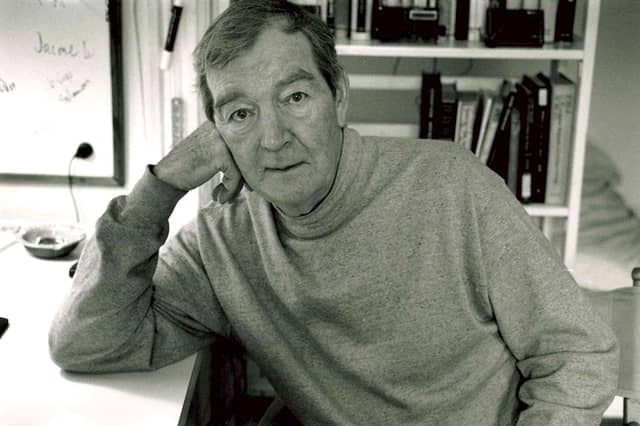

Alastair Reid was born in Galloway in 1926. An internationalist, travel writer, essayist, football reporter, children’s writer and translator, he is often most remembered as a poet. A former patron of Wigtown Book Festival, his legacy is recognised in the Alastair Reid Pamphlet Prize, one of the Wigtown Poetry Prizes. Here, poet Tom Pow, a friend, and editor of the 2018 poetry collection Barefoot, writes in memory of Reid in his centenary year
At the first Wigtown Book Festival in 1999, I took part in two events with Alastair Reid - a session on travel writing and a poetry reading. Alastair was amused, at the time, about the idea of the Book Town, claiming that as a child he’d never seen a book in Wigtown. But the unlikely always found favour with him and we both served the festival in different ways, I on the committee, Alastair as patron.
Now he is no longer with us, it seems the years between his death and his centenary have passed quickly. Might this be because he made such a strong impression on those who met him? Certainly, in The Ginger Farmer (The Saltire Society, 2026), my short memoir of the time I spent with him and his partner, Leslie, in the Dominican Republic, my memory of him from almost 40 years ago remains fresh:
“Watching him with people [at the market], it’s clear that what he does is to make contact with each person the most important happening of the moment… In some ways, it is the same quality that he brings to his writing – concentration, focus; experience shaped into vivid, clarified language for the duration of the essay or the poem.”

“Centenary” is a weighty word, often a marker when commentators move from the lived life to questions of legacy. I imagine “legacy” is an idea that would also amuse him – perhaps provoking him to hold his nose and pull the chain, his favourite critical comment – but it is a question that’s easily dealt with. What is Alastair’s legacy or contribution to Scottish literature? Everything he wrote.
Among these are essays that have been compared to Robert Louis Stevenson’s: on the rough itch of Scotland, on his position as a “foreigner”, on village life in Spain, on his experience of five World Cups and essays on the writers of “El boom”, about whom editors at The New Yorker sought his guidance. In addition to these, three classic children’s books, unsurpassed translations of Borges and Neruda – and his own poetry.
Alastair was an active curator of his own work. In several of his books, poems, translations and essays nudge and illuminate each other, while several essays have poems embedded in them. But “Poet” is the designation on his grave and the Alastair Reid Pamphlet Prize is a fitting way to remember him. The prize recognises a collection of 8-14 poems, with the winner receiving a pamphlet of their work set by Scottish poet and print designer Gerry Cambridge, published by Wigtown Festival Company.
Alastair’s first publication, Twelve Poems, was privately printed in St Andrews in 1949, an edition of 50 signed copies. The pamphlet is the perfect form for showing the present of a poet, but we may imagine now the quality, the deep pleasure, of a 14-poem Alastair Reid pamphlet drawn from throughout his work. There are, I’m sure, a number of poems we could all agree on, ones he often favoured at readings: “My Father Dying”, “The Academy”, “The O Filler”, “Weathering” and “Scotland”, the poem he finally set fire to at the StAnza festival in St Andrews – “Scotland”, No More!
Yet, there is an especial pleasure, as I found editing Barefoot, The Collected Poems (Galileo Publishing, 2018) of reading him at length. Neither his ear nor his eye fail him in his poetry – he is always accessible, lyrical and perceptive. But Alastair used to say that it was the journey through time that was life’s big adventure – “change is where I live” (from “The Spiral”) – and it is by reading the poems as a narrative that you can experience this quality.
If you follow the arc of the poetry, you will realise there is completion here. In “Galilea”, he claimed to seek “somewhere which could become / landscape and vocabulary, / equilibrium, home”. That is what the reader will find, not in individual poems, but in the rich body of his work.
Tom Pow’s most recent collection is The Vulnerability of Precious Things – Encounters with Simone Weil (Mariscat and Molecular Presses, £12). The 2026 Wigtown Book Festival runs from 25 September to 4 October, see www.wigtownbookfestival.com. The Scotsman is the 2026 media partner of the Wigtown Poetry Prizes, see www.wigtownpoetryprize.com
The Scotsman’s arts newsletter is now sent twice a week - subscribe today
Enjoying the Arts & Culture journalism on scotsman.com? Make it easier to find by selecting us as a preferred Google source
Want the latest Scottish headlines sent directly to your phone? Sign up to our new WhatsApp channel here
Comments
Want to join the conversation? Please or to comment on this article.