
Val McDermid on Winter, her 'most personal' book to date
Ahead of her appearance with Nicola Sturgeon at the St Andrew’s Book Festival in London, Val McDermid talks to Susan Mansfield about her new book Winter, in which she offers vivid snapshots from her Fife childhood and celebrates her favourite time of the year
Winter: season of frosty days, blazing log fires and crime writers penning dastardly deeds. It’s an ideal combination, says Val McDermid: “Winter is probably my favourite season because it’s the opportunity to write. There are fewer temptations to go outside and waste time.”


So, as the nights start to draw in, McDermid is at her desk pulling together ideas for the next book. “The process starts off slowly, if I write 50 pages in the first month I’m doing really well. Then it speeds up as I get deeper into it, understanding how all the bits that are dancing around in the back of my head come together and form an eightsome reel.”
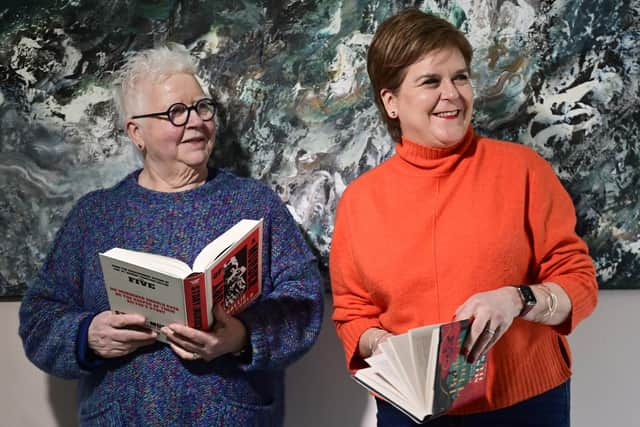
She will, however, take a rare break from the book later this month to join Nicola Sturgeon on stage for one of their popular “two-handers” at the St Andrew’s Book Festival, which celebrates Scottish writing in London. Sturgeon will interview McDermid about “this year’s book”, Silent Bones, featuring Edinburgh-based cold case detective Karen Pirie, and her latest “side gig”, Winter: The Story of a Season, part of a seasonal quartet in which she joins Michael Morpurgo, Bernardine Evaristo and Kate Mosse.
Winter might be McDermid’s most personal book, offering the reader vivid snapshots from her Fife childhood: going as a toddler on her father’s shoulders to see Kirkcaldy’s big town-centre Christmas tree; the memorable bonfire night when her father accidentally dropped a burning taper into a box of fireworks; convivial family Hogmanays.
She sings the praises of winter’s “egalitarian” festivals which, unlike the music and arts festivals of summer, don’t require booking or money to enjoy. Unless, of course, you want to spend Hogmanay in Edinburgh. That’s a burning taper of its own.
“Why would you want to be in Edinburgh for Hogmanay these days, honestly?” she says. “Streets are closed off. People who live within the cordon have to get special passes to go to their own houses, and they can’t have parties because they can’t get guest passes.” She and her partner spend New Year in the East Neuk where things are still neighbourly. On a clear night you can see the Edinburgh fireworks: “The spectacle without the hassle.”
It’s rare to read McDermid being personal. While she has enjoyed a range of public roles, from captaining quiz teams to founding a book festival (the Harrogate Crime Writing Festival) and judging the Booker Prize, she guards her privacy carefully and is never effusive in interviews. “I had to make decisions early on about what I was willing to talk about and what I wasn’t willing to talk about, because I’ve made a very deliberate decision that I don’t want to write a memoir.”
READ MORE: Silent Bones by Val McDermid review: 'a murder that could have changed the future of Scotland'
There are plenty who would read that book: the working-class girl who became the first student from a Scottish state school to be admitted to St Hilda’s College, Oxford; the young news journalist holding her own in male-dominated tabloid news rooms; the crime writer who put strong women and queer women at the centre of her stories. But she’s characteristically frank: “I don’t think I was put on this planet to provide fodder for people to do their PhDs. I’m entitled to private elements of my life, that’s my bolt hole. I close the door and people don’t get in.
“I’m sometimes slightly anxious about young writers publishing their first few novels now because everything is out there on socials and in their work, and I think, ‘where are you going to go when it all goes to shit?’ You need a place to hide in your life, a place where you can pull the curtains closed and deal with what’s going on in your life without everybody picking at it like a scab.
“But the idea of doing this book quite excited me because it allowed me to revisit happy times in my life, things that I’d enjoyed, things that made winter special for me.”

It’s hard to overstate just how successful McDermid is. Over 19 millions books sold, in more than 40 languages; TV, radio and theatre adaptations; an array of prizes and accolades. Her publisher faced a legal challenge from the Agatha Christie estate for calling her the Queen of Crime, but the monicker has stuck nevertheless.
She’s published 40 books. “Forty novels,” she corrects. “And other books. It makes no sense to me, really. In my head I’m still 32.” At that point she was a journalist, but was digging her escape tunnel. Her first novel, Report for Murder, was published in 1987 by The Women’s Press. Then came breakthrough books and bigger publishers, the long-running TV series Fire in the Blood, based on her Tony Hill/Carol Jordan books. More recently, the first two Karen Pirie novels have been dramatised for STV starring Lauren Lyle.
Silent Bones is the eighth in the series, in which Pirie investigates a murder which happened at the time of the Scottish independence referendum, at the centre of which is a mysterious book club. McDermid says it was inspired, in part, by hearing about a similar elite club in Birmingham.
“It has been going for over 200 years and they have a set number of members, so you have to wait for someone to die or leave town before you can join. They have this ceremony at the end of the evening when they cut up a pineapple, which goes back to a time when having a pineapple was a sign of wealth.” Transported to Edinburgh, the Justified Sinners Club connects the powerful men of the city, men more than able to put up obstacles for Pirie and her team.
Although she turned 70 in June, McDermid has no intention of retiring: “What would I do with myself? I’ve had major surgery twice in the last 12 months and it hasn’t really slowed me down. I’m really, really lucky. This is the one thing in the world I wanted to do and they pay me money for it.”
As well as working on “next year’s book” - 1999, the third in the series featuring journalist Allie Burns - she’s collaborating with her partner, geography professor Jo Smart, on a book for Polygon’s Darkland Tales series about Scotland’s failed attempt to found a colony at Darien in 1698.
And when she’s not working on either of those, she’s reading books, as chair of the judges for the Gordon Burn Prize. “Just as well I had my heart surgery and I wasn’t supposed to be doing anything,” she says, wryly. “It’s a privilege to be a judge on prizes because it makes you a much more careful reader, and much more intolerant of bad prose!”
She says she’s never satisfied with anything she writes. “But it’s good to be in a learning place. That’s why doing these ‘side gigs’ refreshes me. It’s a sort of apprenticeship in doing something different and that makes me go back to the mainstream of my work with fresh eyes and fresh excitement.”
Val McDermid will be interviewed by Nicola Sturgeon at St Columba’s Church, Knightsbridge, on 27 November as part of this year’s St Andrew’s Book Festival in London, see www.standrewsbookfestival.org
The Scotsman’s arts newsletter is now sent twice a week - subscribe today
Want the latest Scottish headlines sent directly to your phone? Sign up to our new WhatsApp channel here.
Comments
Want to join the conversation? Please or to comment on this article.