
Andy Goldsworthy on curating his 50 year retrospective at the National Galleries of Scotland
The multi-award-winning and eternally uncompromising artist tells our arts critic Susan Mansfield all about his 50 year retrospective at the National Galleries of Scotland.
At the top of the stairs in the RSA, the way into Andy Goldsworthy’s long-awaited retrospective is blocked by a hand-made screen. Light glimmers through it. The artist smiles mischievously.
“It’s Andy Goldsworthy, so you think it’s going to be grass stalks, something appealing and pastoral. It’s only when you get up to it you realise it’s barbed wire.”
As someone who had made work outdoors for 50 years, he has history with barbed wire, literal and metaphorical.
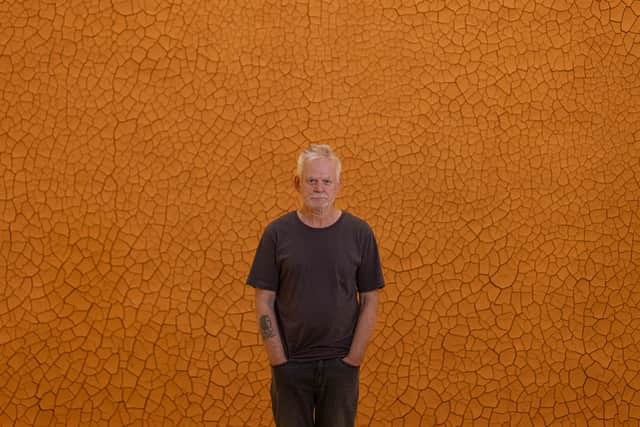

“It’s about being blocked, not being allowed, which has occurred all through my life. I’ve been asked to leave places many a time. There is always an element of resistance and obstruction. The more I see it, the more it’s a portrait of my life.”
This 50 year retrospective for National Galleries Scotland is a rare museum exhibition, and the biggest ever survey of his work by a country mile. Yet only part of it looks back. The major works here are new, made specifically for this building. “Though, in a sense, they are also a retrospective because they couldn’t have been made without the experience of having worked for 50 years.”
Patrick Elliot, chief curator of Modern and Contemporary Art at NGS and curator of this show, told me he expected Goldsworthy to choose Modern One over the RSA, but the challenge of the place energised him.
“It’s not the easiest of buildings to work in,” Goldsworthy says, mildly. “It’s got a lot of character, it’s got dado rails, it’s got this bureaucracy which is astonishingly complex and difficult at times. But it’s become bound up in a dialogue with the landscape around my home [in Dumfriesshire]. It has provoked work I would never have imagined being able to achieve.”
And he has transformed the building in a way I’ve seen no other artist do. He has taken it by the horns with a show five years in the making, visiting every month for the last two years, installing on site for six weeks. Patrick Elliot says: “He’s got incredible energy and he just won’t give in. He’s uncompromising, as a proper artist should be. He fights the institution in order to realise what he needs to realise.”
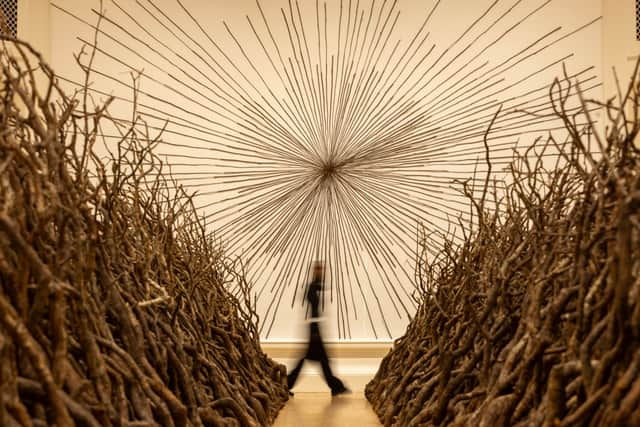
Goldsworthy, 69, is a singular, single-minded artist. No one else does the kind of work he does. He has worked all over the world, including for some of America’s top museums and private collectors, but has no gallery representation in the UK. Most of his work here is outdoors, well off the beaten track.
His best known work might still be his arrangements of leaves, ice, twigs, stones: beautiful, ephemeral things which he made and photographed for coffee table art books. There is little of that here. This work is blood and earth, sheep’s wool and cut branches. It’s fierce and feral, red in tooth and claw. 18 tons of stones dug out of graves; 10,000 reeds; a year’s collection of barbed wire.
Goldsworthy himself is a wiry coiled spring of energy. He doesn’t like explaining his work; the wall text for the show - at his insistence - is minimal. Yet, once talking, he forgets to be curmudgeonly, he’s passionate and, actually, I think, rather pleased: “This has been an opportunity to bring some things to a conclusion, draw together the disparate aspects of the practice. The cliché about time, how it passes so quickly, is absolutely true, but at the same time I’m thinking, how did I manage to make all this? I have achieved at lot.”
Goldsworthy grew up wanting to be an artist, only to be rejected by several art schools. He was prepared to go it alone, but got a place through clearing at Preston Polytechnic. One day, stultified by trying to work in a white cube studio, he headed out to Morecambe Bay and dug holes in the sand until the tide came in and filled them.
“That experience taught me so much about tides and different qualities of sand. It was rich, it was a source. My art changed from being a thing where you were supposed to think of an idea on canvas or paper to being a means by which I could feed myself and learn about the world around me and my place in it. That’s a big deal! That’s enough. That’s sustained me ever since.”
Looking at the earliest work in the show, photographs and film made when he was at art college, he sees the continuity. “I can see the seed from which it grew. Of course it’s grown, expanded. It’s got stronger and deeper and more beautiful and darker. Life is like that. It gets deeper and richer and I think that’s reflected in the things that I make.”
His singular vision came mainly from two places. “I worked on farms from the age of 14, and that’s a very sculptural activity: the ploughing of fields, the laying the hedges, the picking of stones, the working with the animals, the raw experience of it.
“Then I went to art school and we were shown a lot of American land art: Smithson, Dennis Oppenheim, and also people like Yves Klein, Josef Beuys, Kaprow. Just seeing that art could take place out on the streets, or in the fields on in the hills.” However, for Goldsworthy, outside was never wilderness. It was farmed and tended, full of history. One might say the connection of humanity to land is fundamental thread running through all he does.
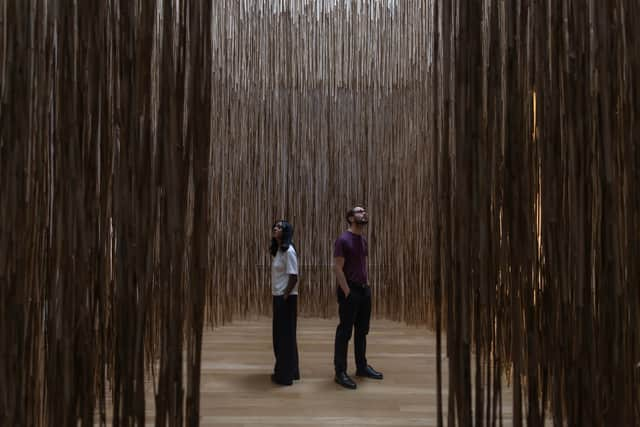
Back in those early days, he buried himself in seaweed, covered his body in black sand, but he made things too, ephemeral works which fell down, melted, blew away. It was all about touch, still is.
“Jacob Bronowski said in The Ascent of Man that the hand is the cutting edge of the mind. The hand, for me, is so important. I think through my hands, get ideas through my hands, the world makes sense through my hands.”
Every day, he’s out in the landscape making something. Some things work, others don’t. Some yield ideas for other, larger works. This sustains the other side of his practice, the big projects which require a team and power tools and long hours spent negotiating with barbed wire.
“I’m fortunate in that I have an art that gives, through which I learn and understand, and the bigger projects could be seen as a time when I give. I take and I give, that’s a way of keeping things circulating. This show is a lot of giving.”
READ MORE: Art reviews: Mike Nelson | Jonathan Baldock
He still makes work with his body. In the NGS show, we see him in middle age crawling lengthwise through a hedge, walking barefoot on breaking ice, burying himself in seaweed (again), floating face down in a stream: “My Ophelia moment! I found it by chance. My family are used to it, we’re go for a walk, and the next thing I’m lying on the ground to make a rain shadow or stripping naked to jump in a river.”
Having finished making the show of a lifetime, he’s thinking about the next thing: a permanent site for his Gravestones project, high in the Galloway hills; the conclusion of Hanging Stones project, a series of sculptures inside ten restored buildings on a six mile walk in North Yorkshire.
“It’s good to get this out of the way to make space for things to come. I would have been carrying a lot around in my head, I think, if I hadn’t done this show. Now it’s been done, I feel cleaned, or emptied. Ready for more.”
Andy Goldsworthy: Fifty Years, National Galleries Scotland is at the RSA, Edinburgh, until 2 November, tickets £5-£19. www.nationalgalleries.org
Comments
Want to join the conversation? Please or to comment on this article.