
Edinburgh Art Festival reviews: Catherine Opie | Lee McCormack


Two photography exhibition ask important questions about who ‘belongs’ on art gallery walls, writes Susan Mansfield
Catherine Opie: To Be Seen, Royal Scottish Academy, Edinburgh ★★★★
Lee McCormack: A Magic Lantern, Craigmillar Now ★★★★
Perhaps the making of a portrait is always a political act. What is a portrait, after all, but a performance of identity, an image which is designed to be seen? And it has become abundantly clear in recent years, if it wasn’t already, that our portrait collections are full of rich, white, male subjects, and that imbalance must somehow be addressed.
In one sense, the entire career of American photographer Catherine Opie has been about redressing that balance. Now 65, she has been making work for more than four decades, the best known of which are her portraits of the queer community, often her friends, where the poses, backdrops and sheer quality of image open up a conscious dialogue with historic portraiture.
At the National Portrait Gallery in London where this show opened, and now under the banner of National Galleries Scotland in the RSA building, the physical context extends that dialogue. In Edinburgh, in her first solo show in Scotland, she intersperses her work with portraits she has selected from the NGS collection.
This show is a career survey which begins with her first major series, Being and Having (1991), 13 portraits of butch lesbians (including herself) in their masculine personas, against the plain, brightly coloured backdrops which would become her signature.

Later, we meet other portraits, three-quarter, full length and occasionally landscape, of friends, artists, collaborators: Justin Bond, Ron Athey, Divinity Fudge, trans and non-binary actor Daniel Sea. Her friend Raelyn Gallina is hung next to portrait of Benedetto Gennari’s Elizabeth Murray, Duchess of Lauderdale, the two mirroring one another in seated poses. She invites her sitters to decide how they want to be seen, but she captures something extra too: they are confident, sometimes defiant, but also vulnerable. The performed identity is also what lies behind the mask.
In a bold piece of juxtaposition, she hangs her Self Portrait, Nursing next to a 16th-century Madonna. One is immediately struck by the staged, idealised vision of motherhood next to the visceral - and beautiful - image of a real woman feeding her baby, her skin scarred and pock-marked by life. Skin is important for Opie: for Self Portrait, Cutting, made in 1993, at the height of the Aids crisis, she had a child’s drawing of a lesbian family scratched into her back.
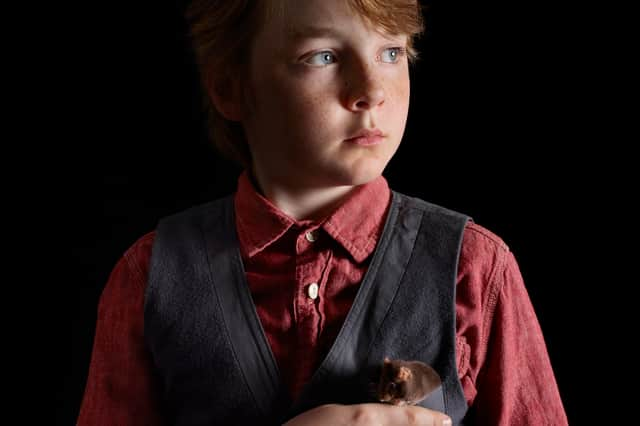
A series of portraits of people who inspire her make use of dark backgrounds, another deliberate reference to the Old Masters. David Hockney is here, photographed in 2017, as is Isaac Julien, Gillian Wearing, curator Thelma Goldon with fashion designer Duro Olowu, and others. Her son Oliver, with his pet mouse, references Da Vinci’s Lady with an Ermine. A tender portrait of her grandson in his father’s arms is masterful in its use of chiaroscuro.
Her series of portraits of children is extraordinary. It’s as if she sat back from the camera and gave them the space to be as they wanted to be. As a result, she captures something from the inside, the aspects of childhood which can be awkward, introspective or self-contained and unknowable.
Also in the noughties, she was drawn to make pictures of high school footballers, a series she described as “digging deep into Americana”. Here, again, she finds a combination of strength and the vulnerability, physical prowess and body armour contrasting with youthful faces. This work took on extra poignancy, she has said, when she realised high school athletes are often recruited into the US military.
Opie’s first love was documentary photography, and there are documentary pictures here: people of colour celebrating Obama’s inauguration; white men in American Patriot baseball caps at Tea Party rallies. There is a photograph of a protest against California’s attempt to introduce anti-gay laws in 1991, and one from the once legendary Michigan Women’s Music Festival.
Her “Domestic” series, made in the 1990s, was the result of a 9,000-mile journey around the US photographing lesbian families in their homes. There are only a handful here - it would be great to see more - but they sit somewhere between documentary work and studio portraiture.
Enjoying The Scotsman's coverage of the Edinburgh festivals? For just £2 a month you can get unlimited access to scotsman.com plus 2-for-1 Fringe tickets. For details visit www.scotsman.com/subscriptions
The thing I found challenging about this show is the fact that the bodies of work are not hung together: each room is a mixture, making use of the sightlines between the spaces and foregrounding the interplay between the contemporary and historical works. Some of the pairings with traditional portraits are more impactful than others, and some feel unnecessary: one only has to look at Opie’s black and white image of a woman kneeling in a bath, light cascading over her shoulder, to see Vermeer.
The large central room, for example, is divided awkwardly by two partition walls, funnelling visitors into a central diamond shaped space which contains five works: a portrait of Opie’s ex-wife Julie, bare-chested on a rock in a river, a Ferdinand Hodler landscape, Picasso’s blue period Mother and Child, a “Domestic” series piece of a couple in North Carolina, and an abstracted image of the white cliffs of Dover made at the time of Brexit. While all of these are well worth looking at, it’s not clear what they are saying to one another, or what they bring to our overall understanding of Opie’s work.
Instead of a structured, chronological hang, it is a space to meander and discover your own connections. Today, this work is suspended between radical and normative. It should no longer be radical to see portaits of queer people in museums. And yet, Opie says, she would never be allowed to stage a show like this in Trump’s America. So it is radical again. And important and political. And will remain so until one day when, we hope, it will simply be normal.

Of course, the question of who is “seen”, and who “belongs” on gallery walls goes beyond the queer community. Craigmillar Now, the organisation which brought to light the extraordinary work of Sandra George, currently on show at the City Art Centre, is presenting for Edinburgh Art Festival the first solo exhibition by Lee McCormack, a photographer and community worker taking pictures in Edinburgh from the late 1970s to the early 2000s.
McCormack grew up in Niddrie and was introduced to photography as a teenager through the Film Workshop Trust, sometimes crossing the city on foot to use their dark room in Stockbridge because she didn’t have money for the bus. Her photography was interwoven with her community work: as well as taking her own images, she helped community groups to take their own, creating audio-visual presentations which are available to watch on video.
This show brings together an early selection of her work, mainly from the 1970s. Often, her subjects are children: kids from Edinburgh housing schemes on trips to the countryside and the seaside, kids from the Royal Blind School on a trip to a community farm, or playing in the street in in Niddrie and South House. Always, her camera finds the interesting angle, the quirky detail. Some of the strongest images are from Pilton Gala Day in 1979, seeking out the unusual, poignant, amusing, a sensitive capturing of lives which won’t find themselves on gallery walls - but perhaps they should.
Catherine Opie: To Be Seen runs until 1 November; Lee McCormack: A Magic Lantern until 20 August
The Scotsman’s arts newsletter is now sent twice a week - subscribe today
Enjoying the Arts & Culture journalism on scotsman.com? Make it easier to find by selecting us as a preferred Google source
Want the latest Scottish headlines sent directly to your phone? Sign up to our new WhatsApp channel here
Comments
Want to join the conversation? Please or to comment on this article.