
Author Valeria Luiselli on motherhood, memory, myth and a world increasingly touched by fire
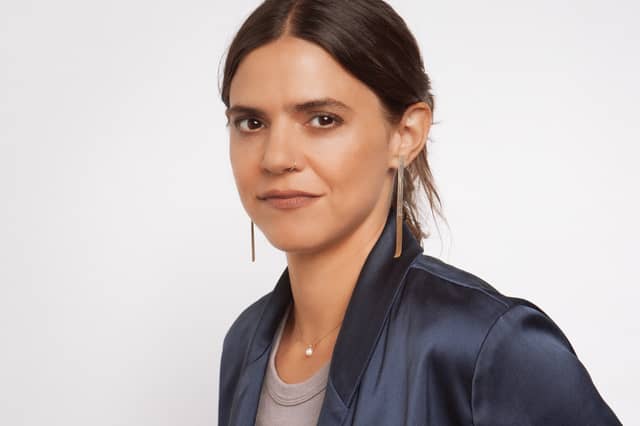

Multi-award winning acclaimed Mexican-American author Valeria Luiselli's new experimental novel Beginning Middle End muses on the midlife squeeze, immigration, the climate crisis and the essence of time itself. Ahead of her appearance at the Edinburgh International Book Festival, she chats to Susan Mansfield.
VALERIA Luiselli’s new novel is haunted by fires: ancient volcanic eruptions from the guts of the earth and modern climate-induced wild fires. We’re aware as we speak that this summer has seen fires burn across Europe: in Sicily, where the novel is set, and where Luiselli has just been, in France and Spain, even in Scotland.
There’s something apocalyptic in the air, as there is in the book, Beginning Middle End. “The beginning of the world and the end of it, right?” she says softly. “The novel works at different scales, fires and catastrophes, but also beginnings in the very small scale of human life. Both explorations are happening at the same time.”
Sicily, she says, is the natural place for all this. She visits the island at least once a year, often in connection with her work on immigration which runs parallel to her fiction writing. “Sicily condenses so many of the issues of our times. It is the great border of borders. It’s a geopolitical border, of course, in Europe, where most of the ships crossing the Mediterranean arrive. In ancient history, it’s a space of confluence of the Middle Eastern, African and European worlds. Everyone, at one point or another, arrived in Sicily: the Greeks, the Romans, the Phoenicians, the Carthaginians, the Normans, the Arabs.
“And it is a border in a very real tectonic sense, which produces a volcanic archipelago which is very active. There is a sense that the world begins and ends there.”
The nameless protagonist of her novel is a writer who arrives in Catania with her 12-year-old daughter after a European book tour. Emerging from a “slow, entangled divorce”, she plans to stay for a while on the island where her grandmother grew up. She is worried about her mother, back in California, who is beginning to lose her memory, and is struggling to write a book about a mother and daughter who arrive on Sicily.
“I wouldn’t dare say this novel is about one thing,” Luiselli says, “but if someone forced me to choose one thing, I would say it’s about being in the middle of life. Observing the younger generation coming to life with all their new questions, complexities, needs, and at the same time observing our elders slowly walk out, and being faced with the sadness of that, the beauty of that, and the duty to make sense of all that.”
Enjoying The Scotsman's coverage of the Edinburgh festivals? For just £2 a month you can get unlimited access to scotsman.com plus 2-for-1 Fringe tickets. For details visit www.scotsman.com/subscriptions
Luiselli is a thoughtful, articulate interviewee. Since the publication of her first novel, Faces in the Crowd, she has been recognised as important literary voice. She was one of the National Book Foundation’s Five under 35, and is a winner of the Carnegie Medal and an American Book Award. Her last novel, Lost Children Archive, was longlisted for the Booker Prize. Born in Mexico, she grew up in South Africa, Korea, India; her father was a diplomat, her mother worked for NGOs. She studied Philosophy in Mexico, then moved to the US where she still lives.
Like all of her novels, Beginning Middle End is experimental in form. It’s written in fragments and interwoven with other stories and texts: Pliny’s Natural History, Rachel Carson’s The Sea Around Us, Euripides’ Trojan Women. Part of the narrative is told in postcards written by the daughter to her grandmother, another part in Polaroid photographs. She has also worked with a team to create a soundscape for the book, a kind of “emotional undercurrent” of recorded sound which is available to listen to online.
The title itself is a provocation: what is a beginning? Is the traditional three-part structure helpful or restrictive? The writer’s daughter, a smart, sassy antagonist on the cusp between childhood and adulthood, challenges her: “When will you finally write a novel with a beginning, a middle and an end?” Luiselli says: “I enjoy reading novels that are transparent about the process of their own making, there’s a sense of them being an archive of themselves in some way.”
She says an important “seed” of the book came when her own daughter was about the same age as the daughter in the book. “She was having a lot of night anxiety and insomnia and I went back to reading to her at night. I would read Greek and Roman myths to her, and one night she asked me why it was that, in all these origin myths that we were reading, something was always ‘torn asunder’ in the beginning, and she asked, what does it mean to be ‘torn asunder’.
“I was able to answer the second question, but not the important question: why are things broken in beginnings? That was an enormous question that I had never myself asked or pondered. So the book began very much around the question of what is a beginning, and why is a beginning also an end? What is broken in beginnings, and what does it mean, then, to tell a story?”
For Luiselli, the beginning of any book is in “note-taking”, fragments, which she writes in either English and Spanish, depending on the day. This process might take years. “Only later when I have amassed enough substance, enough material in the form of these small bits and pieces, very much like mosaic tesserae, can I engage with it in a more playful way, thinking about internal architecture, repetition, plot.”
Beginning Middle End is intricate, clever, constantly surprising in its twists and turns. It is, Luiselli says, rather “protean”. The Greek god made an appearance while she was writing and made it clear he was here to stay. “He made his way into the novel in a very sneaky, god-like way, the way that gods so often appear in another form, that trickster thing. He just kept on appearing every time I picked up a book and eventually I had to say, ‘Okay, fine, come in! And thank you, how do we play?’ And as soon as he came in, the novel assumed it’s own current form as a shape-shifting, time-travelling entity.”
Somehow, the book manages to hold in one space the contours of myth, Luiselli’s driving questions about the nature of imagination and memory, the push and pull of mother-daughter relationship and the live issues of the contemporary world. “It’s really not a book about immigration or climate crisis,” she says. “But they are present as they are in our lives. They are the circumstances around the characters. The problems of our planet and of humanity are part of our interior world as well, there aren’t clear borders there.”
Valeria Luiselli will talk about Beginning Middle End at the Edinburgh International Book Festival on 29 August at 5pm, and will take part in an event about Katie Paterson’s Future Library on the same day at 12 noon. Beginning Middle End is published by 4th Estate, priced £18.99. The soundscape for the novel can be found at bmesound.com
The Scotsman’s arts newsletter is now sent twice a week - subscribe today
Enjoying the Arts & Culture journalism on scotsman.com? Make it easier to find by selecting us as a preferred Google source
Want the latest Scottish headlines sent directly to your phone? Sign up to our new WhatsApp channel here
Comments
Want to join the conversation? Please or to comment on this article.