
Dan Gunn on reconstructing the life of Muriel Spark through letters
Few people have immersed themselves in the lives of great writers as thoroughly as Edinburgh-born academic Dan Gunn.
First, there were the 25 years spent putting together the four-volume selection of Samuel Beckett’s letters. He finished that in 2016, but two years later started work on the letters of Muriel Spark. The first of two volumes is published later this month, and for Spark aficionados, it’s pure gold.
The letters don’t have all the answers. There aren’t any surviving ones from before 1944, so there isn’t anything about her Edinburgh childhood, adolescence, marriage, emigration to Southern Rhodesia (now ZImbabwe), motherhood, or the collapse there of her marriage to her manic depressive, violent husband or her wartime intelligence work. There isn’t even too much about her 1954 mental breakdown and subsequent conversion to Catholicism or the six weeks in which she wrote The Prime of Miss Jean Brodie.
Yet if you want to follow her through the 1950s, watch her hitting her stride as a writer in the most transformative decade of her life, when she moves from being an unknown poet to a literary superstar on both sides of the Atlantic, the letters are enormously important. Read them, and you can almost see the self-confidence grow within her.
At least that’s what I thought as I followed her epistolary trail, noting how she switched from asking advice from Alan Maclean, the first editor of her books, to lambasting his failure to promote them properly. I've never read such sustained, imperious, angry eloquence.
But perhaps, hints Gunn, it wasn’t quite so simple. “I was talking the other day with Alan Jenkins [a poet who had also known Spark] and I said that in this volume of her letters (1944-63) she’s not that confident: she has doubts about her writing and her potential. And he said no, she never doubted her own genius.
“I think he’s right, but I’m also right. I think she has an instinctive belief in her own utterly special way of looking at the world. How she translates that vision into writing is something else. When she’s 14 and she wins an [Edinburgh-wide] poetry prize she already knows that’s her path but it’s only when she really gets going with prose and maybe only after two or three novels that she really gets a sense of ‘Wow, this is it! I’m on the path and it’s recursive: it comes back.’”
Other writers might kowtow to their publishers, conscious of the debt they owe them in getting their work into print, especially when – as with Spark - they changed their own rules just to do so. She was never like that. Here she is, in typically blistering form, on 13 November 1961, just after the publication of The Prime of Miss Jean Brodie, telling Macmillan’s why she wants to change some relatively minor detail of her contract:
“I know of no other writer on your list but myself," she writes, "who has had the opportunity to build an intelligent career in the world, or to get married, and who has consciously or deliberately set these safeties aside and endured poverty, and taken the risk of failure, in order to write well.
“It is not a spare-time hobby I am engaged in, but something for which I have had to sacrifice pleasures, and continually have to give up pleasures to do, and no matter how successful I become, I shall always have to make these sacrifices. It is not the kind of work that comes from a compromised life.”
The letter, I should point out, continues in this rather magnificent vein for a full eight pages of Gunn’s book.
The contrast with Beckett is enormous, Gunn says. “He thought success was just a terrible mistake, that somehow they’d got it wrong. Once somebody published him, he didn’t even consider moving. But Muriel believed in her success, and when it comes to publishers she does tend to think there are greener pastures somewhere else. She had great business acumen. I’ve transcribed hundreds if not thousands of her business letters, and though I didn’t include many of them, cumulatively they’re surprising - particularly as she doesn’t write bestsellers, pot boilers, genre fiction. Her novels are too strange, too singular, and she never repeats herself. She writes the book she needs to write, and then says to her agents and publishers, ‘You have one job and one job only - to make me money.’”
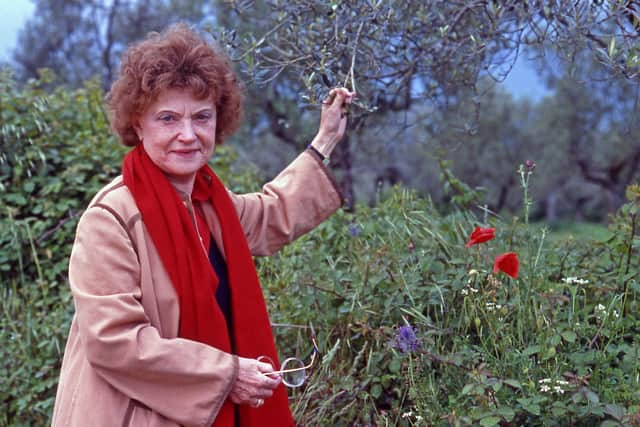

This isn’t as arrogant as it sounds, he says. “ I try to understand it in the context of her being a woman who had to support her family in a world of pretty creepy men, a lot of whom are trying to have at her in one way or another.” (Even, says her most recent biographer, Frances Wilson, to the extent of attempted rape.)
Gunn met Spark 20 years ago when she was awarded an honorary degree by the American University of Paris, where he is a distinguished professor. “She had a magical quality. Even though she could hardly see and was in considerable pain, she could completely command a room. She was so witty and clever, and the extent of her self-education was a revelation.”
As was her charm. “That was probably the hardest thing to communicate through her letters - unless I gave all the other side of the correspondence, which isn’t really my job. But people loved her, absolutely loved her, which is why those publishers and agents put up with her being so extremely demanding.”
Gunn is fully conscious of the fact that, as an editor of letters, he comes right at the end of a centuries-old tradition, one that vanished almost overnight with the arrival of email. “There’s a nostalgic element to representing a world we now don’t know - where you had time to work out what you thought, sit down and write a letter. Certainly, Muriel put a lot of herself into those letters. But without letters, how are you ever going to reconstitute people’s lives when they are dead?”
The Letters of Muriel Spark Volume 1: 1944-1963 edited by Dan Gunn will be published by Virago, price £35. Professor Gunn will be appearing at the Edinburgh International Book Festival on Wednesday 20 August at 2.15pm and at the National Library of Scotland with the Spark Archive curators at 5pm.
Comments
Want to join the conversation? Please or to comment on this article.