
Edinburgh Book Festival round-up: Sarah Perry | Lorraine Kelly | Samira Ahmed | Daisy Fancourt + more


Our latest report from the Edinburgh International Book Festival includes ABBA, the Beatles, musings on AI, and a deeply moving account of delivering palliative care for a loved one.
“Are the arts any good for us?” Thangam Debbonair asked on Saturday morning.
Given that a) she was at a book festival, b) in the middle of the Edinburgh Festival, c) about to introduce two writers who had both written books about how the arts can improve health and happiness and d) used to be Labour’s former shadow Culture Secretary, this was an entirely rhetorical question.
Of course the arts are good for us, Daisy Fancourt argued. Neurologically, physiologically, biologically, behaviourally, they’re brilliant. Yet although there have been 30,000 scientific studies on the health links between health and the arts - and she provided plenty of examples - it hasn’t led to any arts funding boost.
“Only this morning,” she said, “I read a story that we are spending more money putting out fires at waste disposal sites caused by lithium batteries than our entire arts and cultural budget last year.”
Enjoying The Scotsman's coverage of the Edinburgh festivals? For just £2 a month you can get unlimited access to scotsman.com plus 2-for-1 Fringe tickets. For details visit www.scotsman.com/subscriptions
Wayne McGregor uses longer words - “interceptive sense”, “kinesthetic empathy” - but is on the same side of the argument. As the choreographer of Abba Voyager, he is also actively involved in researching what AI can and cannot do (he has, he said, broken two Big Dog robots by trying to get them to pick up an egg and place it on their backs).
Fancourt admits that the quality of AI art has now reached the point that it is impossible to tell the difference, but insists that the “made by humans” tag will always carry a premium (will it be enough?). For McGregor, because we will always be able to tell the difference between a human dancer and an avatar (will we?) AI holds no fears.
His book’s main point is our need to build up our “physical intelligence”, and be more aware of our bodies in everyday life, not just when they break down. The forest of hands at the end marked an enjoyable and wide-ranging discussion.
For me, the most moving event of the weekend, if not the whole festival, was Sarah Perry’s talk about her memoir Death of an Ordinary Man, which is entirely about what happens when a loved one’s body breaks down for the final time. Her father-in-law David died, aged 77, just nine days after a diagnosis of oesophageal cancer.
He had always been robustly healthy, yet one day she and her husband saw him and they both knew - simultaneously, wordlessly, almost supernaturally - that David wasn’t long for this world. In the days of looking after him, she recorded the subtle crossings of boundaries: when she started calling her father-in-law Dad, then “sweetheart”, and then “my darling” - this man who was so formal he always greeted his only son with a handshake.
Her novelist’s eye took in the sad wonder at the swift disintegration and diminishing of the human body. For a moment she doubted that she could cope with all the intimacies involved in palliative care for a dying man.
“There was just a second of that,” she said, “and then it was honestly like I felt a hand on my shoulder, and it was my mum, or it was someone's mum, and there was someone behind her, and there were all of these people who had done exactly the same thing, just putting their hand on my shoulder and saying, ‘This is completely natural. You know what to do.’ And I did. There was no embarrassment. There was nothing, because actually, caring for the dying is as instinctive, and as normal, and as unembarrassing as caring for a child.
“But we don't talk about caring for the dying, and I would never have known that I could have done that, and I wish I had known. And I want to be the hand on the shoulder of the next person. I wanted to write a book that meant that the next time a woman in her forties is presented with someone dying, I need them to know that you can and that you will, and that it will be alright. Won't be easy, but it will be alright.”
And if that brought a tear to your eye, just wait until you read her book’s final page.
Ukraine had its hooks into Guardian arts journalist Charlotte Higgins months before she went there, but on 10 October 2022, as she was getting ready in her hotel room for a breakfast meeting on her first day in Kiev, a cruise missile exploded 400 metres away, killing five people.
At that moment, she said, “the war stopped being for me rhetorical and abstract. The thin membrane between my ordinary life and that other life of catastrophe happening right here had been pierced.”
From then on, she devoted herself to recording how the country’s artists kept their culture alive in the face of massive danger. One of her many moving stories was about a former football hooligan determined to rescue a hat belonging to the great Ukrainian poet Volodymyr Sosiura. It was kept at a museum on the front line and retrieving it meant a strong risk of being killed by Russian artillery fire. When she asked him why he did it, he replied: “If these are your last hours, make them beautiful.”
Such stories of death and art were new to me in a way Edward Wong’s discussion with Lewis Goodall wasn’t. Though Wong highlighted the unpopularity of the Democrats in the US and warned that Cuba is next in Trump’s crosshairs, and Lewis picked out the US Far Right’s obsession with Britain as a fallen country and predicted that Ed Miliband will be an activist foreign secretary, anyone paying a reasonable amount of attention to world affairs would have gained few new insights.
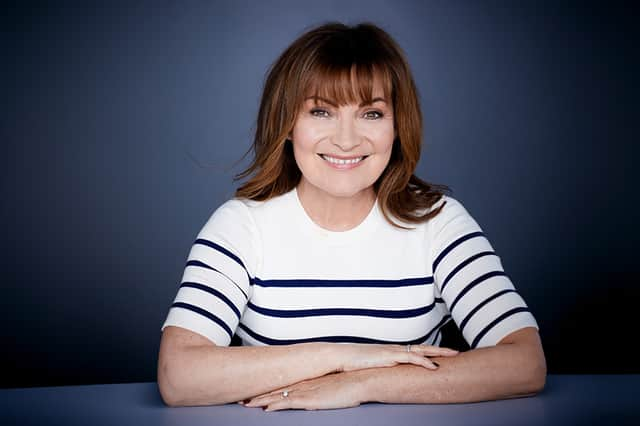
It’s hard to imagine it now, but even as late as the Eighties a non-RP accent was hardly ever heard on television. Even BBC Scotland told Lorraine Kelly she’d never do anything more than vox pops for the channel.
When she rebelled at that and got a job at TV-am in 1984, her new boss told her: “I like you because you’re quite common and you don’t make my trousers twitch”. As Kelly is one of the most likeable interviewees imaginable, a shock of indignation ran through the audience.
Still, as she told Val McDermid, at least that got her to her beloved Orkney, the setting for her two novels, because she went there for her first story for TV-am to report on the shortest flight in Britain - between Westray and Papa Westray.
Unless all her family joins her, she wouldn’t want to live on the archipelago, but apart from the pandemic, she has been back every year since. Indeed, it is where she was heading as soon as she finished her event.
What, a member of the audience asked Samira Ahmed and Ian Lesley - both authors of intriguing-sounding books about the Beatles - would they think of something equivalent to Abba Voyager for the Beatles?
“It’s bound to happen,” said Ahmed, pointing out the appointment of Apple Corps’ new CEO and the scheduled 2028 release of Sam Mendes’s series of films about the Fab Four.
“Who wouldn't be tempted to have the experience of experiencing a Beatles concert in a way that it never would have been in reality? For one thing, you’d be able to hear them (no screaming kids) and the sound quality would be astounding. It’s going to happen.” David Robinson
The Scotsman’s arts newsletter is now sent twice a week - subscribe today
Enjoying the Arts & Culture journalism on scotsman.com? Make it easier to find by selecting us as a preferred Google source
Want the latest Scottish headlines sent directly to your phone? Sign up to our new WhatsApp channel here
Comments
Want to join the conversation? Please or to comment on this article.