
Edinburgh Fringe dance reviews: Border Bodies | Basque Showcase | TWELVE | Celtic Collective
A five-star show from Brazil about peaceful immigration and boxing-inspired choreography from New York are among our critics’ highlights of the best dance to see at the Fringe
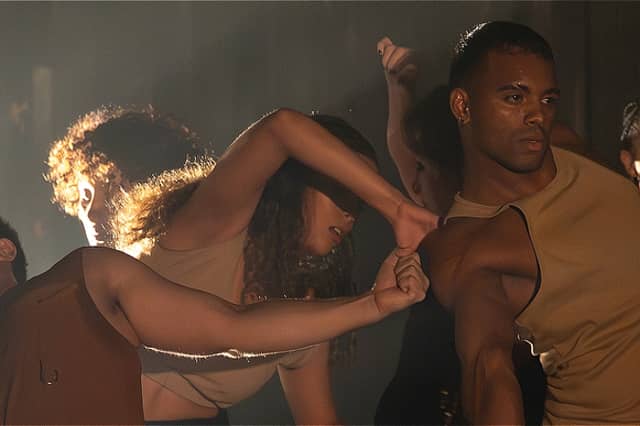

Border Bodies ★★★★★
Dance Base (Venue 22) until 30 August
In the closing moments of Border Bodies, as seven individuals stand before us, sweat glistening, eyes smiling, it’s clear they’ve been on a journey. So have we. It’s a far cry from the opening scene: an extended section populated by almost imperceptible twitches, that leaves you wondering if anything is ever going to happen. Fear not, this is simply a metaphor for dislocation, isolation, and minds closed to the notion of peaceful immigration.
Once they start to move, arms slicing sharply through the air, the arduous road to harmony begins. An energetic, almost violent push and pull finds the dancers in a circle, pulsating in and out. From there, the swarm traverses almost as one across the stage. Arms reach out, clutching the limbs of another in a bid to attach. In other, less charitable moments, they attempt to climb over each other to reach the top and breath clean air. But it’s a road to nowhere, where nobody truly wins – moving as a collective is the route forward.
Part of the São Paulo showcase at this year’s Fringe, Brazilian company T.F. Cia de Dança is known for what it terms “contemporary urban dance”. It’s a genre that’s rife with sub-genres, and one of the starting points for director Igor Gasparini who (along with the other six dancers) co-created the piece. All of the performers operate within slightly different dance styles, at first invisible but exuberant and voluble by the end. Between them, they send an increasingly loud and clear message that while more unites us than divides us, individuality can still shine in a group.
As the movement slides in and out of tempos (slow motion, staccato, high speed juddering), Carlos Ranoya’s superb original score rides alongside them, with an often infectious beat. From their shoes and clothes, to their hair and skin colour, Border Bodies is a coming together of people with their own heritage, desires, technical training, and attitude. But the human need to connect pulls them into a warm, exciting embrace that spills out into the crowd. Kelly Apter
Basque Showcase: Jarraibiderik Gabe and Trembling Frequencies ★★★★
Dance Base (Venue 22) until 16 August
Helena Wilhelmsson isn’t afraid to wear her feelings on the outside. In her new solo, Trembling Frequencies, the Swedish-born dancer experiences the full gamut of emotions, and we’re party to all of them. One half of the Basque Showcase double-bill (Wilhelmsson relocated to Spain many years ago), this passionate work is drenched in rage, confusion, and a need to be heard.
Sitting on an upturned bucket, her back to the audience and buried beneath a headscarf, raincoat and high heels, she initially seems unavailable. Once Wilhelmsson lets us in, however, we’re taken along for the ride. Each silenced scream (head in the bucket, scarf stuffed into her mouth) is raw and penetrating; a powerful template onto which the audience (especially women) can project their own experiences. When she dances, heels kicked off, coat thrown aside, her movement is expansive and beautifully executed.
Prior to Wilhelmsson’s solo, we’re treated to Jarraibiderik Gabe, a duet from newly formed young Basque company Erain. Ioar Labat and Julia Razquin share the stage with an array of scattered tubes, the grey plastic echoing the dancers’ muted costumes. Coupled with the industrial bangs peppering the soundtrack, the set relocates us to a building site; a place of growth and possibility. But, like life, there are no instructions, the duo must assemble the network of pipes without a manual. Each tube is inspected, peered through, hands and feet inserted then withdrawn, as they explore.
When they eventually piece it all together, the frenetic movement that follows suggests a condemnation of over-construction in our towns and cities, or a life pushed to the edge by busyness. But that’s for us to interpret, nothing here is spelt out or spoon-fed. In both their deft choreography and skillful delivery, Labat and Razquin are wonderfully abstract and endlessly watchable. Kelly Apter
TWELVE: Going The Distance ★★★
Summerhall (Venue 26) until 16 August
With the audience seated in the round, bundles of towels, bottles of water and signs proclaiming rounds two, five and eight on the sidelines, are we in for a fair fight or a messy scrap? A trio of performers warm up with tai chi-like moves, flat palms occasionally forming fists to a soundtrack of dissonant pizzicato strings. After several balletic rounds, the music becomes more hectic and they sling a synchronized left hook. Two more women join the dance and the scene is laid for a thoughtful but suitably athletic exploration of the common precision and grace in boxing and choreography from New York-based company Ballaro Dance.
TWELVE: Going the Distance never really breaks sweat or conveys its titular sense of endurance, opting for a more hypnotic interpretation of pugilism. Set-pieces range from a non-contact slo-mo slug of a pas de deux (set to music from Delibe’s Flower Duet), to a more intense bout involving fluid lifts from a solo fighter under pressure in the ring, to a dynamic ensemble street dance set to a blaring hip-hop track. A stern referee injects a bit of levity, while four dancers assume precision angles to become the pillars of the boxing ring itself in the show’s most effective display of the teamwork and tensile balance of this all-female ensemble. Fiona Shepherd
Celtic Collective ★★★
Dance Base (Venue 22) until 16 August
This coming together of two of the UK’s young contemporary dance companies is a timely reminder of two things. Firstly, that there is a hotbed of talent that deserves to be nurtured, and secondly that the global anxiety visited upon this generation is not easily borne.
First up in this energetic double bill, is Momentum – Undone by National Youth Dance Wales. An excerpt from a larger piece originally choreographed by Marcus Jarrell Willis for Ballet Cymru, it’s a work of strength and grace. Six dancers, each with their own giant mirror to hide behind and look into, explore the boundaries of their own resilience in the face of uncertainty.
Dressed in golden costumes that sparkle and shine, the 13 performers of the National Youth Dance Company of Scotland look ready to party. But the young woman woefully singing Skeeter Davis’s The End of The World suggests otherwise. She omits the lines about love, implying the song has been commandeered for a bigger picture worry. Tess Letham’s choreography for Afterglow neatly combines celebration and confusion. But as the piece closes, with a joyous, freestyle romp to Janis Joplin’s Kozmic Blues, we get the sense that all is not yet lost. Kelly Apter
Enjoying The Scotsman's coverage of the Edinburgh festivals? For just £2 a month you can get unlimited access to scotsman.com plus 2-for-1 Fringe tickets. For details visit www.scotsman.com/subscriptions
The Scotsman’s arts newsletter is now sent twice a week - subscribe today
Enjoying the Arts & Culture journalism on scotsman.com? Make it easier to find by selecting us as a preferred Google source
Want the latest Scottish headlines sent directly to your phone? Sign up to our new WhatsApp channel here
Comments
Want to join the conversation? Please or to comment on this article.