
'I've given it my own ending' - musician Floating Points on reinterpreting the Pandora myth for ballet


When the San Francisco Ballet invited British electro musician Sam Shepherd, aka Floating Points, to score a short work, he insisted on doing a full ballet. As the result gets set to bring the Edinburgh International Festival to a close, he tells David Pollock about why he’s interrogating the Pandora myth – and why everyone should move to Scotland
“It was one of the most dystopian shows I've ever done,” says Sam Shepherd, the musician otherwise known as Floating Points, of his only previous experience of the Edinburgh International Festival. The year was 2021, still in the midst of the pandemic but at a point where live music was beginning to open up again.
In Edinburgh the International Festival was at the forefront of this, opening three tented, socially-distanced venues across the city, including the more contemporary-oriented one Shepherd performed in out at Edinburgh Park.
“It was brilliant, though, because for something that didn't seem viable at the time, Edinburgh made it possible,” he continues. “There was such a desire to make something happen. There were these little pods and all these staff around, making sure everyone was separate. I was in a phase of making really banging electronic music, so I was nervous it would be a bit strange, but it was a great show.”
Enjoying The Scotsman's coverage of the Edinburgh festivals? For just £2 a month you can get unlimited access to scotsman.com plus 2-for-1 Fringe tickets. For details visit www.scotsman.com/subscriptions
The ballet Mere Mortals will be Shepherd’s first, having built his name as an electronic composer and DJ under his Floating Points alias for the best part of two decades. Most well-known as a recording artist on the esteemed Ninja Tune label, his first orchestral work also arrived in 2021 – an auspicious year – with the release of the Promises album alongside jazz saxophonist Pharaoh Sanders and the London Symphony Orchestra.
Mere Mortals came about indirectly at first, via Shepherd’s partner Hannah Ekholm, dancer and choreographer with the duo Ecleido (who are performing as part of the Ballet Nights programme at the Assembly Rooms during the Fringe’s final week). Ekholm, in turn, is friends with Tamara Rojo, currently artistic director of the San Francisco Ballet and formerly AD at the English National Ballet. Over dinner together one night, Rojo asked if he might like to score a short five or ten minute work for the SFB.
“I was like, no, I want to do an all-or-nothing full evening performance,” says Shepherd, laughing at his temerity. Yet within days, Rojo had the beginnings of a production team together for him, which grew to include choreographer Aszure Barton. “I needed to tell a story to pin the music on, and I was really interested by the story of the scientist Oppenheimer and his creation of a devilish instrument. Then Christopher Nolan announced a film by the same name and I was like, oh, that'd be a bit weird now, I don't think I should do that.
“At the same time my partner was reading Natalie Haynes' book on Greek mythologies, and she was telling me that the Oppenheimer story is at its core the same as the Pandora myth. So I diverted my attention towards Pandora, then got sucked into this world of etymological bias that exists within translation of these ancient texts.”
He speaks particularly of Erasmus’s 16th century Christian mistranslations of the Pandora myth. “It took her positive attributes and objectified them, took her negative attributes and moralised them,” he says. “It made Pandora this evil temptress. I'm interested in the idea that our understanding of these stories is morphing through time, through all these different lenses, and so the music I wrote for this ballet tried to pin the themes on these ideas.”
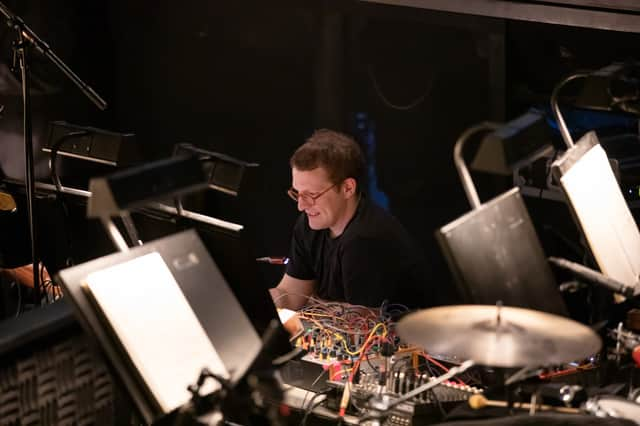
Although Shepherd worked with the San Francisco Ballet Orchestra in recording the album version of Mere Mortals, he’s excited to be working with the Royal Scottish National Orchestra here, his “local orchestra”, which he’s heard nothing but good things about. He will also be producing and helping to perform the score with a modular synthesiser system on the night, and he’s taken advice on how to do things differently for a ballet.
“It’s my first time writing for ballet and for such a large ensemble, and I don't know what I'm doing,” he says modestly. “I spoke to (the composer) Thomas Adès and he gave me some useful pointers. He said, ‘remember, dancers need to get from one side of stage to the other, you need to take your time with things’. So there are things there that are slightly longer than you might expect a piece of music to take, then in the album version I’ve chopped bits out and condensed them a little bit.”
He speaks with precision about the rather complex electronic arrangements he’s created, but I wonder if, with so many moving parts in terms of orchestra, dancers and so on, it might not feel like he’s just holding on for the ride during the live production?
“Always!” laughs Shepherd. “I guess what I’ve done is taken the Pandora story and given it my own ending. I haven't been explicit about what that is, but I think it’s in the music, and so I would like it to spark people to think about the story of Pandora and how it all ends. It doesn't really have an ending in the original text, so I want it to spark some contemplation of what it means for all evil to be broken out in the world, and the end result of that.”
That bizarre but welcome experience in 2021 aside, this will be Shepherd’s first visit to Edinburgh during the Festival and Fringe, and he asks for recommendations for where to go and what to see while he’s here.
“I'm psyched, especially because I don't live far from there now,” he says. “I moved up to Scotland a year ago, so now Edinburgh’s relatively on my doorstep.”
It turns out Shepherd, who is from Manchester, and Ekholm now live “in the middle of nowhere”, which happens to be quite near Oban.
“The Highlands are beautiful,” he says, by way of explanation. “There's something about Scotland, like I've maybe always felt more aligned to it, politically and socially. The people are very nice, every time I come to Glasgow and Edinburgh there's such a warmth. That's not to diss where I’m from, but I just loved it so much every time I came here that I was like, maybe if the opportunity arose I would move up?”
READ MORE: How to get tickets for the San Francisco Ballet's Mere Mortals at Edinburgh International Festival
There’s no family connection behind the move, beyond some childhood memories. “Every summer holiday was spent here as a kid,” says Shepherd. “We didn't really have the means to travel abroad, so the holidays were kept within a car drive from Manchester. We went to Mull a lot, so I know the island very well. Going to Oban to do my weekly shop now is weird, going back to the place I used to think was kind of boring as a child, but now I appreciate the quality of the seafood and all the things that are just phenomenal about the West Coast.”
Once word gets out, I tell him, everyone will be trying to claim him as a Scottish artist. Shepherd seems entirely happy with that. “I think everyone should move to Scotland,” he says, matter of fact. With Mere Mortals, he’ll be hoping to make an impression in his new homeland on one of its biggest stages.
Mere Mortals, Playhouse, 28-30 August
The Scotsman’s arts newsletter is now sent twice a week - subscribe today
Enjoying the Arts & Culture journalism on scotsman.com? Make it easier to find by selecting us as a preferred Google source
Want the latest Scottish headlines sent directly to your phone? Sign up to our new WhatsApp channel here
Comments
Want to join the conversation? Please or to comment on this article.