
Scottish Ballet’s Mary, Queen of Scots at EIF – ‘she had to almost become like a man to survive’
How do you say something new and original about Scotland’s most famous and storied queen? The Scottish Ballet team tell Kelly Apter it’s all about emotion
In real life, they never met - but so imaginative is Scottish Ballet’s new production, that Mary Queen of Scots and Queen Elizabeth I share a brief moment of connection on stage. Not literally, but via the mounds of correspondence these two powerhouse women shared during their long-distance political rivalry.
“We thought it would be really satisfying to bring those two queens together, but as proxies,” explains choreographer, Sophie Laplane. “So it's actually the letters they wrote to each other that meet, and we have two dancers representing Elizabeth and Mary in an abstract way.” This is not unusual for Laplane, Scottish Ballet’s Resident Choreographer, who has made a number of dynamic abstract works for the company. Creating a full-length narrative piece, however, is a whole other proposition. So, joining Laplane as co-creator of Mary, Queen of Scots is director James Bonas, last seen at Scottish Ballet working on their excellent production of The Crucible.


With so many existing depictions of the 16th century cousins, both on stage and screen, Laplane and Bonas had their work cut out devising something new and original. Indeed, Scottish Ballet itself already has a production of Mary, Queen of Scots in its archive, created by company founder Peter Darrell in 1976. The lives of Mary and Elizabeth were also not short on drama, so knowing where and when to base the action was the first point of order.
“If you go beat by beat through Mary’s life, then you're on for a kind of Netflix miniseries,” says Bonas. “So we were keen to find a way to focus in on certain elements. And I'd say we were governed more by emotional, rather than socio-political choices.” Bonas and Laplane were also acutely aware that it’s all too easy for us to look at royal figures and see them simply as kings and queens, not human beings. In the end, it was the sight of a more recent monarch that led to their decision to view the entire show through the lens of Elizabeth’s memories, as her life draws to a close.
“It's all set on the day of Elizabeth’s death, so she's very fragile,” explains Bonas. “And in a way we were inspired by our own Queen Elizabeth. Sophie and I watched her on television when she met Liz Truss, who had just became Prime Minister, and the Queen had marks on her hand from the cannulas. She died two days later, but she’d had to get out of bed to show face, and Elizabeth I also had to carry on. There are rumours her make-up was an inch thick on her last day because she had to keep looking like the queen she was.
“So we begin with a very vulnerable woman who's feeling lost, disoriented and alone - and over the course of the show, we construct her until you see the full Elizabethan image we're used to, but she's nearly dead inside it all. And with Mary, it’s the reverse. We start with her as a sophisticated and wealthy Renaissance queen in France, but by the end she's just dressed in underwear and about to have her head cut off.”
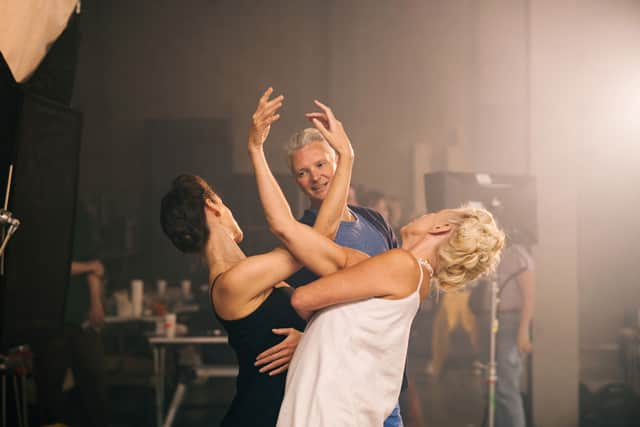
Portraying strength and fragility in a single character isn’t easy, but it made for some interesting casting. To capture the essence that Elizabeth I was a woman operating in a male environment and had to, as Bonas says, “almost become like a man to survive”, they have cast a male dancer to play Elizabeth’s younger self. While the older version will be portrayed by Swedish guest dancer, Charlotta Övferholm. A long-time friend of Scottish Ballet’s artistic director, Christopher Hampson (who refers to her as “a force of nature” and “fearless”), Övferholm is passionate about older dancers being represented on stage. When I mention that so often in ballet, they’re relegated to holding a glass of sherry at the back of the stage, she laughs. “I know that I'm double the age of everyone in this company, but I don't feel it,” says Övferholm. “All the work I create is very physical, so I think I would have a difficult time walking around with a glass of sherry. I would not take that job - I would rather serve the sherry in the intermission at the bar!”
Both Övferholm and Roseanna Leney, who is portraying the titular Mary, found having a director and choreographer at the helm helpful. “Working with James and Sophie has been amazing,” says Leney, “because they’ve made sure that how we react to a certain situation feels genuine. Mary was a mother, a widow, and had horrendous struggles, but she was also a formidable woman in a man’s world. So I’m trying to embody all of that, but then during moments when I'm alone on stage, I'm also allowing her vulnerability to show.” Övferholm has worked with some of the world’s finest physical theatre companies, so knows a good thing when she sees it. “James doesn't want anything fake or overdramatic,” she says. “He wants it to feel real. And Sophie is creating incredible movement, so the two of them have a good craft together.”
From casting and storyline to costuming and music, this bold production may be a far cry from Darrell’s 1976 version, but it fits right in with the Scottish Ballet ethos. “I like to think that we’re known for our brave new productions, and for telling stories in relevant ways,” says Hampson. “And I know that’s what Peter Darrell was about, too. There will be some people who remember his production of Mary, Queen of Scots fondly, and I hope this new show just adds to that canon. Scottish Ballet was only seven years old when he made it, and now we’re 56. We’re all different as we get older and an organisation is no different. So I like to think of this new production as an evolution of Darrell’s work rather than something that’s in competition with it.”
Mary, Queen of Scots, Festival Theatre, Friday 15-Sunday 17 August.
Make sure you keep up to date with Arts and Culture news from across Scotland by signing up to our free newsletter here.
Comments
Want to join the conversation? Please or to comment on this article.