
Edinburgh Book Festival round-up: Olesya Khromeychuk & Jen Stout: Remembering Victoria Amelina | Philippe Sands: Bringing Evil to Justice | David Baddiel: A Family Affair
A tribute to the late Ukrainian novelist, poet, activist and Orwell Prize winner Victoria Amelina leads our latest round-up of Edinburgh International Book Festival events. By Susan Mansfield
A BOOK Festival isn’t always about the people who attend, sometimes it’s about the people who are absent. The absence of Ukrainian writer, poet and activist Victoria Amelina, who died in July 2023 in a Russian missile strike, was keenly felt on Monday at Remembering Victoria Amelina when Scottish journalist and writer Jen Stout and UK-based Ukrainian historian Olesya Khromeychuk joined forces to talk about Amelina’s final book.


Looking at Women, Looking at War was about 60% finished when she was killed and her editors, who included her partner, decided to publish it in its incomplete state, a collection of fragments of diary, memoir and testimony, because, as Khromeychuk says: “That’s what war does to life.”
Amelina had been a novelist but retrained to become a war crimes investigator, committed to hearing the stories of ordinary people and gathering them as material for future war crimes litigation. Khromeychuk described the book, which won the prestigious Orwell Prize in June, as “the sort of book that turns a reader into a witness”.
Stout read a particularly poignant paragraph in which Amelina describes visiting Nuremberg with her son and hearing him say to his cousin: “This room is important, we’ll try Russians here one day”.
Amelina mentions the word “impunity” in the context of Russia’s conduct both post-second world war and in contemporary Ukraine. That chimes with a comment made on Sunday evening by barrister and specialist in international law Philippe Sands, who described impunity as “the word of our times”.
His latest book, 38 Londres Street, documents the extraordinary events around the arrest and attempted extradition of Chile’s former dictator Augusto Pinochet from the UK in 1998, the first time that a former political leader was arrested in another country for crimes committed in his own country while he was president. He said there are “parallels of impunity between Pinochet and [some] current presidents around the world who are very careful where they travel to… This is a moment which is very alive right now.”
At the time, Sands acted on behalf of Human Rights Watch in the battle to extradite Pinochet, but said that 10 years of dogged research for the book revealed far more about the situation than he had guessed at. By tracking down and interviewing figures like Pinochet’s chief negotiator, and the woman who was his interpreter while he was in the UK, he was able to confirm that a deal was struck between Chile and Tony Blair’s government whereby Pinochet – after some schooling on how to mimic the symptoms of dementia – was returned to Chile on medical grounds in 2000.
Make sure you keep up to date with Arts and Culture news from across Scotland by signing up to our free newsletter here.
The book also reveals Pinochet’s friendship with former Nazi SS Officer Walter Rauff, the man responsible for the invention of the mobile gas chamber which claimed hundreds of thousands of lives. Not only was he granted political asylum in Chile, where he lived from 1958 until his death in 1984, he is also now understood to have played a role in the “disappearance” of many hundreds of political opponents of the Pinochet regime.
Just when one was starting to feel that a little bit of light relief might be welcome, David Baddiel arrived at the Book Festival to talk about his memoir, My Family. At the heart of the book is the extraordinary story of his mother Sarah’s long-running and not-very-secret affair with a golf memorabilia salesman, which his father resolutely refused to acknowledge.
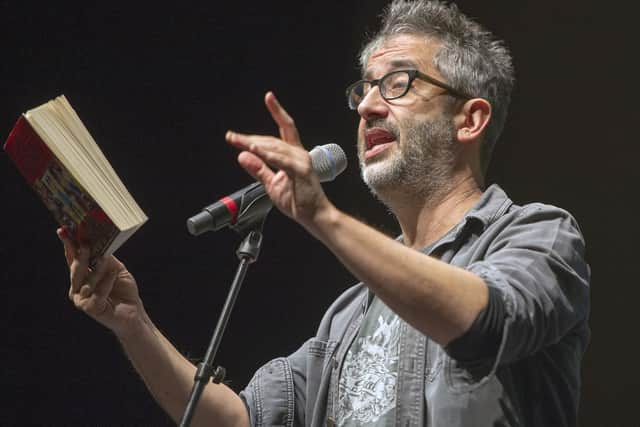
At his mother’s funeral, Baddiel explained, many people told him she was wonderful, but for him delving into the complexities of her life was an act of “reclaiming” the real person.
And, of course, he was very funny. “I could have written this as a misery memoir, whatever that is,” he said. “But comedy gave me the distance I needed from my own upbringing. If it’s funny, it’s positive. If you talk about something and it’s funny, it gets rid of shame.”
Comments
Want to join the conversation? Please or to comment on this article.