
Edinburgh International Book Festival round-up: Richard Flanagan | Andrey Kurkov
An encounter with the Booker-winning author of recent TV hit The Narrow Road to the Deep North leads Susan Mansfield’s latest dispatch from the Edinburgh International Book Festival
How does a kiss in Edwardian London spark a chain reaction which leads to the dropping of the atom bomb on Hiroshima? This is one of the questions posed by Tasmanian writer Richard Flanagan in his genre-bending memoir/novel/history book Question 7.
It goes like this. In 1911, the writer Rebecca West kissed HG Wells. So terrified was he by her proposition of a love without limits that he fled to Switzerland where he wrote his novel The World Set Free, in which he imagined a nuclear war. The book was a commercial failure, but gripped the mind of Hungarian Jewish physicist Leo Szilard, who would go on to work on the science behind the atom bomb. Fearful that the Nazis would develop the technology first, he petitioned Roosevelt to start a development programme which became the Manhattan Project.
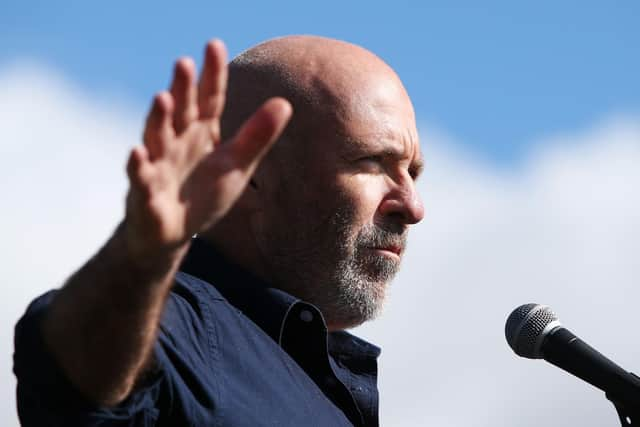

A deep thinker and quietly compelling speaker, Flanagan is well aware of the moral complexities in this story. It also touches him personally: the dropping of the bomb on Hiroshima lead directly to the release of his father from a Japanese labour camp where he would otherwise likely have died. In that sense, he owes his own existence to the bomb.
As he is not on this side of the planet very often, his visit to the Book Festival on Tuesday was a rare chance to encounter a unique writer and a unique mind. Flanagan, who won the Booker Prize in 2014 for his novel, The Narrow Road to the Deep North, explained that Question 7 was written in just ten months, after he was given a misdiagnosis of early-onset dementia (there was later found to be a mistake in the radiologist’s report).

However, the diagnosis focused his mind on profound questions about how we live, and on considering afresh how his parents lived. He realised that, in their “very ordinary lives”, raising six children in the Tasmanian rainforest, they “cleaved to the idea of love and goodness”. If we can take our moral compass from that sense of common humanity, he said, and resist any ideology which dehumanises another person or group, we might find hope in our troubled world.
To stay up to date, why not sign up to our weekly Arts and Culture newsletter? So you don’t miss a thing, it will be sent sent daily during August.
Leading Ukrainian novelist Andrey Kurkov also traced a chain reaction in his visit to the Book Festival, beginning with the writer Gogol and ending with the current war in Ukraine. Born in central Ukraine, Gogol wrote so beautifully about Ukrainian life and customs that he created a fashion for all things Ukrainian among the aristocracy of St Petersburg. It helped embed the idea in the Russian psyche that Ukraine was part of Russia.
Well-known for novels such as Death and the Penguin and a fluent English speaker, Kurkov has become a kind of ambassador for his country in this time of war. His war diaries, the second volume of which has just been published, offer humane and even sometimes humorous insights into daily life in a country at war.
Ethnically Russian – although he has lived in Ukraine since childhood – he spoke about choosing his country over his mother tongue. Russian is still his “internal language”, and the language in which his fiction is first written, though now it is read chiefly in translation: books in Russian are not sold in Ukrainian bookshops, and in Russia his books are banned.
He described the recent summit in Alaska as a “sitcom” in which the “main character… laid out the red carpet for the war criminal”. And he was cautious of any prospect of a peace deal, given the different motivations at play: Trump hoping to win a Nobel Peace Prize; Putin wanting to be remembered as “the tsar who made Russia great again”; Ukraine unlikely to agree to any split on territory.
He said: “For Ukrainians, freedom is more important than stability. For Russians, stability is more important than freedom. There is an ancient tradition in Ukraine to disrespect rules, laws, government, politicians and leaders.”
Comments
Want to join the conversation? Please or to comment on this article.