
EIF preview: Russian director Kirill Serebrennikov on his provocative production of Mozart's The Marriage of Figaro


Ahead of Komische Oper Berlin’s arrival in Edinburgh, Russian director Kirill Serebrennikov unpacks his ‘raw, physical and brutal’ reimagining of a Mozart classic
The Russian film, theatre, ballet and opera director Kirill Serebrennikov is fearless about reinventing opera’s sacred cows in order to amplify their resonance with modern-day audiences. Edinburgh’s opera-goers will discover as much when his thought-provoking production of Mozart’s The Marriage of Figaro for Komische Oper Berlin arrives in Edinburgh next week. Prepare to be challenged.
At the production’s April premiere in Berlin’s Schiller Theatre I witnessed a German audience healthily divided in their response to an audaciously provocative adaptation – this is not merely a period update – that casually inserts Mozart’s Dissonance Quartet into the finale (a haunting amplification of Count Almaviva’s psychological turmoil), invents a singing Cherubina to mirror a balletically mute Cherubino, and threatens to destabilise the Countess’s flagship aria, Dove sono, amid a fog of hyperactivity.
But let’s not give too much away. Suffice to say this is a pressure cooker production, manically pugnacious, in which class conflict is mercilessly exposed within a modern set that horizontally divides the belligerent basement culture of the underlings and the ostentatious bling and entitlement of the upper echelons. Not exactly Upstairs, Downstairs, but an exacting and vicious satire on that very theme.
Which brings us back to Serebrennikov and his own recent misfortunes through dissent. In 2020, convicted in Russia on spurious allegations of embezzlement and misallocation of state funds while artistic director of Moscow’s Gogol Centre, he was placed under house arrest – while still directing stagings abroad via Zoom – only to have his sentence quashed two years later. Since then he has abandoned Russia for a base in Berlin.
The whole episode was considered a political stitch-up, linked to Serebrennikov’s liberal, LGBT-friendly views. “It was quite an adventure,” he recalls with understated dismay. “Here, in Berlin, I’ve discovered a new life where I can work openly and communicate with free-thinking audiences. Everything I now read and know about my former motherland is very sad and very disappointing.”

“It reminds me a lot of the last few years of the Soviet Union, when everything felt rotten, was almost dead, where there was an absence of breath in the air. All of us kids understood quite strongly it would collapse quite soon, that the game was over.” Serebrennikov would have been a 20-year-old student around that time.
And nowadays? “To think this latest crazy lot had given so much money to the theatres, filmmakers, museums, and created quite a big platform for contemporary art, then in a single day destroyed everything. It’s become like objects in a museum, like stuffed birds. Okay, the theatres are still working, but it’s not theatre. Our galleries are all open but the exhibitions are not connected with contemporary art which, like theatre, requires intellectual freedom. If they’re all banned, prohibited, cancelled, and deeply oppressed, then what?
“With a system and society now organised around the [Ukraine] war, who knows when a brighter future for Russian artists will emerge? It could be ten years, which in history terms might seem nothing, but for people living their lives right now it is significant. Ten f***ing years!”
Central to his new Berlin adventure has been a compunction to unleash what he calls the “healing power of Mozart”. Figaro is the second leg in a project in which the Komische Oper are covering all three of the composer’s famous Da Ponte opere buffe. The first was a revival of the Così fan tutte production originally conceived in 2017 for Zurich Opera. Next season sees him complete the trilogy with a brand new Don Giovanni.
Being true to Mozart (and his librettist Da Ponte) does not, he insists, mean producing it for an 18th century audience. “These are provocative stories – games with the genders, with the social classes. Each opera by Mozart and Da Ponte was not accepted as nicely as they wanted it to be. There were issues with censorship. Mozart had to write the finale to Così in a way that explained it wasn’t that bad morally, just a game in the theatre; that we shouldn’t be scared or offended by it, but that it shouldn’t lose its edginess.” To achieve that now, he says, it is essential “to find something linked to our own lives and what we have today”.
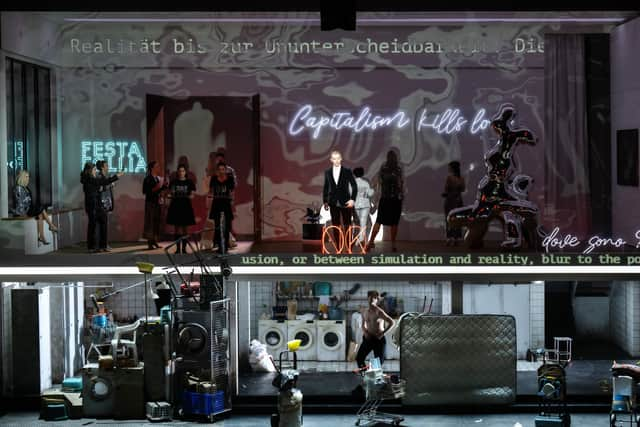
This is where Serebrennikov’s Figaro – for which he is also set and costume designer – is sure to divide opinion. What will purists make of arias uprooted to completely different acts? Or a super-sassy Susanna, rebel with a cause, who’d be well-advised to give up the fags? Or the total absence of Mozart’s prescribed chorus? And did I catch a fifth column quote from a completely different Mozart opera?
When it comes to justification, though, the self-taught award-winning director and designer exhibits rock-solid self-belief. Whether engaged on film (his 2021 Petrov’s Flu won the Vulcan award at Cannes, and in 2022 he was the only Russian represented there with Tchaikovsky’s Wife), theatre or opera, there has to be “contemporary relevance”.
“Successive generations look at opera and think it’s something that belongs to our parents; that we don’t want to go there, that we’re more about clubbing. I think that’s disrespectful to this huge legacy we have in music – all this opera, its thoughts and philosophical heritage. It’s our job to reload it, to reformulate it for new generations.”
Is there a red line he is reluctant to cross? “When I moved from my home town of Rostov, which had no opera company, I moved to Moscow, where I was directing theatre and ballet, and was introduced by a maestro to the world of opera. He explained how to work with a score, with musicians, orchestras, singers, so that later on, when I began to work with opera staging, I was confident in what I was doing. What I learned most was that if you don’t know how to work with the music then don’t touch it.
Does he offer any advice to audiences about to encounter his incendiary Figaro? “Go without any anticipation,” he insists. “Just be open-minded, openhearted, and look at the adventure we have prepared for you. It will be raw, physical, and brutal in a way, quite crazy and weird, but it will be joyful at the same time.”
Guaranteed, it will make you think. Four months after the Berlin premiere I’m still gobsmacked by its potent questioning.
Komische Oper Berlin’s The Marriage of Figaro, Edinburgh Festival Theatre, 16-18 August, www.eif.co.uk
Comments
Want to join the conversation? Please or to comment on this article.