
'Like a cosmic carousel' - Adele Thomas on directing Verdi's A Masked Ball at EIF


Director Adele Thomas tells David Kettle about the significance of the revolving set in her EIF production of A Masked Ball, and how setting the opera to Gilded Age America brings out some ‘uncanny’ parallels with the present day
It’s as if Verdi was thinking: ‘How can I smash together a Wagner opera and the can-can?’ The result is A Masked Ball.” Director Adele Thomas is reflecting on the perhaps unlikely duo of inspirations behind the Italian composer’s idiosyncratic opera, as related to her by eminent conductor Sir Antonio Pappano just before she began work on her staging of the work.
That unorthodox collision, however, goes a long way towards explaining the striking contrasts in material, tone, even genre within A Masked Ball. The production’s conductor, Gianandrea Noseda, takes a similar perspective. “By the time he came to write it, Verdi had had a lot of success with Il trovatore, La traviata and Rigoletto. But he wanted to become a better composer. His next opera – I vespri siciliani – was the first time he approached French grand opera. Then shortly after came A Masked Ball, which for me is the ultimate in melodrama, with elements of both comedy and tragedy – precisely what we expect from a melodrama.”
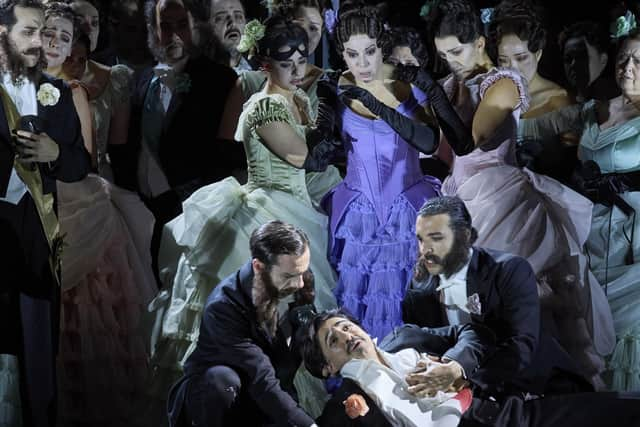
Comedy, tragedy, Wagner, can-can: it’s a heady mix, but it’s also an amalgam that’s played a crucial role in the way Thomas has approached her American-set production, first unveiled at Zurich Opera in 2024, revived earlier this year, and heading to Edinburgh for four outings at the International Festival.
And for Thomas, that heady mix brought to mind another influential artistic figure. “What I love about Verdi goes right back to my English studies at university, which of course covered Shakespeare.” Verdi was, she explains, “a Shakespeare obsessive”: indeed, the composer created operas based on Macbeth, Othello and Falstaff, and spent decades contemplating an operatic King Lear. “Early in his career, Shakespeare adheres to rules about genre, and he’s brilliant within them. But as he grows more confident, he plays more with genre, so you get things like Love’s Labour’s Lost, which is ostensibly a comedy with a tragic ending, and Measure for Measure, which is almost a tragedy with a complicated, weird comic ending.”
Enjoying The Scotsman's coverage of the Edinburgh festivals? For just £2 a month you can get unlimited access to scotsman.com plus 2-for-1 Fringe tickets. For details visit www.scotsman.com/subscriptions
Thomas sees parallels in A Masked Ball. Its storyline does indeed combine political intrigue, a doomed love triangle, and even elements of the supernatural. Ruler Riccardo falls for Amelia, wife of his trusted friend and confidant Renato, and (it’s probably no spoiler to reveal) he later meets his grisly end at Renato’s hands in a lavish masked ball, a fate foretold by the sorceress Ulrica. “In a piece like this,” explains Thomas, “I think the key is to allow the different elements and styles to exist, and not to squash them into a kind of middle ground. A lot of the process of coming up with the design and concept was about defining what world would allow that.” A focal element in Thomas’s staging addresses precisely that question. “There’s a central carousel that just keeps on turning: it starts off as an autopsy room, then becomes the Senate, then Ulrica’s den, then a back alley, then the constantly spinning ballroom. It’s almost like the wheel of fortune, a never-ending cosmic carousel.”
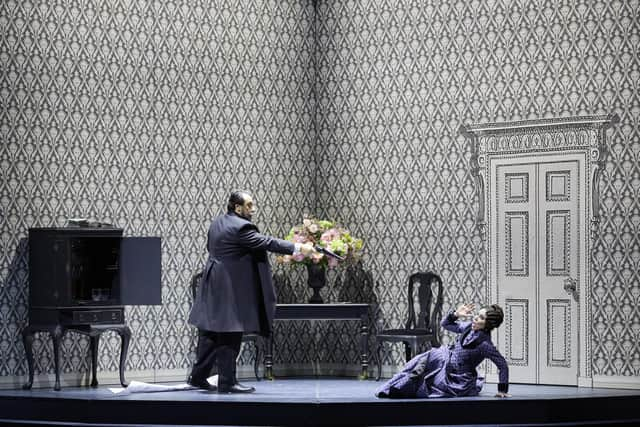
The idea of a cosmic carousel of settings and locations could equally well be applied to the history of the opera itself. Verdi and his librettist Antonio Somma originally based it on the real-life assassination in 1792 of King Gustav III of Sweden, but killing a European monarch on stage was deemed wholly unacceptable by Neapolitan censors, so the composer was forced to relocate the action to far further-flung colonial Boston, USA. Many modern-day productions reinstate the Swedish setting, but Thomas has opted instead to remain Stateside – although not quite in the era that Verdi originally planned. “There’s a line in the libretto right near the start about a ‘virgin world’, so it was obvious to me that that should be America. But we’ve set it in the 1880s, in the so-called Gilded Age. At that time we’re hurtling towards the 20th century, with technologies like light bulbs and new surgical procedures and printing processes, but at the same time there are ancient ideas like tragedy, death and revenge that the characters can’t outrun.”
A powerful US ruler, simmering unrest, whispers of scandal: was Thomas not tempted to make more explicit references to our own turbulent times? “I just didn’t think we needed to. And honestly, I can think of nothing worse than making it about Donald Trump, because he’s not the end point. He’s a symptom of something much deeper. And that’s what I find really fascinating.”
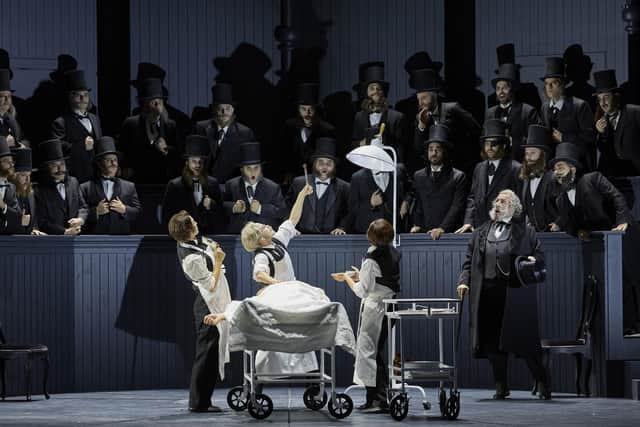
Instead, Thomas feels, the somewhat uncanny parallels between Gilded Age America and today don’t need over-emphasising. “You get the growth of the robber barons like the Rockefellers and the Vanderbilts, families that still control immense power now, and you get the birth of American banking systems and the kind of accelerated capitalism that essentially leads us to where we are today.”
Even the opera’s supernatural elements find telling parallels in a fascination with spiritualism in the late 19th century. “Every time technology advances, there’s a parallel fascination with the indescribable and the unfathomable – as though science gives us explanations and rationales, but people also crave the irrational, the unseen, the unknown. One of my favourite references there was Whoopi Goldberg’s character Oda Mae Brown in the film Ghost. The supernatural Ulrica has to be very over the top: her psychic abilities are entirely a performance, until she realises that they might actually be real.”
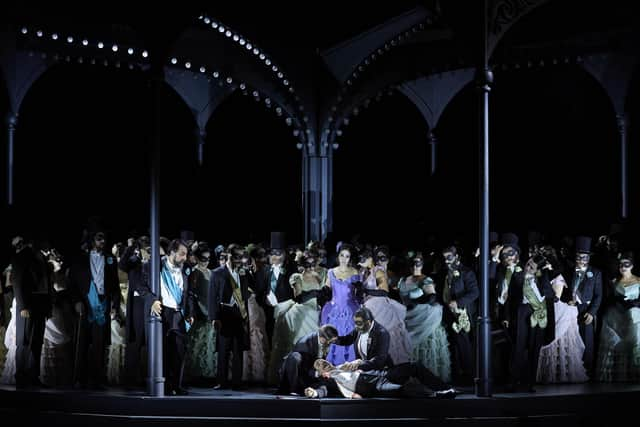
Thomas’s production has been celebrated for its insights, its clarity and its power. “I think it’s a very satisfying night at the opera,” smiles Noseda. “Adele has done a great job with it, and I’ve been very happy to be part of that process.” And despite the opera’s unconventional collision of styles, its intertwining themes and its idiosyncratic storyline, A Masked Ball remains enduringly popular. Why is that? Thomas singles out one particular element. “I just love Verdi’s music. Where else do you get to hear a genuine can-can and then a final chorus that Wagner would have been proud to write? It’s like a banquet of unbelievable musical dishes, and that’s what makes it really exciting. As time goes on, I think we’ll start to realise that its inherent contradictions are what make it fascinating, and very human. We all contain multitudes, which are often in direct collision with each other, but that’s what makes life so compelling.”
A Masked Ball, Festival Theatre, Edinburgh, 26-30 August
The Scotsman’s arts newsletter is now sent twice a week - subscribe today
Enjoying the Arts & Culture journalism on scotsman.com? Make it easier to find by selecting us as a preferred Google source
Want the latest Scottish headlines sent directly to your phone? Sign up to our new WhatsApp channel here
Comments
Want to join the conversation? Please or to comment on this article.