
Fringe theatre reviews: Mayflies | After Party | Cathy


Death and grief loom in new work by Grid Iron, Morna Young and Eilidh Loan, writes Joyce McMillan
THEATRE
Mayflies ★★★★
Brown’s of Leith (Venue 320) until 30 August
After Party ★★★
Cathy ★★★★
Traverse Theatre (Venue 15) until 30 August
Death comes as a shock to all of us when it first begins to brush close, taking those we once assumed would be in our lives forever; and year’s Fringe features three major shows made in Scotland, all of which seek new creative perspectives on our mortality, and our attitudes to it.
At Brown’s Of Leith, Edinburgh’s brilliant site-specific theatre specialists Grid Iron tackle the task in characteristic style, opening up a fabulous old warehouse space on The Shore for their new staging of Andrew O’Hagan’s acclaimed 2020 book (and later television drama) Mayflies.
Mayflies is essentially a love story about the profound friendship between two men, Tully and Jimmy, who grew up together in a working class Ayrshire town, and are bonded forever by their intense shared teenage experiences in music and culture, notably an unforgettable weekend in Manchester at the great Tenth Summer music festival of 1986.
Jimmy is a quiet, observant lad, who eventually becomes a successful writer. Tully, though, is the star of their group of friends, a brilliant, cool, charismatic and fearless character; and when, 30 years on, he calls Jimmy to say that he has had a terminal diagnosis, and that he wants help in arranging to end his own life when the time comes, Jimmy feels compelled to step up.
All of this, and particularly the early part of the story, is brilliantly conjured up in director Ben Harrison’s stage adaptation, which brings the warehouse space alive with fine late-1980s beats from David Paul Jones’s soundtrack, and stunning projected images, video and light by Lewis den Hertog and Simon Wilkinson.
Among the powerful, fast-moving ensemble cast, new Royal Conservatoire of Scotland graduate Jude Bain delivers a truly stellar central performance as the irresistible young Tully, quietly matched by Kieran Devine’s thoughtful young Jimmy; Lucianne McEvoy is equally vivid and poignant as the older Tully’s grief-stricken partner Anna. And if Graham Mackay-Bruce and Matthew Pidgeon are more subdued and less memorable as the older Tully and Jimmy, the downward arc of the story perhaps makes that shift almost inevitable.
Some sharp cutting, in the final movement towards an exit that most in the audience will understand only too well, would do no harm to the show; but otherwise, Mayflies offers an almost flawless evocation of O’Hagan’s beautifully told story about the gentler rhythms of male friendship, in an age when traditional masculinity is often viewed as toxic; and about how the ghosts of an old, violent culture of emotional silence and repression can still haunt Scotland’s menfolk, to the end.
Morna Young’s latest play After Party tackles the same subject in a very different style, in a full-length family drama that revolves around the vivid, complex, and hugely entertaining figure of Vivienne, dazzlingly played by the great Alison Peebles. Viv is the retired actress mother and grandmother of a warring clan who gather for a major birthday party at her place, only to find that - in a Scotland that has finally enacted an assisted dying law - she is also, after a grim diagnosis, celebrating the eve of her planned death.
The story of After Party therefore evolves into a familiar one from generations of plays set around the death of a leading family member, as relatives panic over the will, try to bully Viv into changing her plans, and learn with shock that Viv is now married to her money-grubbing son Geoff’s first ex-wife, Carol. There is a hugely entertaining cameo from Benny Young as Viv’s actor husband Bill, father to Geoff and to Viv’s bible-bashing daughter Lily, played with passion by Hilary Maclean.
The play’s problem, as a piece of theatre, is not that it lacks entertaining and insightful incidents or fine performances; but simply that it tries to do too much, in a two-act format that creaks under the strain of giving credible storylines to all nine characters. In describing the plot, for example, there is no cause even to mention the two characters who open the play, Viv’s tearful New York-based grandson James, and his improbable rock star girlfriend Cass, beautifully played by Ruby Glyne; and the fact that they are so superfluous to the structure of the story speaks volumes about a play that often seems more like a series of sketches for other works, than a single dramatic movement in its own right.
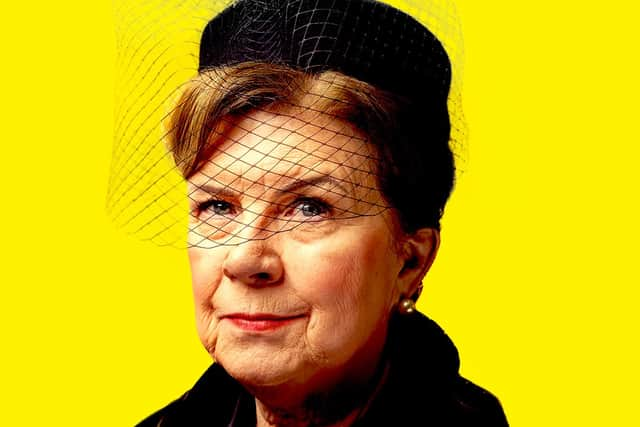
There’s no such problem, though, with Eilidh Loan’s new play Cathy, another drama about death that begins with the funeral of Tommy, beloved husband of the play’s central character, Cathy. To call Cathy a feisty widow is to understate the case. Played with tremendous flair by Elaine C. Smith, she is sharp-tongued to the point of cruelty, and militantly grief-stricken over the death of her man, whom she loved as she has been frankly unable to love anyone else, including her daughter Flo. She is also a strong Catholic, although not of the loving and forgiving kind; and we hear her giving God a sharp warning, in her prayers, that she cannot stand the pain of her loss, and will end her own life if he does not do it first.
The arc of the story, of course, concerns how this difficult woman gradually learns to live with her loss; and if it is a familiar tale, it is handled with a near-perfect narrative and comic flair in Eilidh Loan’s own production, delivered by a perfectly-cast five strong ensemble, and featuring some briliantly sharp dialogue, set in the still-sectarian landscape of west central Scotland.
The saving grace in the story comes from Cathy’s single and pregnant granddaughter Amy, and her charity-shop employer Lizzie, an improbable guiding angel, beautifully played by Sally Reid; and if the play’s closing nativity scene veers towards the sentimental - well, life itself sometimes does that, when the broken- hearted find a moment of happiness, and a reason to live again. Joyce McMillan
The Scotsman’s arts newsletter is now sent twice a week - subscribe today
Enjoying the Arts & Culture journalism on scotsman.com? Make it easier to find by selecting us as a preferred Google source
Want the latest Scottish headlines sent directly to your phone? Sign up to our new WhatsApp channel here
Comments
Want to join the conversation? Please or to comment on this article.