
Fringe theatre reviews: Tether | Aliens | Lucy Best: Unbelievable | The Woman in the Mirror | The Reunion
In their latest Fringe theatre round-up, our critics review a passionate collaboration between a Scottish and Korean theatre company, a play about a mother and daughter exploring their shared Irish/Italian heritage, and a drama about father/son road trip to see Oasis
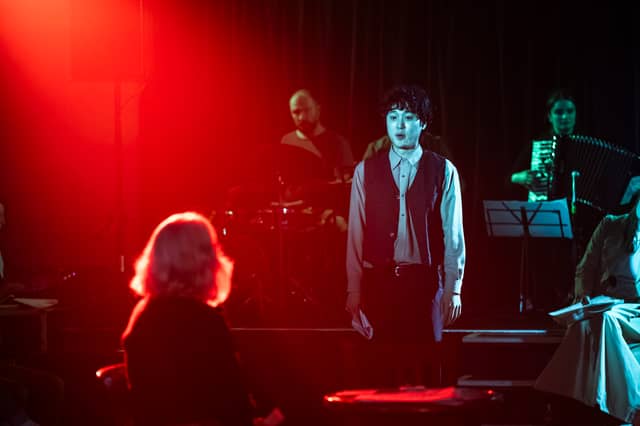

Tether 4 stars ★ ★ ★ ★
Summerhall (Venue 26) until 31 August
Co-created by the brilliant young Scottish company Wonder Fools with South Korea’s Theatre SAN, Tether – played out in the ceilidh place that is Summerhall’s Main Hall – is a true international co-production, developed over two years of intense conversations between Scottish and Korean theatre-makers, including writer-directors Robbie Gordon, Jack Nurse and Yoon Jungwhan.
Set in three time-periods between 1918 and 1970, Tether is an ambitious and sometimes exhilarating piece of music theatre, featuring a cast of seven backed by an excellent six-piece live band, which begins and ends with some real-life ceilidh dancing, in which the audience is invited to join. The show tells the story of young Dae Han, a Christian convert from South Korea who arrives in Glasgow in 1918 to study the Presbyterian faith, only to find the life of the city much more diverse and unruly than he expected.
Enjoying The Scotsman's coverage of the Edinburgh festivals? For just £2 a month you can get unlimited access to scotsman.com plus 2-for-1 Fringe tickets. For details visit www.scotsman.com/subscriptions
Staying in a lively Glasgow lodging-house, he soon falls in love with the landlady’s daughter, Jane, a beautiful singer and dance-caller to whom he teaches an old Korean song of love, longing and separation, called Arirang, before he returns home to join his country’s struggle for independence. And it’s a melody that echoes down the generations in Scotland and South Korea, so that Jane is still singing it in the 1950s, when her daughter Nancy travels to Korea as an army nurse, and in 1970, when Dae Han’s granddaughter arrives in Scotland to research Scottish folk-song.
All of this is told in sketchy outline, but with great feeling, in an hour-long show that cannot explore such an epic story in any depth, but is beautifully told and sung, notably by Molly Bryson as young Jane, Isabella Jarrett as older Jane, and a moving and thoughtful Hyeonkyu Choi as Dae Han. And the high technical demands of the story – combining music, surtitles, movement, dialogue and songs – are handled with impressive skill by the whole Tether team; in a show that never quite gives itself time to focus fully on the story it wants to tell, but is still full of energy, entertainment value, and real collaborative passion. Joyce McMillan
Aliens ★ ★ ★ ★
Zoo Southside (Venue 82) until 30 August
We start on a film, an obvious home video, two women laughing. They’re in a car, passing a van with the legend ‘Morelli – Ireland's famous Italian ice cream’ on the side. The elder woman says she once met the twin brothers who founded the real-life company, explaining how they were raised separately after the war. One speaks fluent Italian with an Italian accent, the other has a Belfast accent and no Italian.
This sense of cultural disconnection is germane to Aliens because the two women making the trip, Alessandra Celesia and her daughter Marta, share the same Irish-Italian ancestry. Their story rolls out over the course of the piece; of how filmmaker Alessandra met Marta’s Irish father at theatre school in Paris; of how they were married in Donegal and Marta was born in Belfast; of how Alessandra couldn’t settle, feeling like an alien abroad, and took her daughter back to Paris to raise her.
This tale is detailed through the medium of a hopefully cathartic road trip (or series of trips) the women took together, as relayed here through film, dialogue, storytelling and a live score performed by a third artist. The pair start in Donegal, off the coast of which the SS Arandora Star was sunk by a German U-boat in 1940, killing many Italian internees being shipped to Canada. Then they travel to Belfast, where stories of Italian chippies being smashed, bombed and burned are told.
In Calais, Marta’s girlfriend Elise works for a voluntary sea rescue hotline, trying to save migrants from drowning in the Channel. Then they’re in the small Italian hillside village of Casalattico, where many Italian migrants to Ireland originated, the place now a hollowed-out summer destination for English tourists. Not quite healing old wounds, the women’s personally meaningful route also maps fissure points in Europe’s migration history, past and present, giving their evocative story much wider resonance. David Pollock
Lucy Best: Unbelievable ★ ★ ★
Paradise in Augustine’s (Venue 152) until 30 August
Lucy Best’s wholesome, heartfelt one-woman show opens with house lights up, inviting the audience to move and fidget – an early signal of the loose, conversational register the hour maintains.
Best, a self-described “pocket rocket” from Melbourne, retells a string of hard-to-believe true stories, including an unconventional upbringing, a boarding school expulsion, and holding a dying baby dolphin on a beach.
Her material is drawn with specificity – an ADHD diagnosis that came late, a marriage she describes as being “unbridled” from, a sibling connection to reality TV, and crisp one-liners about heteronormativity and identity.
There’s an easy, observational wit too, as in her aside on runners: “someone got up earlier than they needed to, and someone wasn’t even chasing them.”
A stepladder, brought all the way from Melbourne, becomes a recurring device, letting Best physically climb into the voice of her own inner critic. Best is a warm, engaging presence, and the show is reliably funny throughout.
Where it falls short is shape: for all its charm, the show often plays more like an extended, generous conversation than a fully-fledged piece of theatre, and could benefit from tighter structure and a stronger emotional throughline to match its comic instincts. Josephine Balfour-Oatts
The Woman in the Mirror ★ ★ ★
ZOO Southside (Venue 82) until 30 August
Dayna Steele’s autobiographical show follows her mother Fran’s decline into Alzheimer’s, staged among cardboard boxes, a scrapbook, and a photo frame – the debris of a life being packed away.
Fran is drawn with warmth: a woman who wins at Vegas by “system,” makes everyone feel special, and whose diagnosis begins with a simple failure to recall three words – blue, tree, run. Steele’s Facebook post about the diagnosis, and the flood of responses it draws, becomes the seed of the wider caregiving community the show speaks to and for.
The material is moving – Steele compares her mum to Reagan in a running anecdote about leaves collected from a pool, repeated joyfully and without memory, and recounts her mum eating her favourite M&M’s as if for the first time. Steele is candid about the toll of caregiving, and unflinching about its harder, uglier edges: agitation, aggression, the loss of independence she must oversee and enforce.
The show’s pacing, however, rarely shifts gear, keeping even its most intense moments at an even keel, which blunts some of the material’s natural impact. The production is emotionally rich and plainly told, though it may find its fullest expression on the page rather than the stage. Josephine Balfour-Oatts
The Reunion ★ ★ ★
C ARTS / C venues / C aurora (Venue 6) until 30 August
GaggleHouse’s The Reunion follows Mackenzie Millar, three years into hiding his scholarship-boy background behind a fake Eton persona, whose graduation-day gift from his loud, beer-in-hand father is two tickets to an Oasis reunion – two days away, and at the opposite end of the country. The pair set off on a hitchhiked journey from England to Scotland, staged with energy and rawness that’s closer to a gig than a play.
The father-son dynamic is well drawn – a believable, prickly, funny rapport that shifts gradually into something closer to tenderness. A single actor multiroles through the colourful cast of drivers they encounter en route, from a man of exactly four words to a mystic, each briskly and distinctly sketched.
Threaded throughout is a pressing note about class: Mackenzie’s discomfort with his own name, changed without telling his father, and university rituals his dad finds baffling rather than amusing. The show is loud, messy, and occasionally unwieldy, but its script has a strong throughline, and the chaotic journey pays off in a euphoric final stretch. Josephine Balfour-Oatts
The Scotsman’s arts newsletter is now sent twice a week - subscribe today
Enjoying the Arts & Culture journalism on scotsman.com? Make it easier to find by selecting us as a preferred Google source
Want the latest Scottish headlines sent directly to your phone? Sign up to our new WhatsApp channel here
Comments
Want to join the conversation? Please or to comment on this article.