
Fringe theatre reviews: Under the Influence | An Audience with Virginia Woolf: Writing One's Mind + more
In our latest Fringe theatre round-up, our critics find a musical about being twins offers a refreshing hour of wit, while a contemporary writer’s own riff on the wisdom of Virginia Woolf is an act of sisterly solidarity
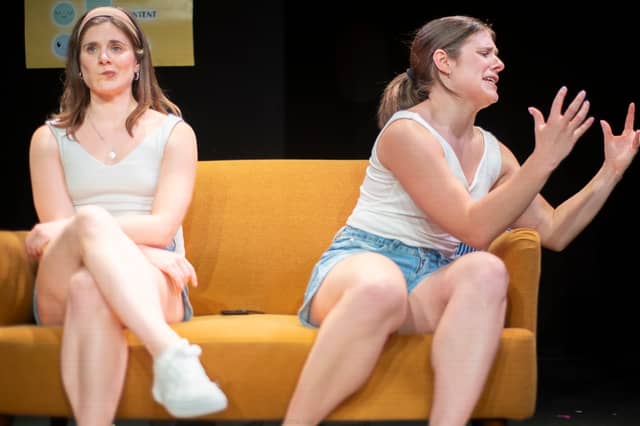

Under the Influence ★ ★ ★ ★
Underbelly, Bristo Square (Venue 302) until 30 August
Twins Frances and Carine Gilbert have millions of followers online, but by bringing their new musical Under the Influence to this year’s Fringe, they are ready to really test their popularity. In a vibrant success fusing musical theatre with sketch comedy, the twins develop a simple concept into a lighthearted evening of fun.
It’s not easy being twins, and we meet Frances and Carine as they’ve wound up at therapy to resolve many of their sister issues. Tellingly, they live and work together, have moved across the ocean together, and throughout this, have only ever spent a week apart. Through song, dance, and their fair share of arguments, they overcome this hostility with their therapist, played by Shona Maule, who accompanies their journey on piano.
Frances is the sensitive twin, whereas Carine is the irrational one, and the girls perform as exaggerated versions of themselves, complementing the musical's dramatic tone. Maule is witty yet measured as the therapist, balancing their theatrics. The plot never quite digs to the depths of the sisters' problems, but it therefore remains buoyant. It seems a shame that its time slot, language and sexual themes exclude children from its audience, as its catchy songs and sisterly fighting would undoubtedly prove popular.
Enjoying The Scotsman's coverage of the Edinburgh festivals? For just £2 a month you can get unlimited access to scotsman.com plus 2-for-1 Fringe tickets. For details visit www.scotsman.com/subscriptions
Whether you’re an avid follower of the Gilbert twins, or seeing them for the first time on stage, Under the Influence remains enjoyable regardless, making it uncomfortable when we become subject to their online appeal: being filmed for Instagram during the applause without consent. Still, it’s a refreshing hour of wit amongst a festival that often favours tragedy. If you're lucky, or unlucky, enough to have a twin, or even just a sister, I’m sure you’ll recognise yourselves within the bickering-turned-loving-turned-bickering cycle that the Gilbert twins repeat in song. Róisin McMullan
An Audience with Virginia Woolf: Writing One's Mind ★ ★ ★ ★
Assembly Rooms (Venue 20) until 30 August
“Virginia Woolf in The Drawing Room?” Abbreviating the title and venue of this show to quickly establish where it takes place makes it sound like a game of Cluedo. And it’s through similarly succinct but more seamless editing that writer/performer Lucy Stevens weaves together words from Virginia Woolf’s novels, essays and life writing with her own to create a powerful meditation on how we, as women writers today – whether it’s working on books or newspapers – might continue to have the courage to, as she puts it, "write our minds”.
It’s a highly focussed deployment of the art of adaptation and one that, with Stevens' own similarly styled words, forms a new work – with a similar structure to Stephen King’s On Writing – from a theme that shone through the Woolf’s most famous texts, including the essay A Room of One’s Own and her novels Orlando, To the Lighthouse and The Waves.
With Woolf speaking simultaneously of the exhaustion of writing – how it requires the activation of every fibre of your body – but also of its importance as a practice, Stevens’ continuation of it feels like an act of sisterly solidarity that expands the capacity and continues the clarity of one of the 20th century’s greatest thinkers.
Standing alone on stage and speaking directly to the audience, Stevens portrays Woolf as a stoic, sunny and engaging presence, not defined by her mental health issues as she is in other representations – including popular cinematic ones – but her words. Whether it’s killing “the Angel” that draws her to appealing to men (“the struggle was severe”) or not getting worn out by it all (“be amused”), the wit and wisdom of Woolf’s words, seamlessly built upon and resolutely delivered, are finally pointed towards where they could be most effectively targeted today: abolishing tyrants and dictators, and telling the truth about war. Sally Stott
The Terribly Credible Definitely Edible Tale of the Town of Cropshire ★ ★ ★
Assembly Roxy (Venue 139) until 31 August
A cost-of-carrots crisis brings trouble to the vegetable-growing, welly-wearing farmers of Cropshire. The Government decides that the solution is to ban carrots altogether, and when that drives up the price of other vegetables, an Equality Act is introduced which bans the rest as well. In Cropshire, locals buy carrots on the black market while a former beauty queen flogs vegetable-adjacent nutrition supplements.
This devised performance by young company Diagnostic Trouble Code mixes clowning, slapstick and satire to explore some very serious political issues. The show was the winner of the Shedload-of-Future Fund for 2026, selected by Francesca Moody productions, for emerging companies making their Edinburgh debut.
The cast of six are outstanding physical performers and the music and soundscape created by Daniela Mandoki Somlo is initially quaint and playful. But the laughter quickly fades when the ineffectual Mayor Boots is replaced by a new political leader, who is rapidly gaining support for “restoring the glory days of Cropshire”.
There is a long tradition of exploring questions of totalitarianism using the language of the ridiculous, but it tends to lead to despair rather than any kind of hope. Susan Mansfield
The Night Ali Died ★ ★ ★
theSpace on the Mile (Venue 39) until 29 August
A tightly-plotted, fast-paced crime thriller with a sense of jeopardy behind every door or in every deserted city street after dark, The Night Ali Died’s lead character is Ali Clark, a chemist from Norwich with no connection to the underworld, who's suddenly flung into danger when he realises his work colleague Tony has been synthesising MDMA for ruthless London gangsters.
Knowledge is a dangerous thing for Ali, as it comes with a death sentence for him and his family. Like a kind of Norfolk-based Breaking Bad, he tries to stay ahead of his fate and even cut a deal with the crooks, as writer and solo performer Chris Sainton-Clark snatches various overcoats and hoodies from hooks on the backdrop to jump into the storytelling persona of the characters who populate his play.
Alongside Ali he plays Jason, the hapless assassin dispatched to sort out the Norwich problem; DCI Wiggins, the weary and selfish cop taking money to be the crime boss's enforcer; and the boss himself, Max Wheeler, a nasty but swearily amusing piece of work. Keeping the audience guessing as to whether it delivers on that title, it’s a simple but excitingly-told tale. David Pollock
Dirty Dancer ★ ★
Underbelly, Cowgate (Venue 61) until 30 August
Melissa Firlit hits the stage with fierce main character energy. As it turns out, she’s going to play every character in this hectic tribute to her favourite film, walking, bounding and twirling through the plot of Dirty Dancing with comic affection. Firlit has mighty pipes and enough enthusiasm to carry off what is a rather meagre premise - yes, she really is just going to act out the film, with mild audience participation and negligible cultural commentary on its sex-positive message. How does she do the famous lift in a one woman show? You’ll need to buy into her high-kicking fantasy to find out. Fiona Shepherd
Brick ★ ★
C aurora at C ARTS (Venue 6) until 30 August
Thrown into jail with a cellmate in a drunken sleep, James – arrested from a protest – tries to occupy himself. Long moments trying out handstands and singing to himself complement monologues about grief, chess and his journey to a political consciousness.
While moments of the writing are full of delicious wit, the premise begins to feel like an elaborate set-up to unload basic political theory on an audience. A twist ending attempts to recast the plot as more than this, but it doesn’t quite land – and the first visually interesting thing to happen onstage comes about 50 minutes too late. Mika Morava
The Scotsman’s arts newsletter is now sent twice a week - subscribe today
Enjoying the Arts & Culture journalism on scotsman.com? Make it easier to find by selecting us as a preferred Google source
Want the latest Scottish headlines sent directly to your phone? Sign up to our new WhatsApp channel here
Comments
Want to join the conversation? Please or to comment on this article.