
Who Was James Stagg? Everything you need to know about the Scottish meteorologist portrayed by Andrew Scott in acclaimed new film Pressure


The Scot was one of the behind-the-scenes heroes of the Second World War.
Cinemagoers have been flocking to muliplexes recently to see war drama Pressure in the last coule of weeks, starring Andrew Scott and Brendan Fraser.
Based on a stage play written by, and originally starring, Four Weddings and a Funeral star David Haig, the film is already garnering awards buzz.
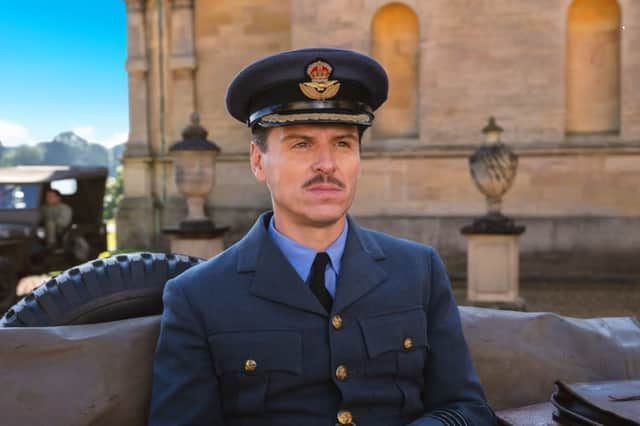
It tells the true-life story of Scottish meteorologist James Stagg (Scott) who used his expertise to judge the perfect time to stage the Normany Landings - one of the decisive chapters of the conflict.
Stagg was drafted into action by Allied supreme commander and future US President Gen. Dwight D. Eisenhower (Fraser) on the recommendation of Prime Minister Winston Churchhill.
The D-Day Landings were intially to have taken place on June 5 but Stagg’s advice to delay the operation due to a storm was to be a masterstroke, instead taking advantage of a window in the weather the next day to catch the German’s unaware. The rest is history.
But the film doesn’t address Stagg’s background or how he came to be one of the preeminent weather forecasters of his generation.
Here’s everything you need to know about the man.
Where was James Stagg born?
Stagg was born on June 30, 1900, in the East Lothian town of Musselburgh.
Where was James Stagg educated?
Stagg went to Dalkeith High School followed by Broughton Junior Student Centre in Edinburgh, before studying for a Master of Arts degree at the University of Edinburgh.
What did James Stagg do before becoming a meteorologist?
Stagg was originally a teacher, working as a science master at Edinburgh’s George Heriot’s School after graduating in 1921. It was at Heriot’s where he had his first taste of military life when he was commissioned as a second lieutenant in the school’s Officers' Training Corps - the scheme that would later become the Combined Cadet Force (CCF).
When did James Stagg become a meteorologist?
Stagg moved into meteorology in 1924, becoming an assistant in the British Meteorological Office, receiving a Doctor of Science from the University of Edinburgh in 1926 for his work on terrestial magnetism before leading the British Polar Expedition of Arctic Canada in 1932.
He received an OBE for his work with the Air Ministry’s Meteorological Office in 1937 and was appointed superintendent of Kew Observatory in 1939.
How did James Stagg end up working on Operation Overlord?
In November 1943 Stagg was granted an emergency commission to become a group captain in the Royal Air Force Volunteer Reserve.
This gave him the authority and security clearance to work on Operation Overlord, the codename for the Normany Landings and the events portrayed in Pressure.
He was later appointed an Officer of the US Legion of Merit for his part in the success of the mission.
What did James Stagg do after the war?
After his wartime role Stagg became director of services at the Met Office, was elected as a Fellow of the Royal Society of Edinburgh in 1951 and became President of the Royal Meteorological Society in 1959.
He died in 1975 and was buried in Dalkeith Cemetery. There is a plaque in his memory on the wall of the Dalkeith Library and Arts Centre.
How many children did James Stagg have?
At the end of Pressure Stagg meets his newly-born son Peter Stagg who would go on to play rugby for Scotland and the British Lions.
In 1944 his wife Liz (portrayed in the film by Tamsin Topolski) gave birth to the couple’s second son, Alexander.
Stagg’s grandson Peter worked as an archive editor on Pressure.
Make sure you don't miss a moment of breaking news from across Scotland by signing up to our free newsletter here.
Comments
Want to join the conversation? Please or to comment on this article.