
I went to a theatre production with one audience member in a Pitlochry garden and left with a mystery bracelet

Sharron Devine is a classically-trained actor
As I walk back through the picturesque, seven-acre Explorers Garden above Pitlochry Festival Theatre, I notice something strange on my right wrist.
It is a yellow and orange bracelet made of thread, the kind my daughter used to make with her friends a few years ago. The bracelet itself is not strange, but how it got there is - I have never seen it before in my life, nor do I recall putting it on.
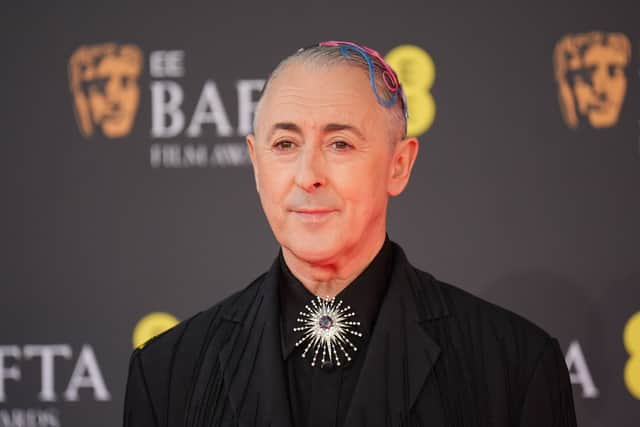
I have just been to see a performance in a wooden hut in the gardens - a Scottish premiere brought to the theatre by artistic director Alan Cumming. The Only Way Out is In is billed as a “live site responsive multi-sensory work” and is performed ten times a day in the David Douglas Pavilion in the gardens until 28 June.
It is a one-woman show written and performed by Sharron Devine, an actor from Broughty Ferry and originally commissioned by Theatre Absolute in Coventry, for Coventry UK City of Culture 2021. The difference between this show and most other performances I have been to, however, is that it has a maximum audience size of one: me.
On entering the hut, it feels like I am going into a fortune teller’s lair. It is draped with fabrics, twinkling lights and an array of vintage objects displayed around the room.

“What’s your name, dear?” asks Ms Devine, taking my bag and coat from me and settling me into a chair on one side of a round table. I ask if I can keep my notebook, I’ve been told she is aware I am a journalist.
She tells me I can, but that it will not be a lot of use, as I am going to be blindfolded for much of the performance. I did read that on the information about the show, but I hadn’t really thought about what it would mean. How would I experience a performance I couldn’t see?
She asks me to select an object from her collection - all personal items from her home. True to form, I choose a typewriter. She asks me why and I tell her about the typewriter I used to play with at my grandparents’ house, how I loved the ink ribbon and the clicky keys. And that I’ve been a journalism nerd since early childhood when my mum used to get me to imitate the BBC’s Brian Hanrahan’s reports on the Falklands War aged two.
Over a cup of green tea, she hands me a piece of paper and asks me to circle words falling under three columns: “I have enough”; “I need more”; “I need less”. I obey and we discuss my answers briefly.
She says that like me, she has a teenage daughter and we talk about how we find we suddenly have more free time than we have previously been used to, now our children are more self sufficient.
We chat comfortably for a few minutes, but I am slightly uneasy, lovely and warm though Ms Devine is. I can’t work out how I am supposed to respond to her. Is she herself? Is she a character? If we talk too much, am I forcing her away from a script?
Next, she asks if I am happy to wear a blindfold. I agree and she leads me through a curtain into - well, I am not sure where she leads me, I never see it. She tells me we are going on a journey and puts a walking jacket on me, I can feel its waterproof layer. She also hands me a heavy suitcase and leads me around a lengthy route inside the tiny hut, where I have a heightened awareness of sounds, music and scents. I become aware of different fragrances - strong smells of orange and incense.
I am reminded of India, a country I have never been to. Taking me by the hand, Ms Devine guides me through what, in my head, is the streets of Delhi. A car horn blares and she grabs my shoulder, pulling me back from its path. My heart is racing as if I have had a real-life near brush with a fast-moving vehicle.
At one point, a soft veil is draped over my head, before I am led away, letting it drop to the floor. She seats me in a comfortable chair and light, warm rain begins to fall on my face.
“When did you last sit in the rain?” Ms Devine’s voice asks. I’m not sure if it is live or a recording. I ponder the question. I’m not sure I ever have: we live in Scotland. If it is raining, it is likely to be cold, not the balmy temperatures of the Delhi of my imagination.
Finally, I am taken into another part of the hut and my blindfold is removed. In front of me is an installation depicting the sea, with accompanying sounds. Minutes later, we are outside, blinking into the sunlight.
She asks me how I feel. Relaxed, I answer.
On the way up the hill, volunteer Raymond, who has been escorting audience members through the gardens all day, had told me one woman had broken down in tears and told him the performance had changed her life. I hadn’t had such an extreme reaction, but it was undoubtedly a thought provoking experience.
Afterwards, I ask Ms Devine if she can break character, if I can interview her - and I am surprised that she agrees.
She tells me that despite being a classically trained actor, she is not playing a character in The Only Way Out is In, she is very much herself. The objects in the first rooms are all authentically hers and she does, indeed, have a teenage daughter.
She became interested in site-specific work more than 15 years ago, when she worked with a Danish theatre company, where she began performing to single person, or “micro” audiences or up to five people. She ended up touring to New York, Hong Kong and New Zealand.
“This what folk seem to love me doing and I love doing it as well,” she explains. “When you take away a sense, it does remarkable things to people and heightens other senses. People can become very vulnerable and emotional.”
On the way back down to the theatre, Raymond tells me Ms Devine admitted some people have described her as a white witch. Looking at the mysterious bracelet, I’m not sure I disagree.
Comments
Want to join the conversation? Please or to comment on this article.