
Victor Starsky on tackling Nessun dorma in Scottish Opera's Turandot: 'It's a huge responsibility'


New Yorker Victor Starsky tells Kelly Apter how delving into the character of Calaf in Puccini’s Turandot has given him ‘a huge amount of dramatic material’ to draw on when performing the opera’s famous aria
When Franco Alfano was tasked with finishing Puccini’s last opera, after the composer’s untimely death, he must have approached the task with some trepidation. Having taken two years to complete Turandot, we can only imagine his horror when conductor Arturo Toscanini scaled it back before the opera’s world premiere in 1926.
For the past 100 years, the ‘Alfano Two’ ending has been the preferred choice of opera companies, with ‘Alfano One’ deemed too expensive and technically challenging. Without those extra bars of music however, the relationship at the heart of Turandot packs less of a punch. Which is why much excitement surrounds Scottish Opera’s new production, the UK’s first ever staged performance of Turandot with the Alfano One ending.
Also chalking up a UK debut is the young man playing Prince Calaf. After many suitors have failed and died, Calaf is tasked with solving three complex riddles, thereby winning the hand of Princess Turandot. By taking on this coveted role, New Yorker Victor Starsky is seeing multiple dreams come true at once. “If you're American and want to really say you’re an opera singer, you have to sing in Europe,” he says. “And right from the start, everybody at Scottish Opera has been extremely supportive, kind and complimentary. They’ve given me a feeling of community, which has helped me feel like I belong here.”

Starsky is also enjoying working with one of the world’s finest opera directors, Sir David McVicar, who talent-spotted Starsky when he was an understudy in Chicago. “I only sang a handful of lines and David's reaction was ‘Whoa! Who are you?!,” recalls Starsky with a humble smile. “So that was very fortunate because we then scheduled an audition, and David has been a major advocate for me ever since, asking Scottish Opera to hear me sing, then giving me the opportunity to come here. He’s been an ally beyond my wildest dreams.”
Speaking during a break from rehearsals, it’s clear Starsky is loving his time in Glasgow. In particular, the way McVicar is helping him and soprano Trine Møller climb beneath the skin of Calaf and Turandot. “David has done an excellent job delving into the characters and giving us more to work with,” says Starsky. “But what also helps tremendously is that we're doing the Alfano One ending, which has a huge amount of dramatic material that increases your understanding of both characters. So we can create an arc informed by that ending, and it’s given Calaf more depth. Now I see him as a broken hero who finds redemption in trying to save Turandot.”
Although this is Starsky’s first time playing Calaf, he’s no stranger to the character’s most famous aria, Nessun dorma. Having performed it on several occasions, including an open air concert in New York in front of 7,000 people, he acknowledges that singing it is “a massive responsibility”. Regardless, Starsky is sanguine about his ability to carry it off, especially now he’s approaching it as one small part of a much bigger challenge.
“It’s actually one of the easiest parts of the role,” he says. “It's quite short and Puccini takes half of the second verse and gives it to the chorus, so you can rest before coming back in for the high notes. Technically, unless the high Cs and high Bs are blistering and everybody is losing their minds, I haven't done my job. But if you put too much pressure on yourself to be superhuman, you might actually strip away some of the natural beauty of the music.”
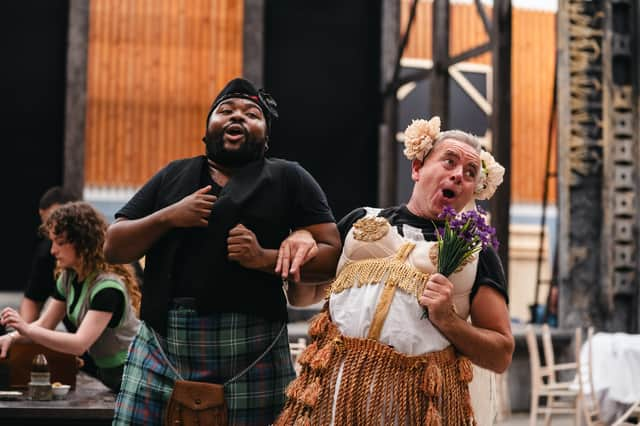
Regardless of which ending is performed, Turandot is one of Puccini’s most lauded operas, packed with passion and drama. Usually set in China, this new production moves the action to a derelict theatre frozen in time, where guests are forever waiting for a wedding that never comes. Having worked together for over two decades, director McVicar and designer Charles Edwards came together with ease for this exciting new production.
“It's a very interesting collaboration because David is a director who sometimes designs, and I'm a designer who sometimes directs,” says Edwards. “So I know he can imagine something visually that I might be thinking about as a designer, and David knows I can imagine something directorially that he's talking about. So we have a connection that operates on various levels at the same time.”
Despite having worked on numerous projects together, Edwards has found that the “collaborations here at Scottish Opera are actually the best”, giving them room to breath artistically. Especially now they have those rarely seen final scenes to play with. “The whole production is heavily influenced by the fact we're doing Alfano's original ending,” explains Edwards. “When Alfano was forced to reduce it, he robbed the characters of Turandot and Calaf of a good deal of the psychological development they need to go through in that last scene. But in order to concentrate on the psychology of the characters, we had to find a balance between a realistic environment and something that had a sense of the fable about it. Which led us to the idea of a society that's in decline, where a nightmare wedding ritual is reenacted each time a new suitor appears for Turandot.
“Who knows how much longer the ending would have been had Puccini lived to write it. There was still so much left to unpack, and doing any version other than Alfano One just doesn't allow you to develop that.”
Scottish Opera’s Turandot is at the Theatre Royal, Glasgow, 22, 25, 28, 31 October and 4 & 7 November, and at the Festival Theatre, Edinburgh, 11, 14, 17, 19 & 22 November, see www.scottishopera.org.uk This feature was produced in association with Scottish Opera.
The Scotsman’s arts newsletter is now sent twice a week - subscribe today
Enjoying the Arts & Culture journalism on scotsman.com? Make it easier to find by selecting us as a preferred Google source
Want the latest Scottish headlines sent directly to your phone? Sign up to our new WhatsApp channel here
Comments
Want to join the conversation? Please or to comment on this article.