
Theatre in Schools Scotland marks its tenth birthday with free shows for 10,000 children


Jointly run by the National Theatre of Scotland and Imaginate, the Theatre in Schools Scotland programme is celebrating its tenth birthday with a giant giveaway, writes Susan Mansfield
When you mark a significant birthday, it’s more usual to receive gifts than give them yourself. However, Theatre in Schools Scotland (TiSS), which takes live performance to children and young people across the country every year, has chosen to mark its tenth birthday with a giant giveaway.
TiSS, founded in 2016 and jointly managed by National Theatre of Scotland and Imaginate, the leading organisation in Scotland which develops and presents theatre for children and young people, creates an annual programme of high-quality theatre and dance shows which schools can hire at a subsidised rate. To date, 1,557 performances have reached 114,000 pupils all over Scotland. The difference with this year’s programme - which began this week - is that the shows are being offered for free.
When schools were invited to “express interest” in the seven shows on offer, TiSS was inundated with more than 450 requests. “It shows how much demand there is for the work,” says Belinda McElhinney, chief executive of Imaginate. “And it shows that cost is the final barrier. TiSS has removed geographical and conceptual barriers, but with all the challenges schools are facing at the moment, the cost issue is very clear.”
The TiSS team hope that the programme, TiSS at 10, will reach 10,000 children across Scotland, with two shows in digital versions - Catherine Wheels’ White and Birds of Paradise’ Super Special Disability Roadshow - expanding its reach. Care is being taken to offer shows in every local authority area, and to schools where social, economic or geographical factors limit access to live theatre.
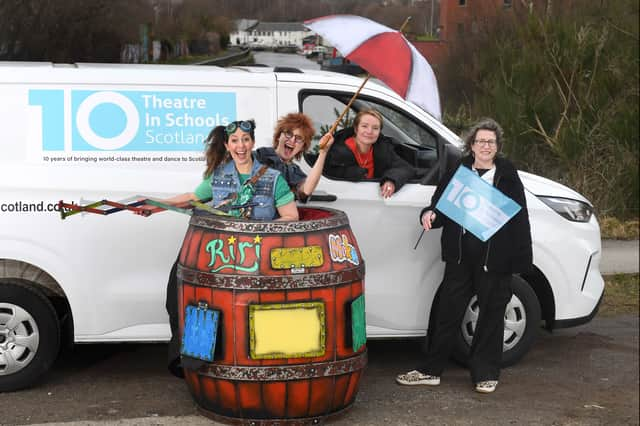
The work ranges from Two in a Barrel, by Glasgow-based duo Ruxy Cantir and Sarah Rose Graber, a clown-inspired performance for P1-P3 about the waste we create and living in an environment with limited resources, to Catherine Wheels’ CATS Award-winning drama Lightning Ridge, for P5-P7. One of the shows, Hayley Earlam’s Brrr, is a multi-sensory and dance performance aimed at young people with complex needs.
Jackie Wylie, CEO of the National Theatre of Scotland, says: “We are so fortunate that our funding partners on this project [the Weir Charitable Trust and a host of others] really understand the value of TiSS and enabled us to make this free offer. The uptake of that has energised us around the importance of it and how beloved it is. We want to learn from that and build on it. We are working with Imaginate to figure out how we can continue to offer it for free in the future.
“TiSS is hugely important to NTS. It really embodies our Theatre Without Walls principle. One of the things that means is that any space can be a theatre, including a school hall. Often, a TiSS show is a human being’s first encounter with theatre, nothing can be more important than that.”
TiSS is the biggest provider of subsidised theatre for schools in Scotland, offering shows by top Scottish companies such as Visible Fictions, Barrowland Ballet and Tortoise in a Nutshell in a time of tightening budgets for schools and local authorities. A report by advocacy network Culture Counts earlier this month found that the proportion of Scotland’s public expenditure allocated to culture has been reduced by around one third since 2013, with a growing gap between local authority spend (which has dropped more quickly) and Government spend.

All those involved agree that the work is vital. “It opens doors to other worlds,” McElhinney says. “It really changes something fundamental in children’s understanding that theatre is for them. It’s not just for people in cities, or only on the mainland, or something you pay a lot of money for. It’s in a space that is familiar and yet it’s completely transformed.”
Longitudinal research into the benefits of live theatre conducted by the New Victory Theatre on Broadway, which specialises in work for young audiences, turned up a remarkable result. McElhinney says: “Alongside all the educational benefits, improved literacy, improved confidence, they found that access to live theatre increases children’s aspiration for what they can achieve in the world. The world is just bigger for them.”
Another surprising statistic, from TiSS’s own research among teachers, is that 94 per cent believe that experiencing live performance improves a young person’s mental health. Wylie says: “Young people today are facing an extraordinary set of challenges that no other generation has faced. I’ve never felt more keenly than I do now the value of that live theatre experience. There’s something about it which allows them to feel seen, to understand themselves, to see the world in new ways and experience joy and elation - and to do it together. Schools work is often talked about in terms of building the audiences of the future, but what we really care about is the experience that audience member is having in that moment.”
The shows presented by TiSS in the past nine years don’t shy away from topics young people are grappling with - Hazel Darwin-Clements’ Maya and the Whale, for P6-S2, tells the story of a teenager-turned-climate activist on the run; Jan Sobrie’s award-winning play Titus, for P6-S1, in an English version by Oliver Emanuel, begins with a ten-year-old on the edge of the school roof - but the emphasis is less on issues than on experiencing the magic of live performance.

The project is also enormously important for theatre-makers. Victoria Beesley, a writer, director and producer of children’s theatre, is delighted to be kicking off the TiSS at 10 programme with My Friend Selma, her one-woman show based on her own story about growing up among Bosnian refugees after her father started a charity in 1992 to help people start new lives in the UK. It first toured with TiSS in 2018 and has been selected from the back catalogue to return for the 10th birthday year.
She says: “TiSS is a massive thing for people like me who make work for children. It’s a way of getting directly to an audience. I feel honoured to have been asked to bring back My Friend Selma. On a schools tour, you’re doing two shows a day for several weeks, doing it again and again and again, it’s like sliding into an old pair of jogging bottoms!”
For schools touring, a show needs to be light on its feet, easily packed into a van, and capable of running in a gym hall or classroom with no stage and just a couple of power sockets. “It’s hard work but the rewards are massive,” says Beesley. “It’s always a sell-out for a start, and the sense of excitement is tangible. You feel their excitement and curiosity as they walk in.
“I always have a Q&A afterwards, and they always ask brilliant questions, about the story, about theatre, about the making of the show. They are so engaged. This is the best kind of touring as far as I’m concerned.”
For more information about Theatre in Schools Scotland, visit www.theatreinschoolsscotland.co.uk. TiSS at 10 is sponsored by Savendie and supported by The Weir Charitable Trust, with additional support from funders across the UK. This feature was produced in association with the National Theatre of Scotland
The Scotsman’s arts newsletter is now sent twice a week - subscribe today
Enjoying the Arts & Culture journalism on scotsman.com? Make it easier to find by selecting us as a preferred Google source
Want the latest Scottish headlines sent directly to your phone? Sign up to our new WhatsApp channel here
Comments
Want to join the conversation? Please or to comment on this article.