
A Scottish wind turbine startup that thinks smaller is better
Myriad’s founders are boldly going small


In 1887, an electrical engineer called James Blyth erected a primitive wind turbine at his home in rolling farmland in Aberdeenshire, making the building the first in the world to be powered by wind-generated electricity.
Now, a Stirling-based startup is picking up where the pioneering Scotsman left off by bringing small-scale wind power to farming and other parts of the rural economy in the 21st century.
Myriad Wind Energy Systems is a Scottish renewable energy startup founded in 2021 by three former PhD students at University of Strathclyde’s engineering school: Adam Harris, Paul Pirrie and Peter Taylor. Their idea? Small scale, multi-rotor wind turbines, at a time when the industry is going in the opposite direction.
Six months ago, a Chinese wind company called Goldwind notched up a milestone in the long march to turbine gigantism by erecting the world’s tallest unit off the Chinese coast: a 20-megawatt turbine 300 metres high with 150-metre-long blades, capable of powering 44,000 homes.
For comparison, the largest turbines operating in Scottish waters are Siemens Gamesa units at the Moray East wind farm, each 257 metres high and with blades 108 metres long.

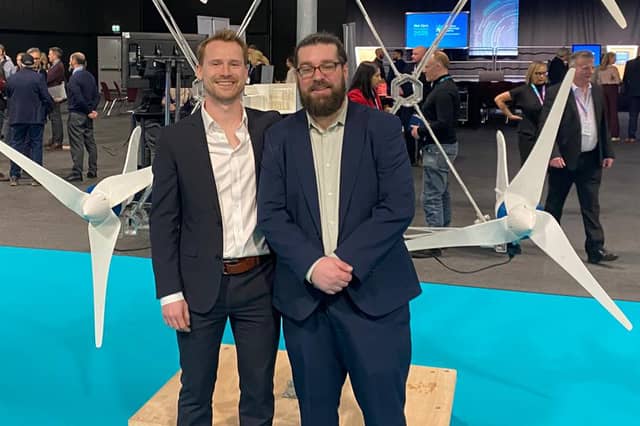
Myriad’s founders are boldly going small. They have developed a unit to which 10 mini-rotors are attached, instead of relying on a single turbine to do the work.
They think this is more efficient, and cheaper to install. “What our maths says is the more [smaller] turbines you have the better it is in terms of cost effectiveness,” says Harris, Myriad’s chief executive, at the company’s office in the Stirling branch of Codebase, the growth platform for tech startups.
To make a single turbine larger, all the parts involved in that turbine have to be made larger in proportion to the increase in size, which comes at a cost, whereas with Myriad’s concept the unit is made up of small, fixed-cost rotors.
So, where is the market for miniature? The initial idea was to aim for offshore wind, where some others are already trying out similar solutions. Wind Catching Systems, a Norwegian company, has developed a prototype called Windcatcher, a square frame with 32 rotors attached.
Yet the challenge that Myriad’s founders quickly identified was the difficulty of a tiny startup breaking into the offshore market where long project life cycles mean returns can take years to materialise. So they decided to focus on the onshore wind market, where scale is also somewhat smaller.
Harris says it became clear that an obvious market was farmers and rural businesses facing high fuel costs and squeezed margins - as Scottish dairy and pig farmers are currently finding amid plummeting prices for their produce.
“We were talking to a lot of farmers and energy-intensive businesses and the cost of electricity for these guys has been skyrocketing recently,” Harris says.
“That’s a huge struggle for them because these are businesses that operate on very low margins.”
The other big challenge is the logistics involved in delivering even a single wind turbine to rural locations, some only accessible along narrow roads. Most are also sufficiently heavy that a crane is needed to lift them to vertical position.
Getting a crane to a farm sometimes requires road access that may not be available.
Myriad’s solution is a 50-kilowatt (kW) prototype that’s 24 metres high, comes with 10 mini rotors, and can power about 50 households. The whole thing is deliverable to a location as a kit, assembled on site without the need for a crane. To match the amount of power that the unit can produce in a year, you would need to install three times the capacity of solar power. The team developed it after a year testing a 2kW demonstrator unit in a field in Fife for most of 2024
Investors seem to like the idea. Myriad has attracted £1.24 million in equity funding, starting with £375,000 in pre-seed funding from SFC Capital, a London-based early-stage investor, in 2023, with co-investment from Old College Capital, the University of Edinburgh’s venture investment fund.
Last year, Myriad raised a further £865,000 from Tricapital, a Scottish angel investor syndicate, with contributions from others including SFC and Scottish Enterprise.
On top of all this has come £350,000 in grant funding from Scottish Enterprise, Innovate UK and the Net Technology Centre, a non-profit organisation based in Aberdeen that co-invests with industry and government to accelerate deployment of new technologies. This week, Myriad took a step forward in developing its proposition when it signed a lease for a workshop in East Kilbride, where its 50kW units will be assembled and tested. Rotors are to be provided by Ryse Energy, a small-turbine manufacturer with which Myriad signed a deal in April under which the UK-based company will supply rotors from a facility in Spain.
Selling wind turbines can be a risky proposition given the volatility in the price of key inputs. This is why turbine makers enter into maintenance contracts with the developers to which they have sold their turbines, locking in a higher margin revenue stream for years after turbines have been installed.
Myriad is hoping eventually to incorporate a service element so that revenue can be captured through ongoing maintenance of the units it aims to sell to distilleries and off-grid communities, in addition to farmers.
Meanwhile, changes to UK government regulations that could make it easier for businesses in rural areas such as farmers to instal turbines at greater height and with less planning hassle may be on the horizon, with a consultation on so-called “permitted development rights” for England closing this week.
“We don’t need to reinvent the wind turbine, because it’s already there,” Harris says.
“All we’re trying to do is say, ‘Hey, let’s put it together in a more efficient package’.”
Comments
Want to join the conversation? Please or to comment on this article.