
Floating ambition: How Scotland’s Green Volt wind farm is leading a £1 trillion revolution
“They are massive infrastructure projects that require a lot of consenting and planning, and the raising of capital” – Barry MacLeod, Flotation Energy
If current projections are realised, then the floating offshore wind market could in time be worth as much as £1 trillion globally and up to £270 billion in the UK alone.
The ambitions are grand, but floating wind is still in its infancy and the challenges of financing, constructing and maintaining giant floating turbines so far from land, and connecting them to the power grid, remain considerable.
Floating wind farms can make use of the huge blades fitted to towers hundreds of feet in height to capture more wind and thus generate greater power. The foundations on which they sit, made of tubular steel or concrete, float on the sea surface and are tethered by lengthy cables that snake down to massive seabed anchors. Located far from any coastline in deep waters, floating wind farms are less likely to attract the attention of those angered by the sight of giant, spinning blades.


Green Volt, a pioneering joint venture project involving Scotland’s Flotation Energy and Norwegian partner Vårgrønn, is on track to become Europe’s first commercial-scale floating offshore wind farm. Sited some 80 kilometres off the Aberdeenshire coast, the 560-megawatt facility will deliver electrification of participating North Sea oil and gas platforms, slashing their carbon emissions, while providing considerable green power to the UK grid.
Barry MacLeod, Flotation Energy’s recently appointed chief executive, says the ambitious Green Volt project has made considerable progress in the past 18 months, agreeing engineering contracts and being awarded a crucial Contracts for Difference (CfD) by the UK government.
“The UK is now a world leader in offshore wind and we are starting to be a world leader in floating wind as well,” he says. “This is something that we need to shout about.
“Off the back of securing the CfD we are now in a process of working towards raising project finance. We have our financial advisors on board and will be doing a bank launch in spring/summer to secure that financing.
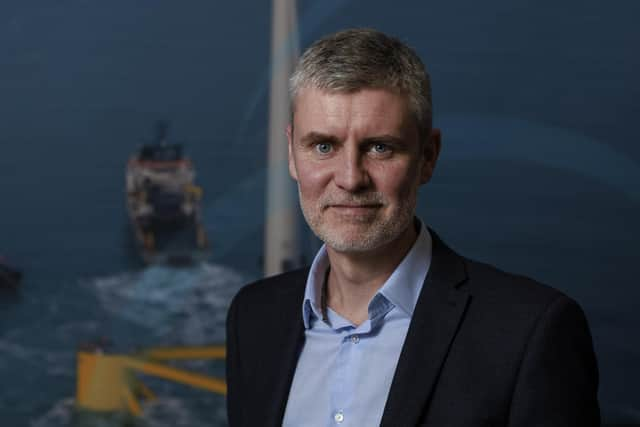
“On the journey to doing that it’s about refining things, getting more project definition and getting detailed engineering work done.”
MacLeod, who took up the CEO role at Flotation in October and has more than two decades of offshore leadership experience, says the wind farm remains on track for first power in 2029.
One of the most heated debates around wind power and particularly offshore wind, with its greater challenges and up-front costs, is the potential to reduce energy costs for businesses and consumers.
The UK government argues that switching to renewable sources of power will protect users from volatile gas prices and bring bills down “for good”. Critics will point to the hidden costs of grid, storage and wasted wind that can feed through to energy bills.
A recent study suggested that wind power had cut some £104bn collectively from UK energy bills in a 13-year period from 2010 up to the start of the Russian-Ukraine conflict, which caused gas prices to spike.
The researchers from University College London found that electricity generated by on and offshore wind farms was lower than traditional gas alternatives over the 13-year period, with renewables reducing the need to build fossil fuel-fired power stations.
“If you look at the success of fixed offshore wind there are benefits for energy security and climate change/decarbonising, and all the jobs created off the back of that,” observes MacLeod. “Through successive subsidy rounds we’ve seen that it does bring down the price. Floating wind is still a very early technology so you are going to pay higher prices to support that until it’s fully commercialised.
“Green Volt in itself is not going to be bringing prices down to the consumer but it’s the start of a commercialisation of that technology.”
Green Volt already has a grid connection secured but a queue is building for other planned offshore power projects and Flotation Energy’s boss, who joined the company about four years ago, warns that is creating a bottleneck.
“For Green Volt we have a grid connection,” he notes. “Others have found they have won the lease for the seabed area but they don’t yet have a connection in the grid queue. It’s a challenge that’s going to be spoken about over the next few years.”
Make sure you keep up to date with breaking news from across Scotland by signing up to our free newsletter here.
MacLeod acknowledges that oil and gas, and particularly gas, will remain an important part of the UK’s energy mix for years to come, even as a series of large-scale renewable schemes come on stream.
“We have to be realistic about the pace of these renewable projects coming online,” he concedes. “They are massive infrastructure projects that require a lot of consenting and planning, and the raising of capital. This is where this energy transition is important.
“Oil and gas is going to remain an essential part of the energy mix for a decade-plus, before we can transition to these renewable projects.
“If we have a healthier oil and gas sector then we can retain that supply chain and those skills that we need to deliver huge floating wind projects,” he adds.
The nascent floating wind industry is gaining valuable insight from decades of fixed wind, in terms of the operating challenges, maintenance and reliability. Those learnings are being put to good use with regard to preventative maintenance, avoiding major expense in hard-to-reach and inhospitable conditions.
“We are working with other developers to look at having a port and facilities ready in Scotland that’s accessible to the North Sea and where we can quickly deal with one of these major events and minimise any downtime,” says MacLeod.
Comments
Want to join the conversation? Please or to comment on this article.