
How Grangemouth port has diversified as Scotland's export hub
The container port is arguably the most significant part of Grangemouth now that oil refining is history


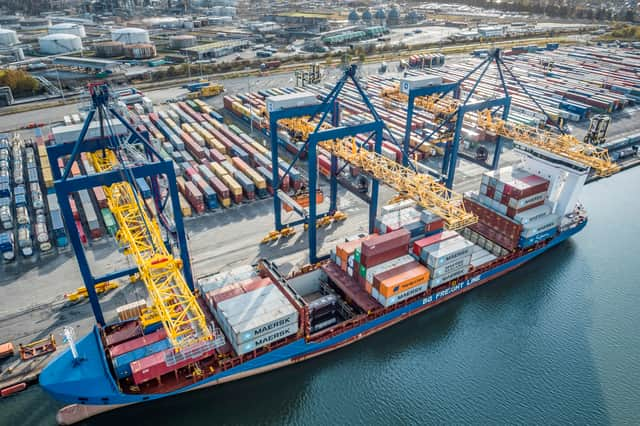
With its dark blue hull and container-stacked deck, the “CMA CGM Goya” was tied up two weeks ago at Grangemouth container port as a crane operating overhead loaded a few final boxes.
The Portuguese-flagged vessel later sailed for Antwerp where its cargo was transferred to larger ocean-going ships bound for Asia, Africa and the Americas.
It’s a “feeder port” function that Scotland’s largest container terminal has performed for years, allowing goods produced here to reach far-flung export markets – seed potatoes grown in Angus for Egypt, Quaker Oats produced in Fife for Saudi Arabia, Diageo whisky brands bound for India.
It was also here in 1966 that the first containers were handled by any UK port.
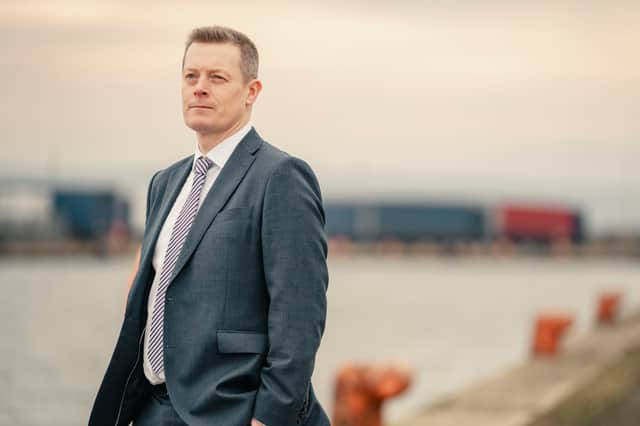
“Not surprisingly they were carrying whisky,” says Derek Knox, regional director for Scotland at Forth Ports Group, Grangemouth’s owner. These days, whisky makes up 42 per cent of the container business here, meaning it handles more whisky than any other Scottish port.
Most attention focused on Grangemouth recently has been on how the oil refinery that was shut down last year by owner Petroineos is to be turned in to a low-carbon manufacturing hub. On Wednesday Celtic Renewables, a Scottish green chemicals producer, said it had secured £10 million in funding from Scottish Enterprise and existing investors towards the construction of a new biorefinery at the location. An adjacent ethylene plant was in December rescued by a UK government £120 million support package that preserved 500 jobs.
Yet the container port is arguably the most significant part of Grangemouth now that oil refining, which started in 1924, is history. The facility handles fuel, general cargo and containers representing about 30 per cent of Scotland’s gross domestic product. It also claims to handle 60 per cent of all container volume moving to and from Scotland.
This makes Grangemouth one of two beating hearts of the Scottish economy – the other being Port of Greenock, Scotland’s deepest water terminal that’s part of Peel Ports’ “Clydeport” network of ports west of Glasgow.
Grangemouth’s ultimate ownership also highlights the attraction of Scotland’s transport infrastructure to global investors. Forth Ports, which also owns Tilbury in London, the port in Dundee and six on the Firth of Forth including Port of Leith and Rosyth, has since 2018 been majority owned by PSP Investments, one of Canada’s largest pension investors. PSP also owns AGS Airports, operator of Glasgow and Aberdeen airports, through its AviAlliance subsidiary.
Since the conflict erupted in the Middle East, ports are obviously being buffeted as seaborne trade is disrupted. Yet dealing with disruption is nothing new for Grangemouth port, which had to grapple with a decline in oil refining next door for 15 years until the refinery closed.
Knox explains that the threat from more competitive, modern refineries elsewhere started to bite around 2018. While there was a modest resurgence after Russia’s invasion of Ukraine, by the time the decision came to close the refinery Grangemouth’s fuels volumes had halved from levels in the mid- 2000s.
In 2007, more than half of what Grangemouth handled was so-called liquid bulk business – that is, importing North Sea crude oil for refining, and exports of refined product. As of January, that business stood at around 40 per cent, buoyed by increased fuel imports, especially liquefied natural gas from the US.
This shift in the business mix has come as Grangemouth has found new sources of revenue. One of them has been from warehouses built on unused land where customers like Quaker Oats can bring goods to the port. They are then loaded into containers in the warehouse instead of handling this at a separate site often miles away. “Or we’ll take a container that comes in from the continent, take the goods out, and then they can collect or distribute from the port as opposed to taking it to a facility 20 miles away,” explains Craig Torrance, operations manager for the port.
This is essentially a logistics efficiency play that saves road haulage miles while allowing customers to reduce their transport emissions. “On top of the cost savings in logistics the carbon benefits are becoming more and more prominent, particularly as global players are looking at the emissions in their supply chain,” explains Knox. “Also, getting other customers into the port has created new opportunities that we didn't foresee and that's allowed us to look at broadening our expertise.”
Warehousing has grown to 15 per cent of earnings from 10 per cent in 2007, while container handling now accounts for 40 per cent of the business, up from 37 per cent in 2007. General cargo makes up three per cent, up from one per cent.
Knox acknowledges that the future of whisky exports is somewhat uncertain given tariffs and the recent trend away from alcoholic drinks. But he is optimistic about the prospects for selling to India under a reduced whisky tariff agreed under the UK-India free trade agreement last year. “I think the thing that helps Scotland is the trademark protection of Scotch as Scotch,” Knox adds.
Grangemouth shows how diversification is increasingly important to Scottish ports as they adjust to volatile US tariffs, chaotic geopolitics and uncertainty over the build-out of offshore wind. Port of Aberdeen said in January that this year would be “pivotal” as it “doubles down” on a diversification strategy involving efforts to attract new activity in energy, cargo, cruise and ferries.
Knox argues that Forth Ports is sufficiently diversified to provide resilience in the face of shocks. “This gives us some comfort when we’re making investments across various sectors that we don’t have all our eggs in one basket,” he says.
Comments
Want to join the conversation? Please or to comment on this article.