
Scotland's Robotarium leads charge on UK's robotics ambitions
‘Scotland could become the robotics hotbed for the UK’

The first thing you notice entering the atrium of The National Robotarium is a whale.
Not a real one, obviously. This is a robotic model complete with mechanical tail and a camera in each eye. The aquatic machine was used to film ocean creatures up close in a BBC documentary that aired three years ago called “Spy in the Ocean”.
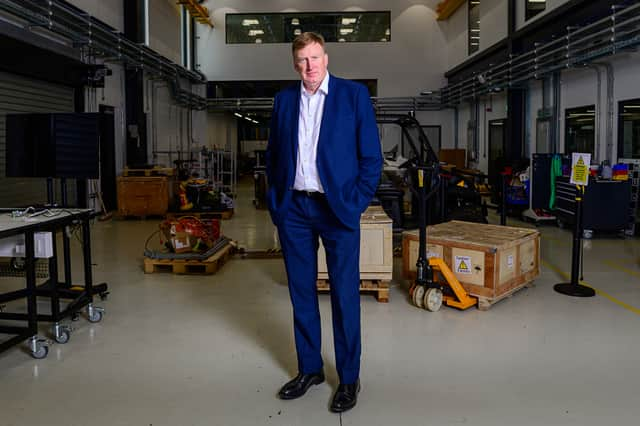
“We use it to spark the imagination of school trips,” explains Stewart Miller, chief executive of the Robotarium since it opened on Heriot-Watt University’s campus in late 2022. The building’s location, in parkland on the outskirts of Edinburgh, belies its significance. While there is a robotics laboratory in Bristol and robotics for “extreme industrial environments” at the UK Atomic Energy Authority in Oxfordshire, the Robotarium is the country’s only research laboratory for robotics that doubles as an incubator for robotics and AI startups.
This provides them with access to labs, office space, equipment, and engineering expertise to develop their ideas, attract investment and – as the Robotarium’s website puts it - “shape the future of robotics”.

The project was initially funded in partnership with The University of Edinburgh as part of the Edinburgh and South-East Scotland City Region Deal, awarded in 2018 and supported with £300 million each from the UK and Scottish governments.
Robotics is rapidly becoming “as big a change as any other of the technology shifts we’ve seen”, Miller says, citing the internet, mobile phone and personal computing.
The number of industrial robots installed globally in 2024 was double that of a decade previously, according to the International Federation of Robotics. Asia – mostly China - accounted for 74 per cent of new deployments, compared with 16 per cent in Europe and nine per cent in the Americas.
The emergence of humanoid robots is the next big thing, epitomised by Tesla’s Optimus and eye-opening achievements by China, the global robotics leader. A video of Unitree’s “dancing robots” showing off martial arts moves on Chinese state television’s recent lunar new year broadcast offered a dystopian glimpse of the future.
The idea behind the Robotarium was to create a place where university spinouts could build robots while tapping into advice from a team of on-site engineers and academics.
Since it opened, startups have developed robots that help stroke survivors rehabilitate at home, deployed 5G-connected systems that could transform how Scotland’s farms are managed, and built the UK’s first subsea robot for inspecting hard-to-access parts of offshore oil rigs and wind farms.
Currently, 11 startups are active in the building. There’s Metacarpal, which has developed a mechanical prosthetic hand that’s being used by military veterans in the US; Crover, which is developing a robot to check the health of grain stored in a silo; and Touchlab, which has developed fingertips for a robotic human hand that allows it to “feel” the surfaces it’s interacting with for better manipulation.
“Once they’ve got mature enough that they’re ready to start building their first robots, that’s where we can really help. We then hold their hand until they’re ready for scaled-up production,” explains Miller, a former chief technology officer at the UK government’s innovation agency, Innovate UK, in addition to working in senior roles at Italian defence contractor Leonardo and BAE Systems.
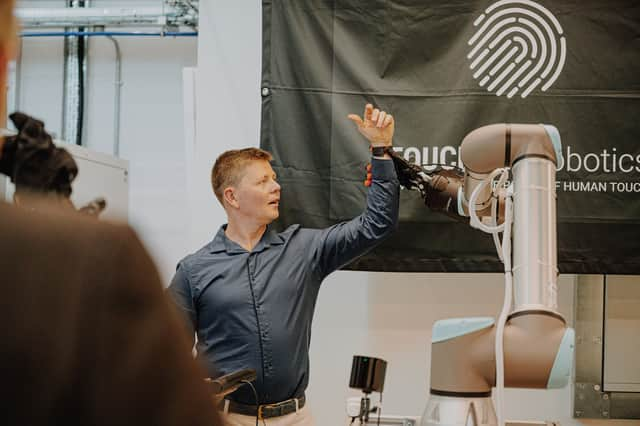
This explains the laboratories and workshops in the building where robotic devices can be built from scratch and fine-tuned.
A series of “human-robot interaction” labs host researchers studying the interaction between humans and robotics. One project by University of Edinburgh spinout Bioliberty is using AI and softrobotic wearable devices to help therapists deliver better rehabilitation support for people recovering from mobility-limiting conditions or injuries.
This week, it secured funding from the Scottish National Investment Bank, Scottish angel investor syndicate Archangels and others to enable further expansion in the US, where the company’s technology is already used in rehabilitation facilities. Another space is a “robotics and autonomous systems” lab, used to test prototypes for industrial applications, such as a new type of robot dog recently tested by India’s Tata Consulting Services.
The Robotarium also advises companies on the best way to adopt robotics into their industrial processes, drawing on a team of in-house “industry partners”.
“We’ll get under the skin of the issue to understand what it is they’re trying to do with robotics. We’ll then advise them as to the best way to get started,” Miller explains. “At the heart of this is knowledge and expertise around what’s happening in robotics worldwide.”
Yet keeping up with the pace of change can be a challenge. Miller points to a humanoid robot supplied to the Robotarium by Unitree about a year ago. Two software upgrades later, the company has moved on to a new version and will no longer be providing updates for the older model. Then there’s the fusion of AI and robotics, which Miller says has emerged only recently.
All of this throws up a dilemma for companies looking to adopt robots: invest now or wait until the technology has matured? “You should make a start, but with your eyes open,” Miller advises.
One immediate challenge for the UK is to catch up with the rest of the world. According to techUK, the UK’s technology trade association, Britain ranks 24th for industrial robotics adoption in spite of coming top for robotics research quality.
The good news is that the UK government included robotics in November’s Modern Industrial Strategy. Last month a tender was launched via Innovate UK for the creation of a network of “robotics adoption hubs”, using £52m in government funding.
“If we get this right,” says Miller, “Scotland could become the robotics hotbed for the UK.”
Comments
Want to join the conversation? Please or to comment on this article.